![]() |
| Always alert. |
Sunday, August 14, 2022
Eastern cottontail rabbit
Sunday, July 17, 2022
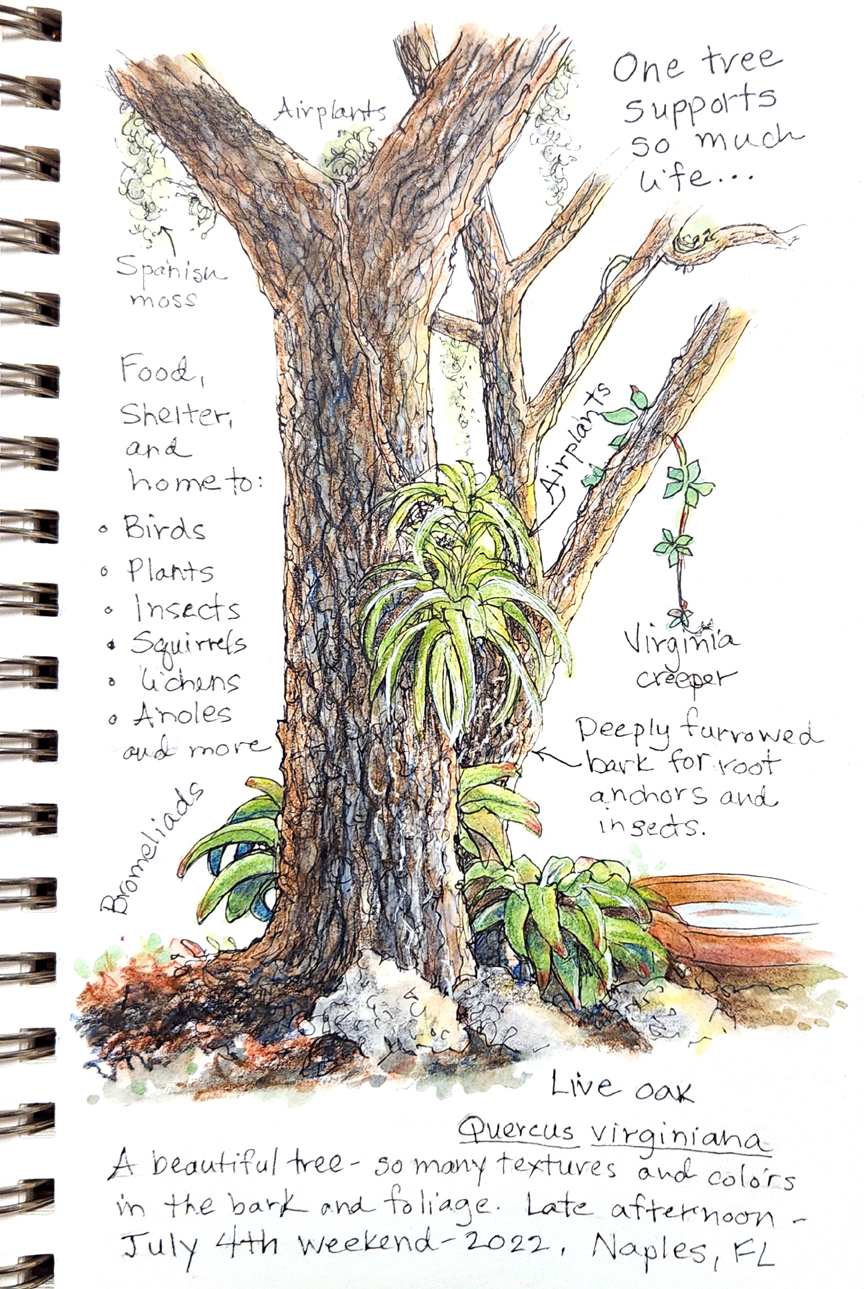
Live oak – a keystone species (and friend)
![]() |
| Click on image to view larger. |
More on oaks: There is much more to learn about oaks. For an overview on the many values of oaks (for nature and ourselves), I suggest you start by watching a presentation by Dr. Doug Tallamy on his book “The Nature of Oaks” on YouTube: https://www.youtube.com/watch?v=EdiUgB_3A9w
Monday, July 4, 2022
Midsummer Florida
Summertime in Southwest Florida has a rhythm of its own. It’s a pattern of heat and moisture and rain and cooling. It’s a time of luxuriant growth for the plants adapted to it. It’s also a time when I notice young lizards and birds and bunnies out and about, learning the ways of the world.
![]() |
| Storm coming. |
![]() |
| So much nature can be seen in suburban spaces. |
The flowers of spring are turning into fruits now – nearby I
see Simpson stopper ripening, seagrape (still green), cocoplum and more. June flowers are blooming of course: a casual
suburban observer might see common natives like Spanish needles, beach
sunflower, and duck potato easily. These
are just a few volunteers in the space I move within every day, the ones I
happen to stop and notice. I also see
the birds and their nests, an occasional small black snake, and young Eastern
cottontails (one every day!), and other signs of procreation and growth.
No matter what's going on in the human world, the natural world keeps marking time, finding its own rhythms, confirming new life. These are the drumbeats that feed my soul and the music that helps me make sense of life.
![]() |
| Munching on a bit of grass. |
Mechanical pencil .7mm
Micron Pigma 01, black
Aquabee Super Deluxe Mixed Media sketchbook
Daniel Smith watercolors, Botanical Floral half-pan set
Niji waterbush, round M
Saturday, June 25, 2022
Green heron
Just walking, I happened to veer to the small lake nearby and discovered a green heron intently gazing at the water’s surface. The heron perched on a concrete culvert in the bright sun on the edge of the lake, blue sky above, green water below. Rocking slightly in the breeze on bent, sturdy legs and anchored by long toes, waiting …waiting for a ripple in the water, a movement that might mean dinner.
![]() |
| Click on image to view larger. |
A fascinating item – green herons sometimes use tools to catch food, one of a few species that do this. They drop twigs, insects or other tidbits onto the water surface to entice fish to surface and feed within their reach. Debate may continue over definitions of tools and tool use, but many agree that this type of behavior indicates an increased intelligence.
Want to read more about green herons?
Wikipedia: https://en.wikipedia.org/wiki/Green_heron
Florida Fish and Wildlife Conservation Commission fact
sheet:
https://myfwc.com/media/19710/bba_grhe.pdf
ebird.org: https://ebird.org/species/grnher
Media
Aquabee sketchbook, 6x9”
.7 mm mechanical pencil
Micron Pigma Pen, black 01
Kimberly watercolor pencils
Niji waterbrush, Medium
Friday, November 26, 2021
Mistflower
“The smallest flower is a thought,
a life answering to
some feature of the Great Whole...”
~ Honore de Balzac
There is
a wildflower I’m especially fond of that comes up along the edges and unlikely
places in my yard, and starts blooming in late summer. It always makes me happy to see the tiny
toothed leaves emerge from the ground, because I know that they’ve reseeded and
will do just fine with absolutely no help from me. It’s still blooming in late November but
going to seed. The common name is Mistflower;
these have blooms of lavender and soft violet, and from a distance the many
stamens and coloring sometimes gives the appearance of distant mist drifting
over the ground.
I’m often fascinated by the self-similarity of its leaves. Each tiny leaf a miniature of the largest. You could argue that many plants are like this (and some are), but it’s the way these branch and divide and arrange its heart-shaped leaves that captivates me. I’m not good at fractal geometry, but I enjoy how Mistflower shows up in the world. If you don’t know fractals, here is a partial definition from the FractalFoundation,org: “Fractals are infinitely complex patterns that are self-similar across different scales.”
![]() |
| The tiny leaves are miniatures of the largest leaves. |
Patterns
appear everywhere in nature – some seem random, and some quite precise. Some patterns depend on the macro or the
micro view. When I think of self-similar
things, I’m reminded of mineral structures.
I know, an unlikely sideways jaunt from botany to geology – but this is
one of the things I love about nature journaling. I never know where it might take me.
Those who
know me well, know that I also love rocks.
Geology is a huge part of the why of things, but that’s a subject for
another time. One of the more interesting
things I’ve learned is that the atomic structure of a mineral is reflected in
the external crystal structure. In other
words, we can look at pure salt crystals in our hand and predict that we’ll see
similar crystal shapes under the microscope.
This is because they fracture along specific structural lines. Other minerals and impurities can change
this, but generally the microscopic pattern determines the real-world
pattern.
I don’t
know enough to say that this is what happens in the plant world, just saying
that the natural world is an amazing place and full of unexpected patterns and
connections. We just have to change our
viewpoint. Do you find yourself fascinated by patterns as
well? What connections do you make?
![]() |
| My nature journal page. |
- Micron Pigma 01 pen
- Kimberly watercolor pencils
- Aquabee Super Deluxe drawing paper 93 lb.
For more
about Mistflower
From Florida
Wildflower: https://flawildflowers.org/flower-friday-conoclinium-coelestinum/
Dip into fractals
Fractals in nature from Dave’s Garden:
https://davesgarden.com/guides/articles/view/1966
Fractals in everything: https://news.globallandscapesforum.org/43195/fractals-nature-almost-all-things/
A long but
fascinating article on why fractals resonate with us:
https://www.theatlantic.com/science/archive/2017/01/why-fractals-are-so-soothing/514520/
Dig into mineral
structures
Cleavage and fracture properties explained in
easy-to-understand language on page 4:
An open textbook, in-depth on crystal morphology: https://opengeology.org/Mineralogy/10-crystal-morphology-and-symmetry/
Saturday, November 13, 2021
As summer sighs into fall
Silent wet earth beneath dry and papery leaf quilts, woven and stitched by summer, and a new story begins. Fall to me always feels like a time of resting, a pause, a completion, but also a preparation for the next chapter.
![]() |
| A bit tattered and faded at the end of summer, but still thriving. |
![]() |
| A flash of yellow, and fluttering wings in the birdbath. |
Canson All-media 90 lb. sketchbook
Mechanical pencil and Micron Pigma black artist pen 01
Mission Gold watercolors
Friday, April 10, 2020
April 10th is Florida Gopher Tortoise Day!
![]() |
| A typical gopher tortoise burrow at The Naples Preserve. |
In honor of Florida's Gopher Tortoise Day, I am re-posting an updated version of a post created 9 years ago.
Way back in 2011, I visited the Naples Preserve and sketched a gopher tortoise burrow as part of my nature journal entry about the coastal plain honeycomb head wildflower. It’s funny how a drawing can start trains of thought and exploration. Although I didn’t see any tortoises that day, the burrow opening itself led me to wonder about the gopher tortoise: what they eat and how they live. I've since seen several in various locations in Collier County, mainly in coastal and scrub locations (think SANDY soil!).
Gopher tortoises are a keystone species. A keystone is the wedge-shaped piece at the top of an arch that supports the other parts. If a keystone is removed, the arch collapses. A keystone species has a disproportionately large effect on its environment relative to its quantity. These amazing creatures are very important to the survival of other species that share their habitat.
![]() |
| Click on image to see a larger size. |
For example, it’s been estimated that gopher tortoise burrows (both active and abandoned) provide support for over 300 types of animals, birds, and insects – which use them for shelter, hiding places, or protection from the elements. These are commensal relationships, relationships in which one organism benefits while the other is neither harmed nor helped.
Gopher tortoise burrows average 15 ft. in length and may be as deep as 6 feet. The longest estimate is up to 48 ft. in length! The burrows have one entrance (that is also the exit), and eventually open up into a larger “bedroom.” Species using these burrows range from burrowing owls and scrub jays, to Florida mice, gopher frogs, opossums, scorpions, and indigo snakes.
Gopher tortoises are found all over Florida, but only in certain types of habitats. They range into Georgia, Alabama, Mississippi, and the southernmost tip of South Carolina. Although once common, numbers have dwindled because of habitat destruction In Florida. On the state's Endangered and Threatened Species List they are listed as Threatened.
Some other interesting things I learned about gopher tortoises:
• They first appeared during the Pleistocene Epoch, and are one of our oldest living species.
• Gopher tortoises are land reptiles – they do not live in or near the water! In fact, they rarely drink water, getting fluids from the plants they eat. If you find one, please do NOT place them in water, and help educate others to their needs! Well-meaning people often try to "help" these tortoises by placing them in a nearby lake or canal. They are better off left alone!
• They live in areas with easy to dig sand, such as pine flatwoods and scrub habitats.
• The size of the burrow opening corresponds to the size of the tortoise using it.
• They are herbivore scavengers, eating grasses, legumes, mushrooms, fruits, berries, and even flowers.
• Biologists believe that they have a 40 to 60 year life span in the wild; they live much longer in captivity.
Some websites on gopher tortoises for further exploration:
All about Florida Gopher Tortoise Day with educational resources, including a coloring book to download (scroll down).
Ginny Stibolt's account of finding a gopher tortoise in her Florida backyard, with in-depth facts.
Florida Fish and Wildlife Conservation Commission page
Free coloring page! you can click HERE to download a free gopher tortoise coloring page in PDF format (right).
Thursday, March 19, 2020
A Sanibel Island Workshop
~ John Muir
![]() |
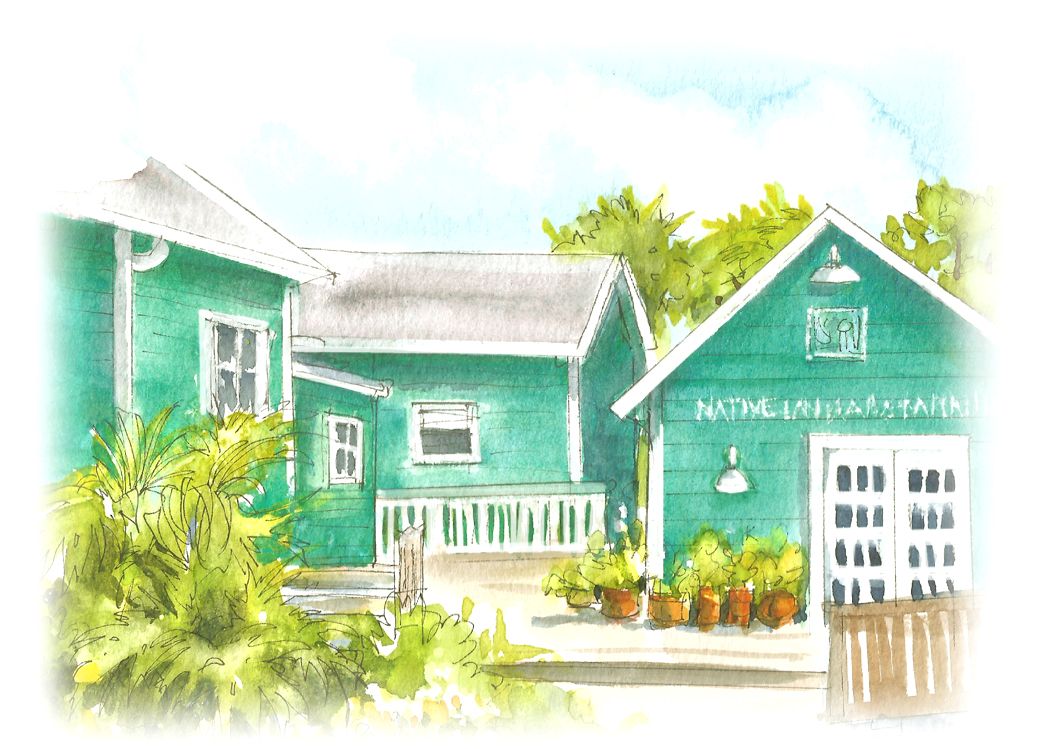
| The back of the Bailey Homestead and the native nursery. Any wacky angles are the artist's, not the construction! |
A workshop
Last Wednesday (March 11, 2020), I facilitated an introduction to nature journaling workshop. We spent a sunny and serene tropical afternoon in the pavilion behind the Bailey Homestead Preserve at the Sanibel-Captiva Conservation Foundation (SCCF), on Sanibel Island, Florida.
Starting off
After our break, we choose a spot and draw individually. This is the time when I try to visit each person privately, to help with a challenge or to admire their progress.
Bright lemon- and buttery-yellow sunflowers and daisy-like flowers abound. Beach sunflower, coreopsis (tickseed), and gaillardia (blanket flower) are all blooming. Vibrant shades of pink-to-lavender-to-violet: verbena, railroad vine, and iris. And a dash of bright scarlet – tropical sage. Mmmmmmm… heaven for the artist within. These are just a few of the flowers along the brick walkways of the native garden center and preserve! I found myself longing for the entire week to explore this magical place. However, fledging nature journalers await.
And time to share
Our next step is to group back in the pavilion to share our experiences, This (to me) is where a lot of our very real learning takes place! Sharing our work is always optional. Our group is here to provide a safe and supportive place with like-minded folks.
![]() |
| Taking time to share, to learn, to grow. |
When we share, we experience the joy of someone’s new paint color, we thrill to a sketchbook of exotic paper, we learn the name of an unidentified species. I always learn something new. It’s exciting to me to see our natural world through the eyes of architects, nurses, or accountants. Each of us has a different lens of experience that informs our work as an artist. How cool is that!
And remember to let yourself shine.
Molotow making fluid pump pen 2 mm