Showing posts with label acorn. Show all posts

Sunday, July 17, 2022

Live oak – a keystone species (and friend)

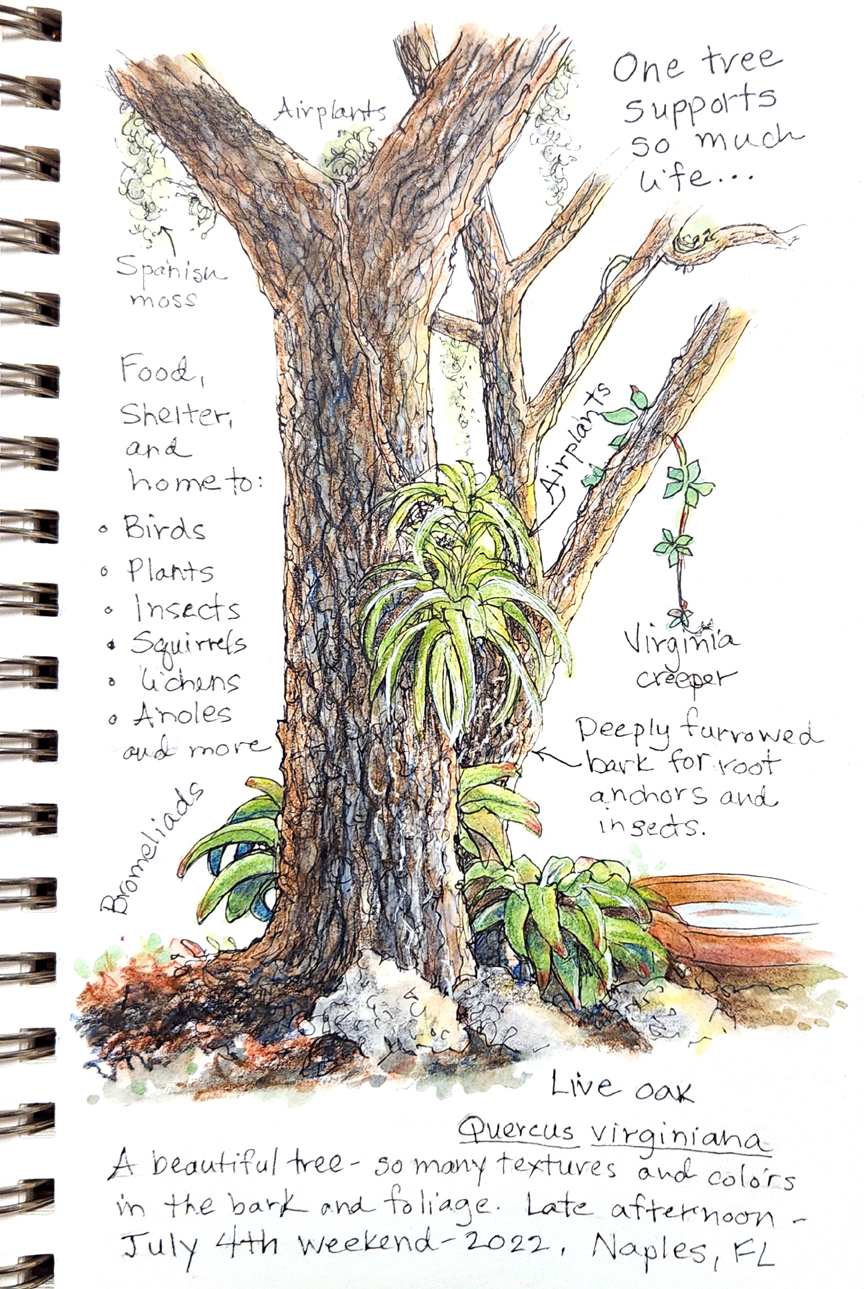
 Live oak is one of my favorite trees -- one of the many types of oaks in the world, but only growing in the US within a limited southern range. My nature journal entry is of a tree that’s about 20 years old, an acorn volunteer from a larger and much older live oak nearby. 

Click on image to view larger.
I love discovering the many things that live oaks support. The bark on the trunks of older oaks is furrowed deep, often dressed with an embroidery of lichens, fungi, and mosses -- sometimes ferns. Look up into the branches and you will probably see several types of epiphytes, those plants that grow on others (not to be confused with parasites), and get sustenance from rain and air as well as sunlight. Sometimes called air plants, many epiphytes are from the bromeliad family – in Florida we have a variety of tillandsias and Spanish moss as the usual suspects. 

Some of these air plants collect water in bowl-like centers, created by the broad bases of their overlapping leaves. It becomes a good water source as well as a habitat for insect larvae that start their life underwater. Small insects attract the things that eat them – larger insects, spiders, anoles, and birds. The thick foliage and sturdy branches of live oak provide shade, cover and a retreat for bird and squirrel nests. About 5 years ago, I enjoyed watching a trio of raccoon kits scamper up and down the trunk of a mature live oak outside my office window as they grew to maturity. When the storms came, they high-tailed it to the 10-foot-high nest tucked under a large staghorn fern in the first fork. 

The leaves are larval food for several species of moths, plus a couple of butterflies. You might notice the tracks of leaf miners or the swellings from gall-forming insects. Live oaks are called “live” because they appear to be evergreen to many people, but they do drop their old leaves, waiting until spring when the new leaves emerge. Live oaks bloom in the spring, and although the catkins rely on wind pollination, they also offer pollen to bees and other insects. 

Oaks are well-known for acorns, not just as food for squirrels, but also for grubs, birds, and small and large mammals (even people). The nuts were processed to remove the tannins and eaten by humans all over the world. Acorn culinary history spans thousands of years, as a regular food source and later as a sustenance and survival food. Contemporary interest in acorn flour and nuts comes from the curious, the epicures, and the food and agriculture specialists working on food security for our future. 

Some of the species noticed over time!

Acorns start dropping to the ground in the fall, with some years (called mast years) welcoming an overabundance. Last year (2021) was a mast year, and we had acorns everywhere! Blue jays and squirrels left pock marks in the dirt and sand as they busily buried as many acorns as they could. Between the nuts on top and the divots below, it was dangerous walking ground.

Oaks are considered a keystone species, which means that they support a large community of living things. They support, shelter, and feed all sorts of life – from the smallest insects to deer and even bears. Live oaks have personal connections for me as well, besides the trio of raccoon kits. The first pair of pileated woodpeckers I spotted in Florida were on a live oak tree. The plonk-plonk of falling acorns has put me to sleep at night; the battles of jays and squirrels over a nut have amused me in the daytime. I enjoy trying to capture the textures and colors of the bark and leaves in my nature journal. There’s not much time to observe our two urban oaks, but I still notice an abundance of life just in passing. I’ve sketched live oaks often enough that I consider them old and beloved friends. 

I hope my words and nature journal entries help you see oaks in a new light. We appreciate the beauty and shade they bring, but they offer so much more. Planting or preserving one oak makes a difference: a cascade of life follows, and this is a wonderful thing! 

More on oaks: There is much more to learn about oaks. For an overview on the many values of oaks (for nature and ourselves), I suggest you start by watching a presentation by Dr. Doug Tallamy on his book “The Nature of Oaks” on YouTube: https://www.youtube.com/watch?v=EdiUgB_3A9w 

Media: 
Mechanical pencil .7mm 
Micron Pigma 01, black 
Aquabee Super Deluxe Mixed Media sketchbook 6x9 in. 
Daniel Smith watercolors 
Niji waterbush, round M


Saturday, January 22, 2011

SketchCrawl pages


Cabbage palms, originally uploaded by Elizabeth Smith.

Today was our second participation in the 30th Worldwide SketchCrawl! We went to Freedom Park again, and along the boardwalk I noted the changes from the last SketchCrawl in October.


The water levels are much lower, and the alligator flag is brown and brittle, with some plants sporting new growth from the bases. The sky is tinted a bit cooler in hue, and there are many more bare branches emerging from the evergreen foliage; grasses and sedges have turned ochre and brown.  I watched a lone great egret wade the shallows, feathery breeding plumes dancing in the wind.

Near the lake, a nearly barren firebush offers abundant sprays of berries to darting songbirds.  Further along the boardwalk, and into the older wetlands dominated by cypress, laurel oak, red maple, and pond apple trees, I spotted a single raccoon digging in the mud.  As I started to sketch, it spotted me and ambled off behind the ferns.

A few more quick sketches, and then back to my warm car.  Not cold compared to my northern friend's and family's climates, but 60 degrees F (and dropping) combined with a drizzly rain and a steady wind signaled a good time to end the day of sketching!


We received some wonderful publicity from our local paper, the Naples Daily News; you can see the photo gallery here.  You can also view the Flickr SketchCrawl group of sketches from all over the world here. 

Wednesday, September 29, 2010

Quick studies ~ drawing with a brush


When time is short, we can still take a few minutes to practice! Part of my ongoing practice is to find techniques that work well in Pentalic’s “Nature Sketch” sketchbook.

The paper isn’t as sturdy as the watercolor papers I’m used to using. Water is a bit of a problem, because I like to use multiple layers and sometimes lift color from the paper surface. This paper is really made for one or two washes, and no lifting. Anything beyond that and the paper starts to disintegrate. So - I’m attempting to streamline my approach.

On this page, I decided to draw directly onto the paper with my brush (a #3 round) and watercolor washes. I thought it best to limit the washes and any reworking, so I kept the colors simple (Sap Green, Burnt Umber, and Shadow Violet) and tried to use minimal colors and brush marks.

Starting with a simple suject,  I tried to capture the essence of it with just a few strokes. The more I painted, the more confident I became. By the time I finished with the various leaves, I felt that I could attempt a more complicated branch by painting free-hand (bottom right)!

It’s all in the name of practice, anyway, and what we learn  ~ happy painting!

You can click on the image above to view it larger on my Flickr photostream.

Thursday, January 28, 2010

Things from my yard


Things from my yard, originally uploaded by Elizabeth Smith.

There is never a shortage of subject matter in nature! These found items represent microcosms of life and activity.

The oak branch and acorn are from a live oak tree (Quercus virginiana) - food and shelter to squirrels, birds, and insects, not to mention support for various lichens and mosses.

The passionvine (Passiflora suberosa) is a native that is continually popping up in my yard; it's a larval food for butterflies in our area such as the Gulf Fritillary and the Julia. I'm pretty sure songbirds eat the berries, and maybe some other critters, too.

Slash pine needles are everywhere on the ground. Each winter the pine trees seem to shed quite a few. I see them turning up in fallen bird's nests, such as this nest I sketched after a pouring rain knocked it down.

I'm not sure if anything eats the necklace pod (Sophora tomentosa) seeds, but I know that bees and butterflies love the nectar from it's bright yellow pea-like flowers.

Lately, it seems that mourning dove feathers are becoming a common occurrence. Are they molting this time of year? Maybe we just have more moving into the area, or perhaps the neighbor cat has been busy.

Fossil shells are fairly common in Florida. This one probably arrived in a load of fill, but it perfectly symbolizes the fact that our part of Florida was once an underwater ecosystem.

I picked these up at first just to draw them as interesting objects in themselves, but somehow the process of drawing and reflection opened up a whole new world. I think I could explore my entire yard and still not fully understand the little worlds within!

You can click on the image above to view it larger on my Flickr photostream.

Wednesday, October 21, 2009

Remains of summer


Remains of summer, originally uploaded by Elizabeth Smith.

Well, I guess I should say that these are remains of a southwest Florida summer. Our few deciduous trees don’t usually lose their leaves until sometime in November or December, and we don’t have the grand color change of more northern areas. Instead, our changes are subtle.

The Live Oak trees in our neighborhood are producing a healthy crop of acorns, and soon we’ll be seeing pockmarks in the dirt as the squirrels stock up for lean times. They’ve been tearing off the scales of the Slash Pine cones to get at the seeds, leaving a bristly inner core of a rich burnt sienna color.

More and more bird flocks are traveling in the skies, the goldenrod is blooming on the roadsides, and the wheel turns once more.

You can click on the image above to view it larger on my Flickr photostream.