Showing posts with label native. Show all posts

Sunday, July 17, 2022

Live oak – a keystone species (and friend)

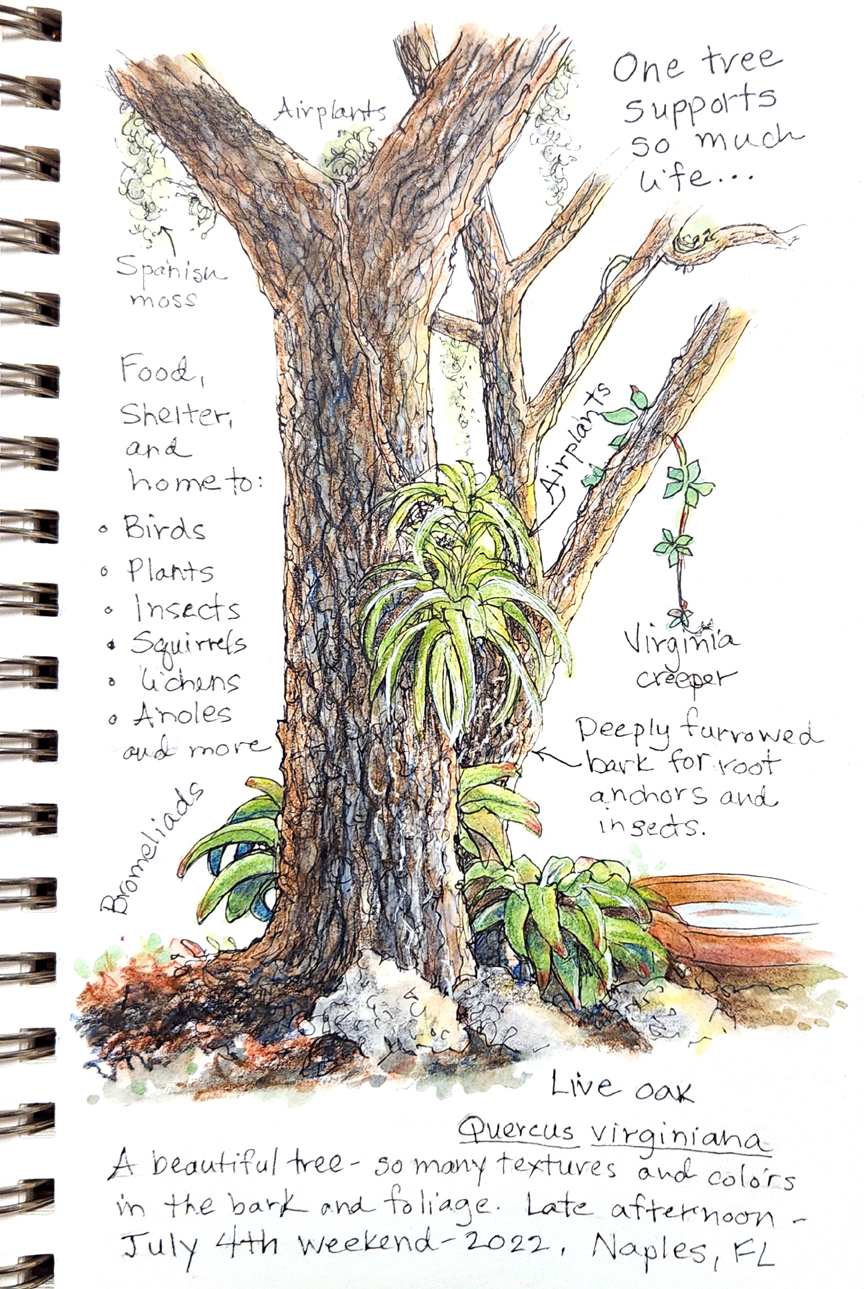
 Live oak is one of my favorite trees -- one of the many types of oaks in the world, but only growing in the US within a limited southern range. My nature journal entry is of a tree that’s about 20 years old, an acorn volunteer from a larger and much older live oak nearby. 

Click on image to view larger.
I love discovering the many things that live oaks support. The bark on the trunks of older oaks is furrowed deep, often dressed with an embroidery of lichens, fungi, and mosses -- sometimes ferns. Look up into the branches and you will probably see several types of epiphytes, those plants that grow on others (not to be confused with parasites), and get sustenance from rain and air as well as sunlight. Sometimes called air plants, many epiphytes are from the bromeliad family – in Florida we have a variety of tillandsias and Spanish moss as the usual suspects. 

Some of these air plants collect water in bowl-like centers, created by the broad bases of their overlapping leaves. It becomes a good water source as well as a habitat for insect larvae that start their life underwater. Small insects attract the things that eat them – larger insects, spiders, anoles, and birds. The thick foliage and sturdy branches of live oak provide shade, cover and a retreat for bird and squirrel nests. About 5 years ago, I enjoyed watching a trio of raccoon kits scamper up and down the trunk of a mature live oak outside my office window as they grew to maturity. When the storms came, they high-tailed it to the 10-foot-high nest tucked under a large staghorn fern in the first fork. 

The leaves are larval food for several species of moths, plus a couple of butterflies. You might notice the tracks of leaf miners or the swellings from gall-forming insects. Live oaks are called “live” because they appear to be evergreen to many people, but they do drop their old leaves, waiting until spring when the new leaves emerge. Live oaks bloom in the spring, and although the catkins rely on wind pollination, they also offer pollen to bees and other insects. 

Oaks are well-known for acorns, not just as food for squirrels, but also for grubs, birds, and small and large mammals (even people). The nuts were processed to remove the tannins and eaten by humans all over the world. Acorn culinary history spans thousands of years, as a regular food source and later as a sustenance and survival food. Contemporary interest in acorn flour and nuts comes from the curious, the epicures, and the food and agriculture specialists working on food security for our future. 

Some of the species noticed over time!

Acorns start dropping to the ground in the fall, with some years (called mast years) welcoming an overabundance. Last year (2021) was a mast year, and we had acorns everywhere! Blue jays and squirrels left pock marks in the dirt and sand as they busily buried as many acorns as they could. Between the nuts on top and the divots below, it was dangerous walking ground.

Oaks are considered a keystone species, which means that they support a large community of living things. They support, shelter, and feed all sorts of life – from the smallest insects to deer and even bears. Live oaks have personal connections for me as well, besides the trio of raccoon kits. The first pair of pileated woodpeckers I spotted in Florida were on a live oak tree. The plonk-plonk of falling acorns has put me to sleep at night; the battles of jays and squirrels over a nut have amused me in the daytime. I enjoy trying to capture the textures and colors of the bark and leaves in my nature journal. There’s not much time to observe our two urban oaks, but I still notice an abundance of life just in passing. I’ve sketched live oaks often enough that I consider them old and beloved friends. 

I hope my words and nature journal entries help you see oaks in a new light. We appreciate the beauty and shade they bring, but they offer so much more. Planting or preserving one oak makes a difference: a cascade of life follows, and this is a wonderful thing! 

More on oaks: There is much more to learn about oaks. For an overview on the many values of oaks (for nature and ourselves), I suggest you start by watching a presentation by Dr. Doug Tallamy on his book “The Nature of Oaks” on YouTube: https://www.youtube.com/watch?v=EdiUgB_3A9w 

Media: 
Mechanical pencil .7mm 
Micron Pigma 01, black 
Aquabee Super Deluxe Mixed Media sketchbook 6x9 in. 
Daniel Smith watercolors 
Niji waterbush, round M


Friday, July 5, 2019

Simpson’s Stopper or Twinberry


My nature sketchbook nestled in the Simpson Stopper, you can see a bit of the trunk on the left.

A favorite of people and wildlife
Simpson’s Stopper is one of my favorite native small trees or large shrubs.  I have two growing now, one a veteran of 20 years and the other a small 3-year old transplant.  I planted this for wildlife, but also because it’s pleasing to look at and needs little maintenance from me. 
Wildlife loves it because of the berries and cover.  A mockingbird and blue jay take turns staking it out when the orange-to-red berries ripen, and the bees and butterflies seem to appreciate the fragrant white flowers that come before.  Simpson’s Stopper even has lovely ornamental trunks (cinnamon and gray markings with decorative peeling) and bright green shiny leaves of varied shapes. 
A story of names
It’s called Simpson’s Stopper because it was named in honor of Charles Torrey Simpson, a contemporary of Dr. David Fairchild (whose plant  collection later became Fairchild Tropical Botanic Garden).  Charles was a self-taught naturalist, a specialist in molluscs and botany, and an author and conservationist who made his home in southeast Florida in the early 1900’s.
The name “stopper” is said to have two possible origins.  The first is that it was used as a medicine to treat flu-like symptoms and to stop diarrhea.  The second is that the multiple trunks make it difficult to pass through a hedge or thicket – thus stopping anyone who tries.
It’s also called Twinberry because the flowers and subsequent fruits are borne on a “Y” shaped stalk – twins.  It’s sometimes called nakedwood – self-evident because of the smooth bark on the copper, gray, and tan trunks. 
Many stamens indeed!
The scientific name is Myricanthes fragrans.  According to The Names of Plants by D. Gledhill, Myriacanthus means “with very many thorns”,  Myriandra means myriad stamens, and Myrica and fragans mean fragrance.  I think we can agree that somewhere in there the many-stamened fragrant flowers fit these definitions.  It’s said that the thorns refer to the stamens (there are no thorns at all on this tree).  Because of the dynamic nature of botanical re-classification through the years, older texts refer to this species as Eugenia simpsonii, which is where the Simpson name emerges.
And more
Simpson’s Stopper is native to south Florida and found throughout within the Caribbean, Central America and northern South America. It is salt tolerant and will grow in coastal areas further north. Once established, little care is needed – mine seems to thrive on benign neglect. 

Because Simpson's stopper is a threatened plant species, collecting from the wild is a no-no. Florida has several native plant nurseries and organizations that will happily set you up with a seedling or more mature specimen. My original shrub was purchased through a local chapter of the Florida Native Plant Society, a great source for plants as well as knowledge. 


Resources you may like to visit to know more:  


Florida IFAS extension plant information: http://gardeningsolutions.ifas.ufl.edu/plants/trees-and-shrubs/shrubs/simpsons-stopper.html

Green Deane on the edibility of Simpson’s Stopper (and more interesting tidbits):
http://www.eattheweeds.com/myricanthes-fragrans-nakedwood-twinberry-2/

The Naples Chapter of the Florida Native Plant society
http://naples.fnpschapters.org/
Media
Aquabee sketchbook, 6x9”
.7 mm mechanical pencil
Pitt artist pen, dark sepia size S
Daniel Smith watercolors
Round brushes, size 4 and 8

Friday, December 14, 2018

Scars on a Cabbage palm


Click on any image to view larger.
The past years have left some scars.  Recent life events of sorts have left me a bit tattered and in need of repair.   No wonder this cabbage palm attracted my pen and brush.  This one has had experiences that have left their marks as well.
 
Cabbage palms in general seem to be always present in our area but seldom noticed.  They are like the fairytale stepchild of landscaping; going about their business in the background but never the star of the show.  Yet… they provide so much and ask for so little.  And to me they are beautiful in many ways.

The cabbage palm, or Sabal palmetto, is our Florida state tree (as well as that of South Carolina).  You might say that Florida was built with this amazing palm.

Early life in Florida was easier because of it.  The growing bud was harvested as food, the berries used medicinally, and the trunks became lumber, utensils, game sticks, and hunting implements.  The matted fiber tucked behind the “boots” makes excellent kindling, as boy scouts learn on overnight adventures.  
 
Cabbage palm with boots.
Boots are the old leaf bases that criss-cross in a spiral around the trunk.  The boots are not always present – sometimes removed by landscapers but they also show up that way in the wild, perhaps removed by fire or time.  The fronds can be woven into mats, bowls, hats, and baskets.  They are used for roofing chickee huts, for making rope, twine, and thread.  

Cabbage palms support a variety of wildlife.  Birds and small mammals eat the berries and find shelter in its fronds (not to mention a friendly rat snake or two).  Larger mammals eat the reachable or fallen berries.  The small white-to-cream flowers provide nectar for insects and bees, which in turn make flavorful honey.  Frogs and anoles make their home in the canopy.  It even provides larval food for the Monk Skipper butterfly.   Just one cabbage palm  might be thought of as a mini-eco system.  Wow.

 
My original sketch in pen.
With all of these gifts, we often turn to this palm only as a way to fulfill our native landscaping quota for new construction.  They grow in a wide range of conditions (salt, drought, and wind tolerant), are available everywhere, and reasonably priced (as palms go).  This hardy native palm is found naturally throughout Florida and along the coastal plains of Texas and up into North Carolina.  

The palm I sketched has no boots except at the very top of the trunk; the pattern of ringed scars around the trunk are where the leaf bases once held fast.  But there are also ravages from other escapades – perhaps a run-in with a large truck caused the deeper, ragged cuts near the top.  The trunk is thinner at the bottom and fuller towards the top.  Were there lean years and then better ones?  It sits alone alongside a major roadway, out of place yet standing tall, but with a slight curve along the stem – leaning towards or leaning away?  

This bit of poetry seems to fit so well:
“Task: to be where I am.
Even when I’m in this solemn and absurd
role: I am still the place

where creation works on itself.”
~ Tomas Tranströmer,
from
the poem “Guard Duty” (1973)

Media
Aquabee sketchbook, 6x9”
Pitt artist pen, dark sepia
Mission Gold watercolors
#8 round wc brush


The small sketch (with boots):
on same paper with
Aquarelle watercolor pencils
Med waterbrush

More reading:
 All about the cabbage palm from FNPS (Florida Native Plant Society):
https://www.fnps.org/plants/plant/sabal-palmetto
 
Edible parts of the cabbage palm from popular author Green Deane:
http://www.eattheweeds.com/cabbage-palm-sabal-palmetto/
 
The many historical uses of cabbage palm:
 Ethnobotany from Native American Ethnobotany, A Database of Foods, Drugs, Dyes and Fibers of Native American Peoples, Derived from Plants.
 http://naeb.brit.org/uses/search/?string=sabal+palmetto