Showing posts with label backyard. Show all posts

Sunday, July 17, 2022

Live oak – a keystone species (and friend)

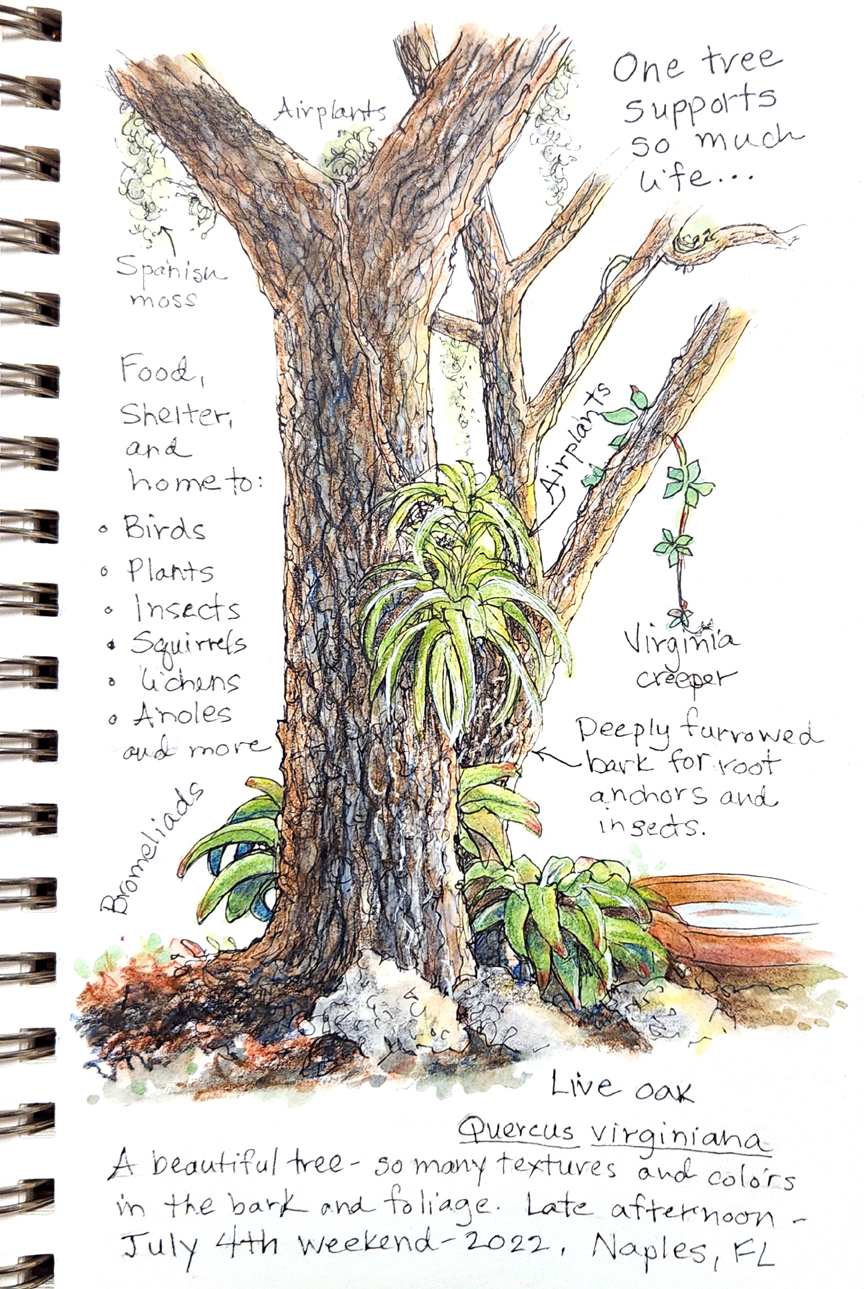
 Live oak is one of my favorite trees -- one of the many types of oaks in the world, but only growing in the US within a limited southern range. My nature journal entry is of a tree that’s about 20 years old, an acorn volunteer from a larger and much older live oak nearby. 

Click on image to view larger.
I love discovering the many things that live oaks support. The bark on the trunks of older oaks is furrowed deep, often dressed with an embroidery of lichens, fungi, and mosses -- sometimes ferns. Look up into the branches and you will probably see several types of epiphytes, those plants that grow on others (not to be confused with parasites), and get sustenance from rain and air as well as sunlight. Sometimes called air plants, many epiphytes are from the bromeliad family – in Florida we have a variety of tillandsias and Spanish moss as the usual suspects. 

Some of these air plants collect water in bowl-like centers, created by the broad bases of their overlapping leaves. It becomes a good water source as well as a habitat for insect larvae that start their life underwater. Small insects attract the things that eat them – larger insects, spiders, anoles, and birds. The thick foliage and sturdy branches of live oak provide shade, cover and a retreat for bird and squirrel nests. About 5 years ago, I enjoyed watching a trio of raccoon kits scamper up and down the trunk of a mature live oak outside my office window as they grew to maturity. When the storms came, they high-tailed it to the 10-foot-high nest tucked under a large staghorn fern in the first fork. 

The leaves are larval food for several species of moths, plus a couple of butterflies. You might notice the tracks of leaf miners or the swellings from gall-forming insects. Live oaks are called “live” because they appear to be evergreen to many people, but they do drop their old leaves, waiting until spring when the new leaves emerge. Live oaks bloom in the spring, and although the catkins rely on wind pollination, they also offer pollen to bees and other insects. 

Oaks are well-known for acorns, not just as food for squirrels, but also for grubs, birds, and small and large mammals (even people). The nuts were processed to remove the tannins and eaten by humans all over the world. Acorn culinary history spans thousands of years, as a regular food source and later as a sustenance and survival food. Contemporary interest in acorn flour and nuts comes from the curious, the epicures, and the food and agriculture specialists working on food security for our future. 

Some of the species noticed over time!

Acorns start dropping to the ground in the fall, with some years (called mast years) welcoming an overabundance. Last year (2021) was a mast year, and we had acorns everywhere! Blue jays and squirrels left pock marks in the dirt and sand as they busily buried as many acorns as they could. Between the nuts on top and the divots below, it was dangerous walking ground.

Oaks are considered a keystone species, which means that they support a large community of living things. They support, shelter, and feed all sorts of life – from the smallest insects to deer and even bears. Live oaks have personal connections for me as well, besides the trio of raccoon kits. The first pair of pileated woodpeckers I spotted in Florida were on a live oak tree. The plonk-plonk of falling acorns has put me to sleep at night; the battles of jays and squirrels over a nut have amused me in the daytime. I enjoy trying to capture the textures and colors of the bark and leaves in my nature journal. There’s not much time to observe our two urban oaks, but I still notice an abundance of life just in passing. I’ve sketched live oaks often enough that I consider them old and beloved friends. 

I hope my words and nature journal entries help you see oaks in a new light. We appreciate the beauty and shade they bring, but they offer so much more. Planting or preserving one oak makes a difference: a cascade of life follows, and this is a wonderful thing! 

More on oaks: There is much more to learn about oaks. For an overview on the many values of oaks (for nature and ourselves), I suggest you start by watching a presentation by Dr. Doug Tallamy on his book “The Nature of Oaks” on YouTube: https://www.youtube.com/watch?v=EdiUgB_3A9w 

Media: 
Mechanical pencil .7mm 
Micron Pigma 01, black 
Aquabee Super Deluxe Mixed Media sketchbook 6x9 in. 
Daniel Smith watercolors 
Niji waterbush, round M


Monday, September 9, 2019

If you build it…


If you plant thoughtfully and plan for basic needs, the birds and wildlife will come.  If you plan to delight the eye, design for serenity, and aim for (relatively) low maintenance, you create something more a sanctuary.  
Baltimore oriole invasion!

This nature journal entry is from last August, done when I visited my parents in northeastern Iowa.  This is part of their backyard!  Here’s what I saw:

  • Eight plus bird species (in an hour or so)
  • A bunny
  • Chipmunks
  • Squirrels
  • Butterflies, honeybees, bumblebees and other insects
Sort of a plein air (from inside!), but from direct observation – hence the start-and-stop lines and redraws.  Everything in nature moves!  Made in ink and watercolor on a Saturday afternoon, finished on Sunday afternoon.

One of the things that makes this a special place is the layout – it is a long and narrow lot with a wonderful viewing spot from inside the house.  This viewing spot is a picture window in the dining room that overlooks nearly the entire back of the property.  Someone can enjoy watching the never-ending show while lingering over a cup of coffee.  It’s also a convenient place to sketch and not frighten away the birds!

Another special thing is that this space is a collaboration between my parents – one gardens for shelter, beauty and food sources and one creates and maintains feeders for the birds (and small and large mammals).  Both create their own forms of functional art. 

We all get thirsty.
Interwoven into the garden spaces are water sources: shallow birdbaths at various heights.  Short grasses and flat limestone rocks delineate paths that wind through flowers, ferns, and small shrubs.  A few strategic benches invite visitors to sit, to meditate, to just rest. 

That weekend was a time of Baltimore orioles, a bird I seldom see in SW Florida.  Bright orange and black for the males, and a more subtle brownish-orange for the females and juveniles.  They came for the grape jelly (yes, my Dad has a soft heart for treats), the hummingbird nectar, and for a drink during their thirsty migration travels.  Small woodpeckers came too, for the seed and suet, flicking in and out of the picture nervously, but sometimes staying for a while.  All sorts of sparrows visited constantly, ever-adapting little bundles of cheeping and hopping feathers.  
 
Just passing through...
Squirrels, chipmunks, and rabbits are the more visible small mammals that come for food.  According to my parent’s reports, deer come through at dawn or dusk to forage and drink.  They live near a park and woodlands, so are treated to residential wildlife traveling through at odd times.

What else makes this space so special?  Design-wise, it’s full of varying but harmonious colors, different heights and textures, and the privacy of screening shrubs and trees -- all with a mindful eye for human needs.  Wildlife-wise, it fills the needs of living creatures, offering water, food, and shelter.  Expanding on that, the offerings are appropriate.  In other words:
  
  • The water sources are clean, at various heights (one is a flat saucer on the ground) and scattered throughout the space.  
  • The food is selected to attract certain species that live locally or migrate through the area.  Some is purchased (seed mixtures, nuts, suet, grape jelly) while some is planted.   Berry and fruit-and-nut bearing species here are highbush cranberry and dogwood shrubs, crabapple, maple and oak trees. 
    Pollinators need food too!  Butterflies, bees, and other insects are important to your garden’s health.  Some flowers are only pollinated by bees, while others are less picky.  We sometimes forget that pollination is a required step in order to make those berries or nuts.
  • The shelter has what certain species need.   There are high and low perches, as well as concealment cover for birds and small climbing chipmunks and squirrels.  Chipmunks need closer-spaced branches while squirrels can jump quite far!  Thick, low-growing shrubs, foliage or grasses provide shelter and cover for rabbits, chipmunks, and ground birds.  The green spaces in their garden are all connected for safer travel.  Is your overall environment a safe place?  Are you using herbicides and/or pesticides?  These do not create a healthy place to live.  Choose more natural methods of controlling pests or not at all.  Ask yourself two questions as a guide: “Would I want to live in the outdoor space I’ve created?”  and  “Would I want my children or small pets to eat, drink and sleep here?” 

Needs are also appropriate to the place and for the species attracted.  This is an urban area, so it’s designed for species that adapt well to town or city spaces.  If this was a rural setting, the design might shift into something very different.

Sanctuary.  Another view of the garden shows a place for humans, too.

 Remember that you have needs too!   Do you thrive with colorful blooms or relax better with serene greens?  Do you crave order or prefer a wildness in your habitat?  Will you observe, walk a path, or sit and read, or will you want to enjoy from afar?  Do you like tending to feeders or prefer that Mother Nature provides sustainable food sources?

I hope that all of the above inspires – if not to start your own backyard wildlife garden, but to appreciate the natural spaces you live, work and move through. There is an amazing world of life out there - if you start with even a single birdbath, they will come.

More resources:

The National Wildlife Federation (based in the US but for anyone): https://www.nwf.org/garden-for-wildlife (many resources, including how to certify your yard as a wildlife habitat)


The Wildlife Trust (based in the UK but for anyone): https://www.wildlifetrusts.org/gardening (lots of how-to ideas and free downloadable  info packs)

Sketchbook Media:
“Baltimore Oriole Invasion”
Aquabee sketchbook, 6x9”
Sakura Micron Pigma artist pen, black 01
Daniel Smith watercolors
Round brushes, size 4 and 8

“Sanctuary”
Fabriano Artistico CP 140 lb., about 6x9”
Mechanical pencil
Daniel Smith watercolors
Round brushes, size 4 and 8