Showing posts with label scrub. Show all posts

Friday, April 10, 2020

April 10th is Florida Gopher Tortoise Day!

A typical gopher tortoise burrow at The Naples Preserve.

In honor of Florida's Gopher Tortoise Day, I am re-posting an updated version of a post  created 9 years ago.

Way back in 2011, I visited the Naples Preserve and sketched a gopher tortoise burrow as part of my nature journal entry about the coastal plain honeycomb head wildflower.  It’s funny how a drawing can start trains of thought and exploration.  Although I didn’t see any tortoises that day, the burrow opening itself led me to wonder about the gopher tortoise: what they eat and how they live.  I've since seen several in various locations in Collier County, mainly in coastal and scrub locations (think SANDY soil!).

Gopher tortoises are a keystone species.  A keystone is the wedge-shaped piece at the top of an arch that supports the other parts. If a keystone is removed, the arch collapses.  A keystone species has a disproportionately large effect on its environment relative to its quantity.  These amazing creatures are very important to the survival of other species that share their habitat.
Click on image to see a larger size.

For example, it’s been estimated that gopher tortoise burrows (both active and abandoned) provide support for over 300 types of animals, birds, and insects – which use them for shelter, hiding places, or protection from the elements.  These are commensal relationships, relationships in which one organism benefits while the other is neither harmed nor helped.

Gopher tortoise burrows average 15 ft. in length and may be as deep as 6 feet. The longest estimate is up to 48 ft. in length! The burrows have one entrance (that is also the exit), and eventually open up into a larger “bedroom.”  Species using these burrows range from burrowing owls and scrub jays, to Florida mice, gopher frogs, opossums, scorpions, and indigo snakes.

Gopher tortoises are found all over Florida, but only in certain types of habitats.  They range into Georgia, Alabama, Mississippi, and the southernmost tip of South Carolina.  Although once common, numbers have dwindled because of habitat destruction In Florida.  On the state's Endangered and Threatened Species List they are listed as Threatened. 

Some other interesting things I learned about gopher tortoises:

• They first appeared during the Pleistocene Epoch, and are one of our oldest living species.

• Gopher tortoises are land reptiles – they do not live in or near the water!  In fact, they rarely drink water, getting fluids from the plants they eat.  If you find one, please do NOT place them in water, and help educate others to their needs!  Well-meaning people often try to "help" these tortoises by placing them  in a nearby lake or canal.  They are better off left alone!


• They live in areas with easy to dig sand, such as pine flatwoods and scrub habitats.

• The size of the burrow opening corresponds to the size of the tortoise using it.

• They are herbivore scavengers, eating grasses, legumes, mushrooms, fruits, berries, and even flowers.

• Biologists believe that they have a 40 to 60 year life span in the wild; they live much longer in captivity.
https://drive.google.com/open?id=1NTlRJ5SxzQFX-HAv9CvOYU-d38uaqciA

Some websites on gopher tortoises for further exploration:

All about Florida Gopher Tortoise Day with educational resources, including a coloring book to download (scroll down).


Ginny Stibolt's account of finding a gopher tortoise in her Florida backyard, with in-depth facts.

Florida Fish and Wildlife Conservation Commission page

Free coloring page!  you can click HERE to download a free gopher tortoise coloring page in PDF format (right).


Monday, March 5, 2012

Sky-blue lupine


My nature journal entry (click to view larger)


I had a chance Saturday to visit some scrub areas at Rookery Bay, and sketch the subtle beauty of the sky blue-lupine, which is blooming now.  Sky-blue lupine (Lupinus diffusus) is well named – the pea-like flowers are a delicate blue and white that echoes the atmospheric colors overhead. 

Amazingly, these native wildflowers grow in one of our harshest habitats in Florida – scrub.  The soil is almost pure sand, a “concealed desert” as described by Dr. W. H. Simmons in 1822.  Imagine surviving in the intensity of a full Florida sun, the light and heat enhanced by reflective white sand that drains quickly after a rain.  Yet these lovely wildflowers are thriving, and new seedlings are emerging.

I chose a small plant to draw as lupines are quite complex!

Sky-blue lupines are on the endangered species list and protected by law.  Their beauty made them irresistible to past collectors; however, they do not like to have their roots disturbed and don’t survive transplanting.  The seeds require specialized soil, and take a long time to germinate.  The sandy scrub they call home was rapidly developed in the past because of its desirable higher elevations.  These factors make for a rarely seen wildflower. 

Larger sky blue lupines,
growing  right out of the scrub's sugar sand.
A member of the bean or pea family, Fabaceae, sky-blue lupine fixes nitrogen in the soil, which is typical of many legumes.  The alternate leaves, stems, and seedpods are covered in very fine silvery-white hairs.  

The genus name of Lupinus derives from the Latin word for wolf, "lupus.".  Explanations I’ve read include the idea that the lupines wolfishly devoured the nutrients from the soil so other plants could not grow; another story is that they grow alone, like the lone wolf.  The species name of diffusus is also Latin, meaning "spread out or wide."

Sky-blue lupine ranges throughout Florida and as far north as North Carolina, and west to Mississippi. I sketched these in pencil first, then drew in black ink, adding watercolor and a touch of watercolor pencil.  Thanks to my companions, Jeanette and Cyril, for an enjoyable morning!

Details: Mechanical pencil, .7 mm (generic)
Pitt artist's pen in black, XS size for drawing, S size for writing
Daniel Smith watercolors and Niji aquabrushes
Kimberly watercolor pencils
Pentalic Nature sketch sketchbook

Web resources and more photos of sky blue lupine:

Sunday, November 20, 2011

Coastal plain honeycomb head


I visited the Naples Preserve recently and saw these wonderful, lacy wildflowers glowing in the late afternoon sun. They were scattered along the boardwalk in different locations, and as I neared the end, I spotted an identification tag: coastal plain honeycomb head. This is the longest common name I’ve ever come across! Not only is it long, but it has a unique flavor as it rolls off the tongue. I gathered that it grows along the coastal plain, and that the flower or seed heads reminded someone of a honeycomb.

 That name (as well as its beauty) led me to take photos and do some sketching. Naples Preserve is a scrub habitat, and the ground you see in my journal entry is pure white sand. Living in soil that is dry, well-drained, nutrient-poor, and heat- and light-reflective takes some adaptation! Many plant species have deep tap roots to reach moister regions and to serve as anchor.


Coastal plain honeycomb head (Balduina angustifolia) is also known as yellow buttons, a more practical name if not quite as whimsical. This native wildflower is an annual, growing up to 3 feet high, and is commonly found in scrub and pinelands. A member of the huge Aster family, it has small linear leaves that lend the stems a feathery appearance.

 It’s found throughout Florida, and into the neighboring states of Georgia, Alabama, and Mississippi. The genus name of Balduina honors William Baldwin, an American physician and botanist. The species name of angustifolia comes from the Latin for “narrow leaves.”

You can see that I've been experimenting with combinations of loose watercolor washes and tighter details.  For this page I also played with a dip pen, using watercolor instead of ink to create the delicate tracery of grasses and vines.  My new favorite toy!

You can click on the top image to see it larger on my Flickr photostream, then select the Actions down-arrow in the upper left, and click on view all sizes (6th choice down from the top).

Sunday, October 16, 2011

Sketchcrawl at Naples Preserve


Sketchcrawl at Naples Preserve, originally uploaded by Elizabeth Smith.

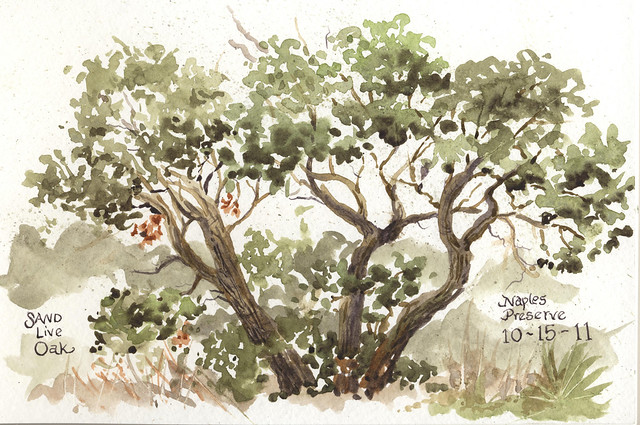
Yesterday eight of us met at the Naples Preserve to participate in the 33rd Worldwide SketchCrawl!  The sky was overcast, and the air was that soft, satiny texture that comes before a rain.  Thankfully the rain held off and we enjoyed exploring the boardwalk that winds through scrub habitat, and sketching the wonderful inhabitants. 


Young gopher tortoise ambling to its burrow. Length was about 12 inches.

Lavender, violet, yellow and blue were the colors of blooming flowers: moss verbena, Florida paintbrush, liatris (violet colors), black-eyed Susan, coreopsis, beach sunflowers (bright yellow) and dayflower (vivid, clear blue).  These were punctuated by the brilliant magenta-purple berries of American beautyberry. 

Gopher tortoise burrows dotted the sandy soil, and we spotted one partially hidden in its underground hideaway, and another smaller tortoise digging in the sugar sand.  Cicada and bird song accompanied our ambles, and we spotted red-bellied woodpeckers and mockingbirds flitting in and out of the scrub oaks. 


My watercolor of a wonderfully twisted sand live oak toward the beginning of the boardwalk.

In progress!


It was an enjoyable day: an opportunity to paint plein air and to make detailed studies of unusual plants.  Thank you to those who helped organize our event, and to those who attended!