Showing posts with label tree. Show all posts

Sunday, July 17, 2022

Live oak – a keystone species (and friend)

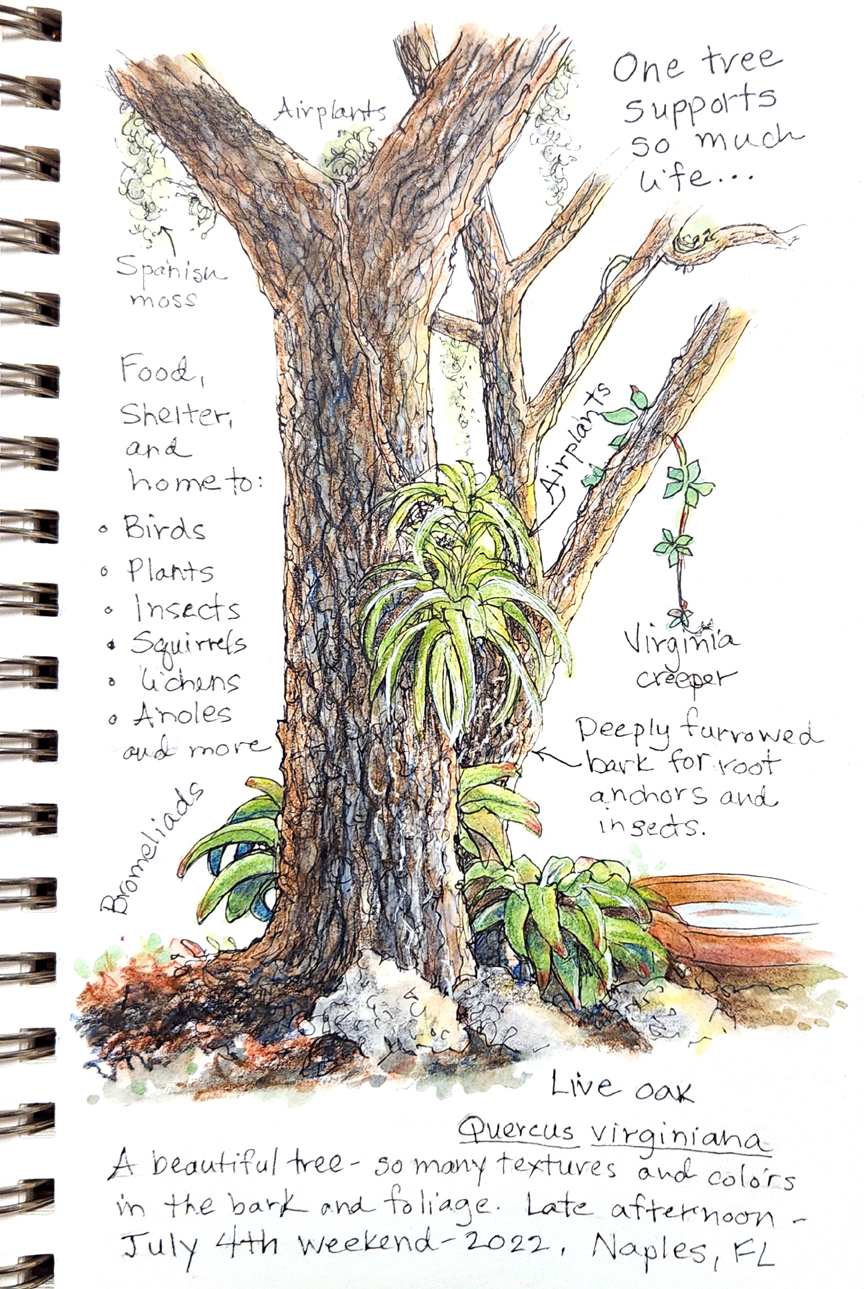
 Live oak is one of my favorite trees -- one of the many types of oaks in the world, but only growing in the US within a limited southern range. My nature journal entry is of a tree that’s about 20 years old, an acorn volunteer from a larger and much older live oak nearby. 

Click on image to view larger.
I love discovering the many things that live oaks support. The bark on the trunks of older oaks is furrowed deep, often dressed with an embroidery of lichens, fungi, and mosses -- sometimes ferns. Look up into the branches and you will probably see several types of epiphytes, those plants that grow on others (not to be confused with parasites), and get sustenance from rain and air as well as sunlight. Sometimes called air plants, many epiphytes are from the bromeliad family – in Florida we have a variety of tillandsias and Spanish moss as the usual suspects. 

Some of these air plants collect water in bowl-like centers, created by the broad bases of their overlapping leaves. It becomes a good water source as well as a habitat for insect larvae that start their life underwater. Small insects attract the things that eat them – larger insects, spiders, anoles, and birds. The thick foliage and sturdy branches of live oak provide shade, cover and a retreat for bird and squirrel nests. About 5 years ago, I enjoyed watching a trio of raccoon kits scamper up and down the trunk of a mature live oak outside my office window as they grew to maturity. When the storms came, they high-tailed it to the 10-foot-high nest tucked under a large staghorn fern in the first fork. 

The leaves are larval food for several species of moths, plus a couple of butterflies. You might notice the tracks of leaf miners or the swellings from gall-forming insects. Live oaks are called “live” because they appear to be evergreen to many people, but they do drop their old leaves, waiting until spring when the new leaves emerge. Live oaks bloom in the spring, and although the catkins rely on wind pollination, they also offer pollen to bees and other insects. 

Oaks are well-known for acorns, not just as food for squirrels, but also for grubs, birds, and small and large mammals (even people). The nuts were processed to remove the tannins and eaten by humans all over the world. Acorn culinary history spans thousands of years, as a regular food source and later as a sustenance and survival food. Contemporary interest in acorn flour and nuts comes from the curious, the epicures, and the food and agriculture specialists working on food security for our future. 

Some of the species noticed over time!

Acorns start dropping to the ground in the fall, with some years (called mast years) welcoming an overabundance. Last year (2021) was a mast year, and we had acorns everywhere! Blue jays and squirrels left pock marks in the dirt and sand as they busily buried as many acorns as they could. Between the nuts on top and the divots below, it was dangerous walking ground.

Oaks are considered a keystone species, which means that they support a large community of living things. They support, shelter, and feed all sorts of life – from the smallest insects to deer and even bears. Live oaks have personal connections for me as well, besides the trio of raccoon kits. The first pair of pileated woodpeckers I spotted in Florida were on a live oak tree. The plonk-plonk of falling acorns has put me to sleep at night; the battles of jays and squirrels over a nut have amused me in the daytime. I enjoy trying to capture the textures and colors of the bark and leaves in my nature journal. There’s not much time to observe our two urban oaks, but I still notice an abundance of life just in passing. I’ve sketched live oaks often enough that I consider them old and beloved friends. 

I hope my words and nature journal entries help you see oaks in a new light. We appreciate the beauty and shade they bring, but they offer so much more. Planting or preserving one oak makes a difference: a cascade of life follows, and this is a wonderful thing! 

More on oaks: There is much more to learn about oaks. For an overview on the many values of oaks (for nature and ourselves), I suggest you start by watching a presentation by Dr. Doug Tallamy on his book “The Nature of Oaks” on YouTube: https://www.youtube.com/watch?v=EdiUgB_3A9w 

Media: 
Mechanical pencil .7mm 
Micron Pigma 01, black 
Aquabee Super Deluxe Mixed Media sketchbook 6x9 in. 
Daniel Smith watercolors 
Niji waterbush, round M


Sunday, February 5, 2012

Wild tamarind ~ scars

(Click to view larger)
“There is something beautiful 
about all scars of whatever nature.  
 A scar means the hurt is over, 
the wound is closed and healed,
done with.”

Last month I spotted this tree trunk near the post office parking lot and had to sketch it.  I didn’t have my sketch kit with me, but I did have some ruled/graph paper and a mechanical pencil!  My attention was caught by the healed-over scars and the smooth bark of the tree.  I’ve been feeling a bit scarred by life, and I felt a kinship with this tree and its visible history of wounds.

Last week I parked near the same tree again, and took a moment to collect a seedpod and leaflet to sketch later.  I believe this is a wild tamarind tree, Lysiloma latisiliquum (also L. bahamensis).   
The seedpod is cream-colored with deep brown markings.
A member of the bean family, Fabaceae, it produces bean-like seeds in a flat pod which remain on the tree year-round.  .  The flowers are fragrant white puffballs that appear in the spring.  The feathery leaves look a bit tattered right now, but I can imagine how lovely they’ll look when the new growth emerges.
The bi-pinnate leaf.

The leaves are bi-pinnately (or double) compound. In other words, they aren’t just compound leaves, but compound times two.  This adds to their delicate and lacy appearance.  I sketched the leaf and the seedpod with an ordinary mechanical pencil on white printer paper.  

Its fast growth, broad canopy, and wide tolerance of soils and growing conditions make this a tree a popular choice for shade.  It’s also salt tolerant, which makes it a good choice for coastal areas.  Wild tamarind is native to South Florida, the Bahamas, and the West Indies, so you’d be right to suspect that it’s not cold tolerant.  The bark is a soothing shade of light grey, with a light texture. 

I hope you enjoyed my drawing of one of our tropical trees, despite the scars.  Like the words in the quote above, I find something beautiful in them.  What I didn’t fully realize before I came across this quote, is that the very nature of a scar signifies a triumph.  So I dedicate these sketches to all who bear the marks of Life’s mishaps and mischief.  Your scars tell a story, not just of the pain, but of the healing. 
 

For more information on Wild Tamarind:


Monday, November 8, 2010

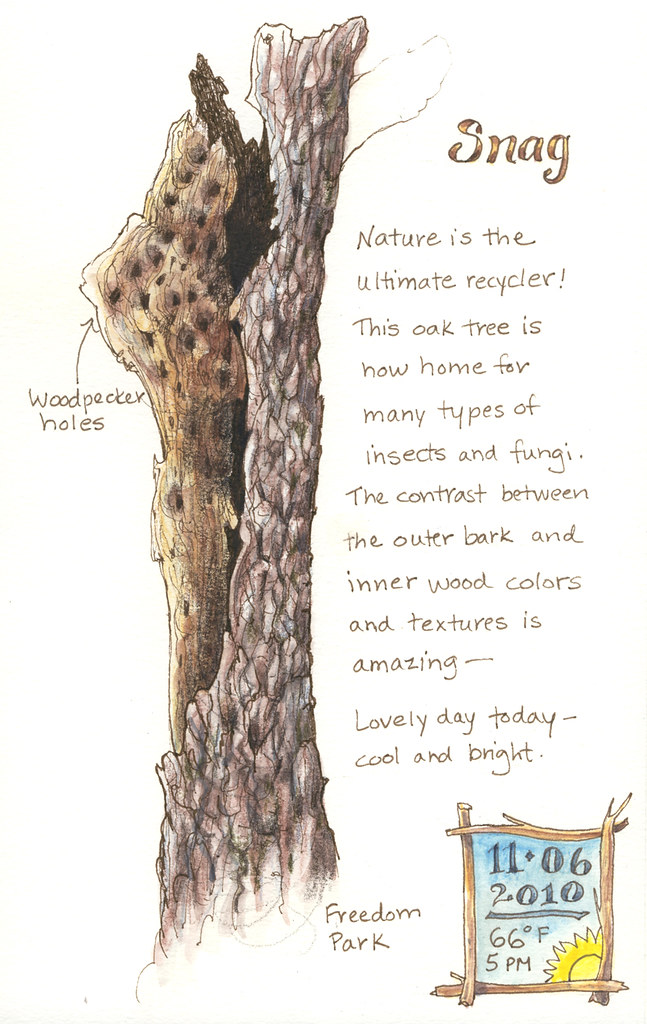
Tree snag


I confess to a fascination with dead wood, perhaps related to childhood memories of exploring woodpiles and decomposing logs. The echo of life is still there –I can imagine the seedling reaching for the sun, the unfurling of bud and leaf and inflorescence, the ripening of fruit or nut.

After death, another cycle of life begins – that of detritivores. On the microscopic level, bacteria and fungi colonize and start the breakdown process.

Invertebrates such as beetles, borers, and termites process wood nutrients or feast on fungi, and are feasted on in turn by vertebrates such as woodpeckers, anoles, and armadillos. Dead trees are used as homes by many species, including birds, bats, and squirrels.

This particular tree was an oak, probably a laurel oak. Something damaged it (lightning, a falling tree?), and the bark shows signs of regrowth round the split. The exterior bark and interior wood seemed to mirror each other, a glimpse of the past and present.

While nature may be extravagant, nothing goes to waste; all is consumed, refashioned, and repurposed – nature is the ultimate recycler.

You can click on the image to view it larger on my Flickr photostream.

Wednesday, November 3, 2010

Dahoon holly


Dahoon holly, originally uploaded by Elizabeth Smith.

Dahoon holly is a small, columnar tree often used in landscaping here in southwest Florida. Now that the berries are turning color, I’ve been noticing it in the wild as well, especially along roads that border wooded areas of pine and maple. Not only do the vibrant red berries catch my eye, but the pale gray trunks distinguish it from the noxious and invasive Brazilian pepper shrubs with similar-looking fruit.

I have always wondered what the word “dahoon” meant. Was it someone’s name? A place?   Daniel F. Austin in Florida Ethnobotany explains that it may derive from a French corruption of the Catawba word yaupon.  Before I confuse the issue further, There is a yaupon holly (Ilex vomitoria) that was thought to be used by native Americans in a ceremonial black drink. And yes, it’s said to induce vomiting.

Because the yaupon holly is similar to the Dahoon holly, Linnaeus grouped them together in the mid 1700's, which caused some classification muddiness. It’s thought that the French began referring to the slightly different holly as houx d’Ahon; Ahon being an altered form of yaupon (houx means holly in French). D’Ahon became Dahoon, and hundreds of years later we still call it dahoon holly.

Dahoon holly provides food for birds and small mammals, and bushy cover for smaller bird species. The trees are dioecious, which means that a tree is either male or female, with the female producing fruit. The berries ripen gradually, revealing shades of light yellow-green to amber to bright red, a feast for the eyes as well!

You can click on the caption above to view it larger on my Flickr photostream.

Tuesday, January 19, 2010

Red maple


Red maple, originally uploaded by Elizabeth Smith.

Since we're in Florida near the western coastline and the Gulf of Mexico, we don't often have to scrape the ice from our windshields before work! Last week we had three frosty mornings, with temperatures dipping just below the freezing point.

The freezing temperatures presented us with an array of dying leaves, some changing colors in magnificent ways. I'm glad I got to take a photo of this wonderful red maple and finish my sketch; today the tree has dropped nearly all of its leaves.

I wish I could share the colors of the leaves with you - at best this is an approximation. The dying maple leaves are even more glorious than the new foliage, which is sometimes a combination of red, purple, and bronze.

Other trees in the area are sporting browns and yellows; the cypresses are my next favorite, its needles turning from green to a golden rusty brown. In the meantime, our temperatures have warmed up considerably!

You can click on the image above to view it larger on my Flickr photostream.