![]() |
| Always alert. |
Sunday, August 14, 2022
Eastern cottontail rabbit
Sunday, July 17, 2022
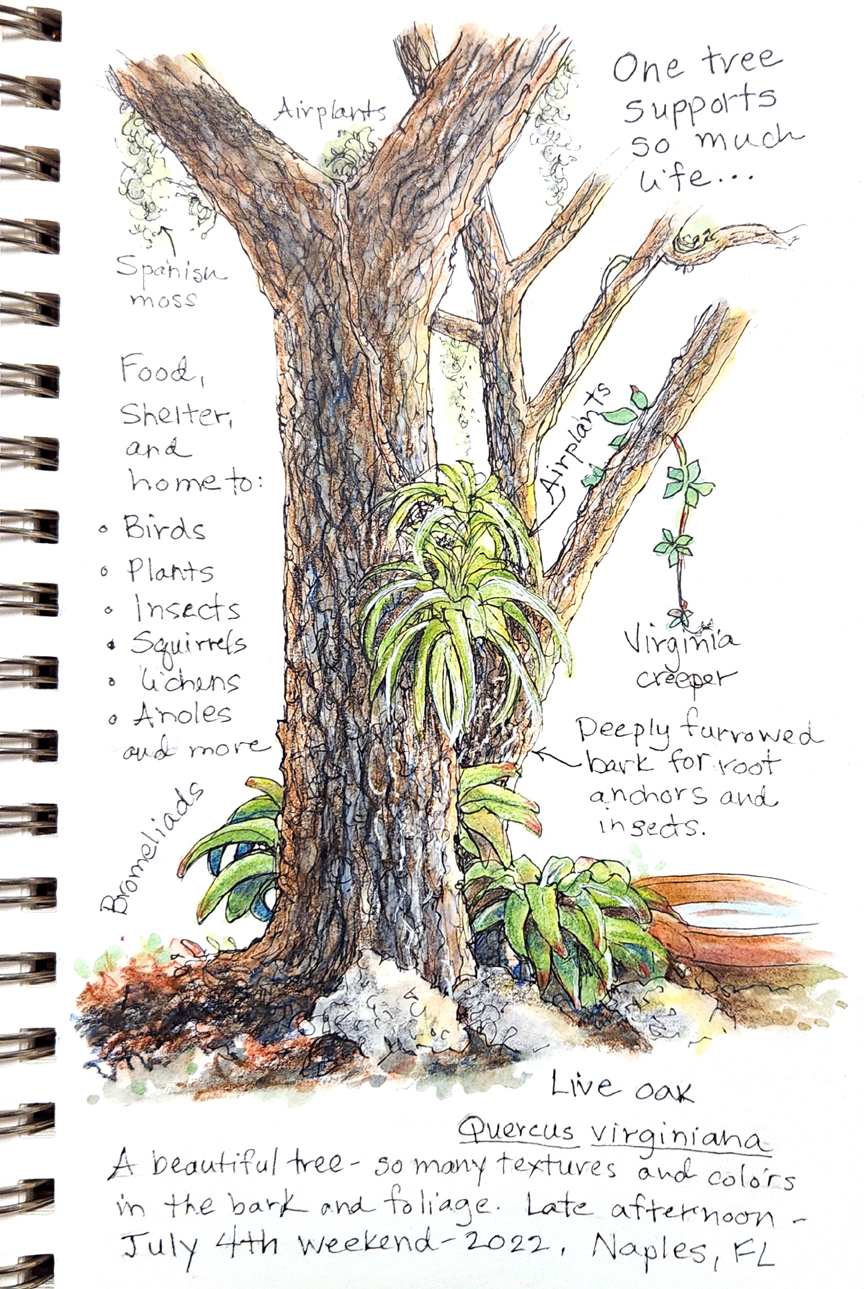
Live oak – a keystone species (and friend)
![]() |
| Click on image to view larger. |
More on oaks: There is much more to learn about oaks. For an overview on the many values of oaks (for nature and ourselves), I suggest you start by watching a presentation by Dr. Doug Tallamy on his book “The Nature of Oaks” on YouTube: https://www.youtube.com/watch?v=EdiUgB_3A9w
Monday, July 4, 2022
Midsummer Florida
Summertime in Southwest Florida has a rhythm of its own. It’s a pattern of heat and moisture and rain and cooling. It’s a time of luxuriant growth for the plants adapted to it. It’s also a time when I notice young lizards and birds and bunnies out and about, learning the ways of the world.
![]() |
| Storm coming. |
![]() |
| So much nature can be seen in suburban spaces. |
The flowers of spring are turning into fruits now – nearby I
see Simpson stopper ripening, seagrape (still green), cocoplum and more. June flowers are blooming of course: a casual
suburban observer might see common natives like Spanish needles, beach
sunflower, and duck potato easily. These
are just a few volunteers in the space I move within every day, the ones I
happen to stop and notice. I also see
the birds and their nests, an occasional small black snake, and young Eastern
cottontails (one every day!), and other signs of procreation and growth.
No matter what's going on in the human world, the natural world keeps marking time, finding its own rhythms, confirming new life. These are the drumbeats that feed my soul and the music that helps me make sense of life.
![]() |
| Munching on a bit of grass. |
Mechanical pencil .7mm
Micron Pigma 01, black
Aquabee Super Deluxe Mixed Media sketchbook
Daniel Smith watercolors, Botanical Floral half-pan set
Niji waterbush, round M
Saturday, June 25, 2022
Green heron
Just walking, I happened to veer to the small lake nearby and discovered a green heron intently gazing at the water’s surface. The heron perched on a concrete culvert in the bright sun on the edge of the lake, blue sky above, green water below. Rocking slightly in the breeze on bent, sturdy legs and anchored by long toes, waiting …waiting for a ripple in the water, a movement that might mean dinner.
![]() |
| Click on image to view larger. |
A fascinating item – green herons sometimes use tools to catch food, one of a few species that do this. They drop twigs, insects or other tidbits onto the water surface to entice fish to surface and feed within their reach. Debate may continue over definitions of tools and tool use, but many agree that this type of behavior indicates an increased intelligence.
Want to read more about green herons?
Wikipedia: https://en.wikipedia.org/wiki/Green_heron
Florida Fish and Wildlife Conservation Commission fact
sheet:
https://myfwc.com/media/19710/bba_grhe.pdf
ebird.org: https://ebird.org/species/grnher
Media
Aquabee sketchbook, 6x9”
.7 mm mechanical pencil
Micron Pigma Pen, black 01
Kimberly watercolor pencils
Niji waterbrush, Medium
Sunday, March 27, 2022
I am from: using nature memories to define who we are and to celebrate our unique sense of place.
The inspiration
Recently I came
across an article about the “I Am From” poem and the project that flowed from it. The poems moved me deeply as I read through
the unique and diverse experiences reflected in the poems people submitted. Some of them, very powerful and moving. The original poem and catalyst for this project was written by
George Ella Lyons. People are welcome to
submit poems to the project’s Facebook page and website, and have even created
videos for YouTube. They do this individually
or as a group. There is a wonderful video of a collaborative fabric art
project that not only celebrates each unique person, but creates a strong sense
of place as a whole.
Then I wondered if condensing
my focus to nature would also work and tried it out – you can read that result
below. This process inspired me to add
the words and resulting imagery to my nature journal. I loved the renewed connection to the nature
of my childhood and beyond, and drew with abandon, not worrying about tidy
lines or splashing color around!
This was such a memorable experience! I suggest you try it in your own nature journal. You can see that some of my sketches are uncomplicated while some have a bit more attention. Some reflect that inner child. Don’t worry about your skill level – just the basics, or even descriptive color swathes work. Both Clare Walker Leslie and Mimi Robinson have used color shapes alone to beautifully describe environments and seasons. Try it and see. There are also other ways to add visual imagery: photos, collage, prints, or ephemera such as pressed leaves or flowers, maps, tickets, fabric, and much more.
It is the deep
connection to place that matters, and the bits and pieces that echo place
besides the flora, fauna, and geology: the colors, smells, tastes, textures,
and emotions. These have created how we
view and interact with nature today. It
is a good thing to recognize the role they’ve played – and it is a good thing
to expand our views when we experience another’s memories.
![]() |
| Click to view larger. |
If you aren’t sure where to start, I offer you an exercise developed just for nature. The 2-page PDF can be downloaded HERE. One side has suggestions and prompts, the other has my nature poem plus links to the I Am From project website and Facebook page, plus YouTube videos.
Here is my “I Am From” poem.
I am from
knee-deep snowdrifts, frozen lashes, the searing breath of
winter.
Summertime poison ivy rash and itchy mosquito bumps
chasing butterflies and garter snakes
magical fireflies and a whippoorwill lullaby.
I am from
the indigo blue comfort after a midwestern sunset
the musty taste of black walnuts and joyful sweetness of
tiny wild blackberries
the bright flash of cardinal and a hummingbird’s glittering
eye.
Fluttering spring beauties with tiaras of columbines
and the thrum of bees in the clover.
![]() |
I am from
The mighty Mississippi,
a languid longing below
the stink of fish and duckweed
and the thrill of snapping turtles.
River bottom land, and banks and bluffs of stacked
limestone.
I am from
sturdy oaks and maples,
deer trails and owl pellets
under improbably green new leaves, so delicate, glowing.
Standing in prairie grasses filled with tiny treasures
and the wind in my hair.
Media
Aquabee Super Deluxe 6x9” mixed media sketchbook (double spread)
Daniel Smith watercolors
Micron Pigma 01 black artist pen
Sakura Gelly Roll white gel pen 10
On the web:
I Am From Project website: https://iamfromproject.com/
I Am From Facebook page: https://www.facebook.com/iamfromproject/
Additional YouTube videos:
I Am From | Celebrating Hispanic Heritage Month by Juan Delgado, https://www.youtube.com/watch?v=XFtXf1bAC-E
I Am From...A Poem by Aaric Pelc, https://www.youtube.com/watch?v=TVryvxLTIyU
And a collective project by participants of the 2020 Whole Child, Whole
Day Social Emotional Learning Symposium:
https://www.youtube.com/watch?v=PRM0-fdEJX4
Wednesday, March 16, 2022
A connection to place
I think we’ve all known special places that have deep meaning for us personally.
It feels like a time to let life unwind, and a place to rest
and heal.
A sacred place.
Media:
Paper - unknown mass-produced watercolor paper pad, about 8x10"
Watercolor paint, probably Grumbacher and/or Winsor &
Newton
(the colors still
surprisingly bright after almost 40 years)
Craft brushes
# 2 Pencil
Friday, November 26, 2021
Mistflower
“The smallest flower is a thought,
a life answering to
some feature of the Great Whole...”
~ Honore de Balzac
There is
a wildflower I’m especially fond of that comes up along the edges and unlikely
places in my yard, and starts blooming in late summer. It always makes me happy to see the tiny
toothed leaves emerge from the ground, because I know that they’ve reseeded and
will do just fine with absolutely no help from me. It’s still blooming in late November but
going to seed. The common name is Mistflower;
these have blooms of lavender and soft violet, and from a distance the many
stamens and coloring sometimes gives the appearance of distant mist drifting
over the ground.
I’m often fascinated by the self-similarity of its leaves. Each tiny leaf a miniature of the largest. You could argue that many plants are like this (and some are), but it’s the way these branch and divide and arrange its heart-shaped leaves that captivates me. I’m not good at fractal geometry, but I enjoy how Mistflower shows up in the world. If you don’t know fractals, here is a partial definition from the FractalFoundation,org: “Fractals are infinitely complex patterns that are self-similar across different scales.”
![]() |
| The tiny leaves are miniatures of the largest leaves. |
Patterns
appear everywhere in nature – some seem random, and some quite precise. Some patterns depend on the macro or the
micro view. When I think of self-similar
things, I’m reminded of mineral structures.
I know, an unlikely sideways jaunt from botany to geology – but this is
one of the things I love about nature journaling. I never know where it might take me.
Those who
know me well, know that I also love rocks.
Geology is a huge part of the why of things, but that’s a subject for
another time. One of the more interesting
things I’ve learned is that the atomic structure of a mineral is reflected in
the external crystal structure. In other
words, we can look at pure salt crystals in our hand and predict that we’ll see
similar crystal shapes under the microscope.
This is because they fracture along specific structural lines. Other minerals and impurities can change
this, but generally the microscopic pattern determines the real-world
pattern.
I don’t
know enough to say that this is what happens in the plant world, just saying
that the natural world is an amazing place and full of unexpected patterns and
connections. We just have to change our
viewpoint. Do you find yourself fascinated by patterns as
well? What connections do you make?
![]() |
| My nature journal page. |
- Micron Pigma 01 pen
- Kimberly watercolor pencils
- Aquabee Super Deluxe drawing paper 93 lb.
For more
about Mistflower
From Florida
Wildflower: https://flawildflowers.org/flower-friday-conoclinium-coelestinum/
Dip into fractals
Fractals in nature from Dave’s Garden:
https://davesgarden.com/guides/articles/view/1966
Fractals in everything: https://news.globallandscapesforum.org/43195/fractals-nature-almost-all-things/
A long but
fascinating article on why fractals resonate with us:
https://www.theatlantic.com/science/archive/2017/01/why-fractals-are-so-soothing/514520/
Dig into mineral
structures
Cleavage and fracture properties explained in
easy-to-understand language on page 4:
An open textbook, in-depth on crystal morphology: https://opengeology.org/Mineralogy/10-crystal-morphology-and-symmetry/
Wednesday, April 14, 2021
An experiment in nature writing – changing a two-letter word
I recently attended a one-hour online writing workshop with Rebecca Rolnick, where she led us in an exploration of “the grammar of animacy." This phrase shows up in a book called Braiding Sweetgrass by Robin Wall Kimmerer, which I’ve been reading off and on for the past few months. It’s taking me a while to read because every page requires a day of reflection! The full title is Braiding Sweetgrass: Indigenous Wisdom, Scientific Knowledge, and the Teachings of Plants, so that gives you an idea of the scope.
![]() |
| Nature journal sketch and poem. Click to view larger. |
What is animacy?
Animacy refers to a feature of language that expresses the “aliveness”
or sentience of something. For
me, the word sentience represents awareness and a capacity for feelings and conscious
action. We tend to think of a thing as either animate
or inanimate, but there are gray areas involved when it comes to personal
meaning. Reflect for a moment on how you
think about the natural world, and how you relate to the essence of something
within it. Do birds have feelings? How aware are bees? Can trees communicate?
The old two-letter word
There is a degree of scale involved here, and a built-in order
of importance when it comes to pronouns.
The idea of “it” vs “he” or “she” is an expression of the degree of animacy. Things in nature are typically an “it”. We typically use the pronoun “it” to refer to
rocks, trees, birds, panthers and porcupines.
People are seldom referred to this way, and when they are it has a
negative meaning.
It seems that animacy used in everyday language in my culture is based not so much on how sentient a thing is, but on its relevance to the speaker. For example, someone may refer to a cat as “it” but a dearly loved pet is nearly always a she or he. They are important to us, they are relevant – they are family.
I too speak and write like this, in spite of a feeling of kinship with living things (which include a deep-seated feeling that rocks have awareness). “It” is what I’ve been taught – the good grammar of communication. Not to mention that the word “it” is a useful, multi-meaning and functional term.
The new two-letter word
After a conversation on the idea of animacy, the words we
use, and the meanings we give them, Rebecca spoke of a new pronoun for nature
proposed by Robin Wall Kimmerer to replace the “it” pronoun when referring to things
of nature. We needed a word that signifies
animacy.
In a 2015 essay for Yes! Magazine, Robin relates how Stewart King suggested to her that the proper Anishinaabe word for “beings of the living Earth” would be Bemaadiziiaaki. Stewart was a Potawatomi elder and spiritual teacher who mentored Robin’s return to her Native American roots and ancestral language. Robin shortens Bemaadiziiaaki to two new pronouns “ki” and “kin”. Ki takes the place of it, he, or she. Kin replaces the plural pronoun they.
As part of our writing exploration last week, Rebecca challenged us to try using these pronouns.
I tried using ki as a nature pronoun instead of “it”. Not to humanize nature, or to drape my subject with an anthropomorphic cloak, but to see if there was a difference. I had been thinking about a poem to go with a recent nature sketch, but the pronoun for my imagined birdling showed up only once. I went ahead anyway and substituted ki for it.
Was there a difference in how I felt? Yes.
What happened?
No trumpets sounded, but somewhere in the sub-basement of my
consciousness, I felt a tremor.
Something shifted (in a positive way).
Because it’s still dark down there, I’m not sure what happened. As I’ve gotten older, I realize that I tend
to process profound emotional changes through my physical body, and this was a
core body feeling.
So… something did change, felt in heart and body. I feel a new closeness, a deeper link that’s hard to describe. I’m already reevaluating my relationship to nature and the responsibilities that emerge when kinship ties deepen. Every rock I’ve collected, every plant transplanted and seeds sown where kin have no business living.
I have to stop thinking at some point because I am
overwhelmed.
Will changing my nature pronouns change how I think and speak and write and live? I hope so. Using ki and kin signifies something – connections strengthened, a sense of family instilled. We treat friends differently than strangers. But habits are persistent, and the old ways tend to creep back in. Perhaps with this bit of awareness, I’m making a place for ki and kin until they become old friends.
Want to explore more? Here are some links for you:
The workshop
The title of the online workshop is Nature
Journal Writing Workshop Wednesdays, led by Rebecca Rolnick, a biologist,
writer, and environmental educator. The
workshop is open to anyone and free, with a donation option. During the one I attended last week, an idea
was discussed, then we explored the concept with a short writing time, and
ended the hour by sharing our words.
The book
Braiding Sweetgrass: Indigenous Wisdom, Scientific
Knowledge, and the Teachings of Plants by Robin Wall Kimmerer. https://en.wikipedia.org/wiki/Braiding_Sweetgrass
Essays by Robin Wall Kimmerer
“Nature Needs a New Pronoun: To Stop the Age of Extinction, Let’s Start by Ditching ‘It”’
Yes! Magazine, March 30, 2015. https://www.yesmagazine.org/issue/together-earth/2015/03/30/alternative-grammar-a-new-language-of-kinship
I’d love to know your thoughts on animacy. What do you feel or think or have experienced?
Sunday, May 31, 2020
International Nature Journal Week starts June 1st!
![]() |
| Common violet, click to view larger. |
Every time I sketch something, I deepen my relationship with my subject by experiencing it differently. I find myself asking questions and thinking more deeply. I get to know my subject on a personal level.
![]() |
| Coral honeysuckle - loved by butterflies and hummingbirds! |
Here is some inspiration to get you and your family started!
![]() |
![]() |
| Getting started PDF - quick ideas | Fun ideas for kids - PDF |