Showing posts with label Simpson stopper. Show all posts

Monday, July 4, 2022

Midsummer Florida

Summertime in Southwest Florida has a rhythm of its own.  It’s a pattern of heat and moisture and rain and cooling.  It’s a time of luxuriant growth for the plants adapted to it.  It’s also a time when I notice young lizards and birds and bunnies out and about, learning the ways of the world. 

Cumulus congestus clouds
Storm coming.

  Our rainy season typically starts the first part of June, sometimes late May.  The days are hot, spilling over with intense bright light as the clouds start forming.  Smaller cotton-ball clouds gather and grow from the moisture that evaporates and rises from the warming land and earth-bound waters.  Boundless clear blue skies start filling up with towering cumulus clouds, sometimes building many miles upwards.

 The clouds roll in from the Everglades, sunlit white, gathering colors of violet, blue, and dark gray along the bottoms and up through the centers.  The air feels a bit cooler when the clouds hide the sun, but it’s still quite humid.  When water saturation reaches a critical point, the rain starts, typically late afternoon.  The other night we had torrential rain off and on for hours – along with booming thunder and sporadic lightning.  Abundant water recharges our underground aquifers, and brings on an explosion of plant growth.


Summertime anture journal page.
So much nature can be seen in suburban spaces.

The flowers of spring are turning into fruits now – nearby I see Simpson stopper ripening, seagrape (still green), cocoplum and more.  June flowers are blooming of course: a casual suburban observer might see common natives like Spanish needles, beach sunflower, and duck potato easily.  These are just a few volunteers in the space I move within every day, the ones I happen to stop and notice.  I also see the birds and their nests, an occasional small black snake, and young Eastern cottontails (one every day!), and other signs of procreation and growth.

 This is our lazy summer rhythm, the days hot and humid, then the clouds and rain, cooler but wet.  Nothing drenches and soaks to the bone like a Florida summer rain.  We’ve just passed the Summer Solstice and the days still feel long, although they are starting to shorten.  Our rainy season continues through the lingering months of July, August and September, and by mid-October I imagine a massive collective sigh of relief among residents.  We may still have the potential for tropical storms and hurricanes until the end of November, but at least we’ll be more comfortable.

No matter what's going on in the human world, the natural world keeps marking time, finding its own rhythms, confirming new life.  These are the drumbeats that feed my soul and the music that helps me make sense of life. 
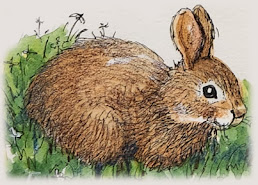
Eastern cottontail drawing
Munching on a bit of grass.

Media:
Mechanical pencil .7mm
Micron Pigma 01, black
Aquabee Super Deluxe Mixed Media sketchbook
Daniel Smith watercolors, Botanical Floral half-pan set
Niji waterbush, round M

Friday, July 5, 2019

Simpson’s Stopper or Twinberry


My nature sketchbook nestled in the Simpson Stopper, you can see a bit of the trunk on the left.

A favorite of people and wildlife
Simpson’s Stopper is one of my favorite native small trees or large shrubs.  I have two growing now, one a veteran of 20 years and the other a small 3-year old transplant.  I planted this for wildlife, but also because it’s pleasing to look at and needs little maintenance from me. 
Wildlife loves it because of the berries and cover.  A mockingbird and blue jay take turns staking it out when the orange-to-red berries ripen, and the bees and butterflies seem to appreciate the fragrant white flowers that come before.  Simpson’s Stopper even has lovely ornamental trunks (cinnamon and gray markings with decorative peeling) and bright green shiny leaves of varied shapes. 
A story of names
It’s called Simpson’s Stopper because it was named in honor of Charles Torrey Simpson, a contemporary of Dr. David Fairchild (whose plant  collection later became Fairchild Tropical Botanic Garden).  Charles was a self-taught naturalist, a specialist in molluscs and botany, and an author and conservationist who made his home in southeast Florida in the early 1900’s.
The name “stopper” is said to have two possible origins.  The first is that it was used as a medicine to treat flu-like symptoms and to stop diarrhea.  The second is that the multiple trunks make it difficult to pass through a hedge or thicket – thus stopping anyone who tries.
It’s also called Twinberry because the flowers and subsequent fruits are borne on a “Y” shaped stalk – twins.  It’s sometimes called nakedwood – self-evident because of the smooth bark on the copper, gray, and tan trunks. 
Many stamens indeed!
The scientific name is Myricanthes fragrans.  According to The Names of Plants by D. Gledhill, Myriacanthus means “with very many thorns”,  Myriandra means myriad stamens, and Myrica and fragans mean fragrance.  I think we can agree that somewhere in there the many-stamened fragrant flowers fit these definitions.  It’s said that the thorns refer to the stamens (there are no thorns at all on this tree).  Because of the dynamic nature of botanical re-classification through the years, older texts refer to this species as Eugenia simpsonii, which is where the Simpson name emerges.
And more
Simpson’s Stopper is native to south Florida and found throughout within the Caribbean, Central America and northern South America. It is salt tolerant and will grow in coastal areas further north. Once established, little care is needed – mine seems to thrive on benign neglect. 

Because Simpson's stopper is a threatened plant species, collecting from the wild is a no-no. Florida has several native plant nurseries and organizations that will happily set you up with a seedling or more mature specimen. My original shrub was purchased through a local chapter of the Florida Native Plant Society, a great source for plants as well as knowledge. 


Resources you may like to visit to know more:  


Florida IFAS extension plant information: http://gardeningsolutions.ifas.ufl.edu/plants/trees-and-shrubs/shrubs/simpsons-stopper.html

Green Deane on the edibility of Simpson’s Stopper (and more interesting tidbits):
http://www.eattheweeds.com/myricanthes-fragrans-nakedwood-twinberry-2/

The Naples Chapter of the Florida Native Plant society
http://naples.fnpschapters.org/
Media
Aquabee sketchbook, 6x9”
.7 mm mechanical pencil
Pitt artist pen, dark sepia size S
Daniel Smith watercolors
Round brushes, size 4 and 8

Thursday, July 15, 2010

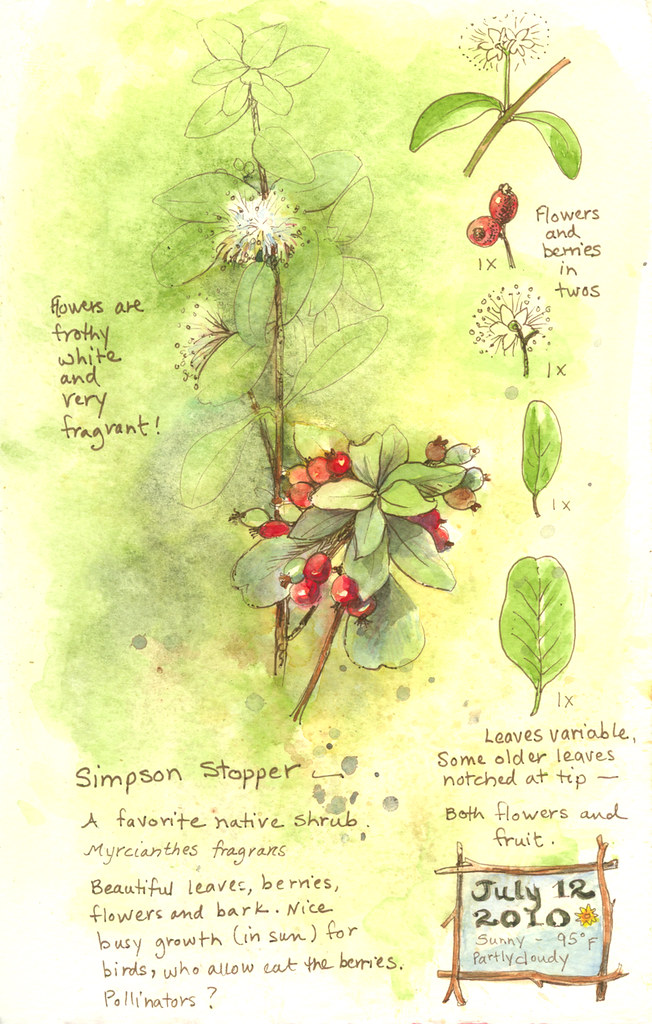
Simpson Stopper


Simpson Stopper, originally uploaded by Elizabeth Smith.

Simpson stopper is blooming and fruiting now; the flowers are incredibly fragrant! This is a quick sketch on cold-press watercolor paper with my Sakura Micron Pigma sepia pens.  I added some watercolor washes during and after. 

Rather than trying to be precise, I tryed for a more emotive style. Ha! Somehow I still reverted to drawing the leaves and flowers in a more descriptive way.


You can click on the images above to go to my Flickr photostream, where you can view them larger.  If you'd like to see a more precise sketch of this shrub or small tree (leaves, bark, and berries) you can click here.  Thank you for visiting!