Showing posts with label butterfly. Show all posts

Tuesday, November 4, 2014

Cassia


My Cassia shrub has suddenly started blooming like crazy!

 Keeping a nature journal and the subsequent quest for deeper knowledge led me to discover that this native is not as advertised!  I planted this about two years ago, and was thrilled to see it covered with flowers this fall.  The butterflies and caterpillars love it, and the bright yellow buds and blooms all over this five-foot rambling shrub lighten the heart. 

The right-side-up view.
As always when I sketch something, I start wondering about it.  I wondered what kind of caterpillars were on it – I was used to seeing the green caterpillars of sulphur butterflies, not these bright yellow creatures.  One thing led to another, and as I read more in depth about this shrub, I realized that I probably purchased one of the non-native Cassias.  After much reading, counting leaves, and comparing leaf shapes, I’m sure of it.  Apparently mislabeling happens quite often with some species, especially this one.

According to my reading, the Florida native is Senna mexicana var. chapmanii, and I believe the one I have is Senna pendula, which is discouraged as it can become invasive.  Yikes!   But it’s so beautiful…

A side view of the bloom.
Cassias go by many common names: Yellow Candlewood, Rambling Senna, Christmas Senna, Golden Shower, Christmas Cassia, and Bahama Cassia, and (of all things) the Scrambled-egg Tree.  The terms "cassia" and "senna" are often used interchangeably, since these plants were once classified under the genus Cassia.  They reside in the very large bean family, Fabaceae (also Leguminosae), which is the third largest plant family in species behind the orchid and aster families.  The bean family contains immensely important species used by humans for millennia for food, forage, fertilizer, flowers, and clothing dyes. 

Its yellow color is related to diet.
Cassias also provide larval and nectar food for several species of sulphur butterflies in Florida: the Cloudless Sulphur, Sleepy Orange, and Orange-barred Sulphur.  The caterpillar I found munching away is an Orange-barred Sulphur, and interestingly enough, its yellow color derives from eating the bright yellow Cassia buds and flowers! 


The sketch was done in my:
Aquabee Super Deluxe  spiral-bound sketchbook
9x6 in, (22.86 x 15.24 cm), 93 lb. paper,
Sakura Micron Pigma pen 01,
and Daniel Smith watercolors.

For more online reading:
Floridata on the Cassia species I believe I have. 
From Heuristron, Orange-barred Sulphur emerging from its chrysalis.
Fact sheet on another non-native Cassia from the University of Florida IFAS Extension


Saturday, October 18, 2014

Pipevine and Polydamas

Even a month and a half later, both pipevine and caterpillars are still going strong!


This pipevine (Aristolochia species) isn’t one of our Florida natives (we only have one that I know of), but I enjoy seeing the swallowtail butterflies fluttering around it.  Why would pipevine attract swallowtails?  It’s not the nectar, although the very odd, weirdly-but-possibly-pipe-shaped flowers seem like they would hold pools of delicious nectar or pollen.  It’s the leaves, especially the soft young leaves at the ends of the new vine tips. 
As you’ve probably guessed by now, pipevine is one of the larval foods for swallowtail butterflies, in my area attracting the Polydamas swallowtail, Battus polydamas. 
The pipevine
A series of posts (or even books) could be written about this unique species.  I’m fascinated by every part of it, from its strange blooms, to its intriguing seed pods and heat-shaped leaves.  This species grows from seed easily, and is now reseeding itself nearby (I see the tiny vines starting in several places).  The leaves are a symmetrical heart shape (cordate to botanists) with slim petioles. 
The blooms give the plant its common name of pipevine or Dutchman’s pipe, as they are thought to resemble a curved pipe stem of a Dutchman-style pipe; think of Sherlock Holmes and his ubiquitous pipe. The flowers are fleshy and curvy, the colors a gradation of pale green near the stem with intricate burgundy patterns over pale yellow or cream on the lips.  The flowers on this vine are about 3 inches by 2 inches, but variable in size, like the leaves.
Young pipevine leaf.
The seeds are spread by the open seed pods, which are shaped like parachutes complete with suspension lines!  These tiny parachutes hang upside down, waiting for the wind or a passerby to jostle the winged seeds out of their nest.  Once out, the winged seeds float to the ground, hopefully to fertile soil.
Pipevine seems to thrive on little care.  Also called calico flower and birthwort, its been used in herbal remedies for childbirth ailments, arthritis, edema, and as a disinfectant.  Pipevine contains the toxin aristolochic acid, which is what gives the swallowtail caterpillars and butterflies their survival edge, as they become both toxic and distasteful.    
Some Aristolochia species are invasive, so don’t let me encourage you to plant these everywhere!  
Wingspans of the butterflies in my yard are about 3 to 3.5 inches wide.
The Polydamas butterfly
Also called gold-rim swallowtail, the Polydamas butterfly is the only tail-less swallowtail in the eastern United States.  They are a tropical species found in peninsular Florida, the Florida Keys and the Bahamas.  Occasional strays may wander as far north as Missouri and Kentucky.  Once of our black and yellow butterflies (a tropical adaptation?), the upper surface of the wings is black with yellow bands along the margins.  The underside of the wings is black, with yellow spots on the top wing and bright orange to red spots on the bottom wing.

The black, brown, and orange caterpillars emerge from small yellow eggs and begin their gastronomical   From there on, it’s all about eating the tender young pipevine leaves until it’s time to create the chrysalis.  The chrysalis may be brown to gold or green – but I’ve noticed that the green ones turn brown right before the butterfly emerges.  I’ve been waiting to post this, as I keep hoping to catch one in action as it emerges, but they’re too quick for me!  Be sure to watch the two YouTube videos from the links at the bottom for a close-up view of the transformation from caterpillar to chrysalis and then to butterfly – very cool!
Caterpillars are brown to black in color.
adventures by consuming the egg shells.
The sketch was done in my
Aquabee Super Deluxe  spiral-bound sketchbook
9x6 in, (22.86 x 15.24 cm), 93 lb. paper,
Sakura Micron Pigma pen 01,
and Daniel Smith watercolors.

The top wings are black with golden rims.
For more information on the web:
 University of Florida, with photos of eggs, caterpillars, and host plants.  
Wikipedia on swallowtail butterflies in general.  
Biokids from University of Michigan on swallowtails in general.  Brief but concise paragraphs covers many aspects of butterfly life.  
Butterfly fun facts, photos and facts about polydamas or gold rim  and photos of the osmeterium of different swallowtails.  
Floridata. About pipevines.
Heuristron, with photos here for butterflies   and here for pipevine photos.  
YouTube video from caterpillar to chrysalis!  
YouTube video from chrysalis to butterfly!  

Sunday, May 20, 2012

Zebra longwing butterfly

A zebra longwing butterfly fluttering among the passionvines.
All this month I've been seeing large numbers of zebra longwing butterflies gathering around the seagrape tree in our front yard.  I became curious, and this weekend decided to investigate.  Mystery solved: a native passionvine had crept up the seagrape trunk and into the leaves over my head.  Passionvines are the larval food plant for a group of butterflies called longwings, of which the zebra is one, and this particular passionvine had been stripped bare of most of its leaves.

I settled myself and looked for details among the brown and green vines hanging from the branches.  I soon spotted a spent chrysalis, then another, and another. A zebra longwing's chrysalis is dull brown with darker brown markings, resembling a dried-up leaf.  I cut one down from above my head in order to take a closer look, and it started a vigorous swinging motion in my hand.  I nearly dropped it!  This chrysalis was still occupied, with its inhabitant attempting to scare me away so I wouldn't eat it.

Doesn't this chrysalis resemble a dried leaf?  Or an alien life form?

The chrysalis body is about one inch long, with feathery-looking "tails" and four iridescent metallic spots on the concave portion.  I'm guessing that I've been seeing the butterflies as they emerge from their chrysalis, and then perhaps when they return to lay eggs on the passionvine.
Zebra longwings have "zebra stripes" in a distinctive yellow and black pattern, making them easy to identify.

Some interesting facts about zebra longwing butterflies:
  • It is the official Florida State butterfly.
  • Zebras fly in slow, lazy, swooping paths.
  • They roost in small communities at night, hanging down from a tree branch or similar perch.
  • It's larval food (passionvine) makes both the caterpillar and the butterfly taste bad to predators.
  • They live longer than many of our other butterflies - sometimes up to six months.
  • Caterpillars feed exclusively on members of the passionvine family.
  • Zebra butterflies feast on nectar and pollen. Protein in the pollen contributes to their long life span.
  • They are  brush-footed butterflies, which means that their two front legs look like small brushes.  This is how they taste plants.
  • They can be found throughout Florida (especially south Florida), and range into Texas, Mexico, and Central and South America.
  • The caterpillars are ferocious-looking: a white body with black spines all over, and orange-brown feet.  The spines are harmless.
  •  The newly laid eggs are tiny yellow oval-shaped spheres, usually found on the tender tips of young passionvine leaves and tendrils.

    Zebra longwings are one of my favorite butterflies.  In the wild, they are a resident of hammock areas, but are equally at home in parks and home gardens.  All they need are the basics - a food source (for both caterpillar and butterfly), water, and shelter.

    For more information on zebra longwing butterflies:

    For teachers, parents, and kids:
    National Geographic's Kids Puzzler  (Zebra longwing puzzle or slider game to do online)
    Longwings coloring page (from my blog)
    Zebra longwing vocabulary words Word Search puzzle (from my blog)

    My nature journal sketches were done on Stillman & Birn Beta Series paper,
    with a Pitt Artist pen in black, XS size, with Daniel Smith watercolors.


    Wednesday, August 31, 2011

    Longwing butterflies


    Longwing butterflies, originally uploaded by Elizabeth Smith.

    This month I've noticed many small passionvines thriving: climbing up shrubs and sprawling over the ground. These passionvines have an undistinguished small flower, and bear small purple fruits. I'm sure that some are the native corky-stemmed passionvine because of the mottled brown and corky base of the vine. Others I'm not so sure of – partly because the leaves are so variable, and the corky-stemmed version doesn't always have a corky stem when it’s young.

    I see some with three-lobed skinny leaves, some with fat lobes, and then there are the plants suddenly sporting “mitten” leaves. One plant has no lobes at all, just a pleasant oval leaf shape. They all attract these three butterflies, the Julia, Gulf Fritillary, and Zebra longwing. The attraction is a chemical that renders the caterpillar (and butterfly) distasteful to predators. So the butterflies identify this helpful plant (through sensors in their feet), and lay their eggs.

    All three of these butterflies have elongated upper wings, hence the common name of longwing. The caterpillars are different colors, but each species has wicked-looking spines in rows along their bodies. They are for looks, though; the spines are harmless.


    The Julia butterfly is often a bright orange on top, but can also range to a soft ochre color. One year it seemed to be the summer of the Julia butterfly – there were Julias everywhere. Other times they seem scarce and are hard to find. They fly quickly, often zigzagging all over the place.

    The Zebra Longwing is the Florida state butterfly. Its easy to identify, with its long black wings with yellow stripes and spots. Zebras like to fly more slowly, almost lazily. They also have an interesting bedtime habit – at night they fold their wings and roost communally on a branch or tree. One year a small community chose a nearby firebush as their night roosting spot, and I could get quite close to them at dusk. What an experience to creep up on thirty or forty butterflies all hanging down from a dead branch!

    I've sketched the Gulf Fritillary before in this journal. They've been plentiful the last two summers, even though the butterflies in general seem to be fewer in number. This butterfly is bright orange with black markings on top, but oh so different below. Underneath, the wings are spotted with patches of silvery iridescence. Where Zebras prefer more shade, these butterflies seem to enjoy open sunny areas with a bit of cover.

    Thanks for visiting! You can read a bit more about these butterflies at the links below.

    Teachers, students, and parents: 
    Please click here for a free down-loadable PDF coloring page of these butterflies.

    You can also visit my Flickr photostream for more of my visual nature journal entries.
     
     Zebra Longwing in Wikipedia
     Gulf Fritillary in Wikipedia
     Julia at Floridata

    Sunday, May 8, 2011

    Happy Mother's Day!

    For Mother's Day: a watercolor of a White M Hairstreak butterfly.  Can you find the "M"? 

    I painted this for the North American Butterfly Association's Count Report; they solicit volunteer artwork each year for the annual report that they can reproduce in black and white.  I'd like to thank Sharon Wander for giving me permission to use her wonderful photo as a reference.

    Happy Mother's Day, and thank you Mom, for making a difference.
    

    Saturday, January 1, 2011

    Gulf Fritillary Butterfly


    Gulf Fritillary Butterfly, originally uploaded by Elizabeth Smith.

    I’ve read that in the winter months, Gulf Fritillaries migrate from southern US states into the south Florida peninsula. Maybe that’s why I’m seeing so many of these brightly colored and patterned butterflies lately. Or perhaps it’s the new growth of Passiflora species I see popping up throughout my yard. Gulf Fritillaries use Passiflora as a larval food as well as a nectar source, and I often see the butterflies and caterpillars near this plant.

    My model for these studies was found on the ground, possibly a victim of one of our recent freezing temperature dips. I was sad to find it dead, but happy to be able to observe it closely and sketch it from different angles. If you’d like to see an earlier journal entry showing the Passiflora leaves, and the Gulf Fritillary caterpillar and chrysalis, please click here.

    To read more, see beautiful photos, and learn some interesting facts about the Gulf Fritillary butterfly, please visit these links:

    University of Florida IFAS

    Tree of Life

    Butterfly Fun Facts

    Wikipedia

    You can also click on the caption under the image to view it on my Flickr photostream.  A very happy New Year to my online friends!

    Sunday, August 29, 2010

    Cumulus clouds


    Cumulus clouds, originally uploaded by Elizabeth Smith.
    Every day this time of year our skies start out fairly clear and blue. Then the clouds start to build, usually puffy clouds, turning into towering cumulus. Towering cumulus can assemble themselves into cumulonimbus – tall, tall skyscrapers of misty water droplets that return to earth in tropical downpours. These clouds can tower for miles, up to 40,000 feet!

    This time of year I also see a lot of butterflies: Sulphurs of all types, Whites, Gulf Fritillaries, Viceroys, White Peacocks, Swallowtails…a riot of fluttering color. It seemed appropriate to add a Sulphur against the clouds, since I see so many pairs of them dancing and swirling up in the sky lately.

    You can click on the image above to see it larger on my Flickr photostream.

    Sunday, August 1, 2010

    A Florida Walk


    A Florida Walk, originally uploaded by Elizabeth Smith.

    I took a walk this morning, down our neighborhood bicycle path and sidewalk. It’s probably not that much different from your neighborhood – filled with trees, plants, birds, and butterflies of one sort or another. It always amazes me the amount of life that abounds in even small areas.

    When I got home from my walk I did a memory sketch – a composite of those things that I most vividly remembered, but believe me there was so much more left out! For example, I didn’t see any birds, but they were singing and calling and fussing all around me: crows in the pines, blue jays in someone’s backyard, mockingbirds in the cabbage palms, and somewhere… the “chip, chip” of a cardinal.

    My drawing is a bit off in some areas, but free-sketching like this helps strengthen my observation and drawing skills. My snake is pretty symbolic, and the Virginia Creeper leaf is really not shaped like that. By the time I added that, all I could remember was “five lobes.”

    Anyway, I hope you enjoy a vicarious outing in Southwest Florida. At least with a virtual walk there is no heat and humidity!

    You can click on the image above to view it larger on my Flickr photostream.

    Saturday, September 12, 2009

    Keeping a nature art sketchbook

    I like to draw, paint, and write short notes about the natural world around me – it might be a leaf, or an insect, or a habitat. We all see things just a little bit differently than our friends; we each have a unique viewpoint. When an artist draws, he or she also edits what they present on the page.

    For example, if you drew a picture of your house, you might not draw every window and door. You pick out what you want to show. Drawing and writing is also about learning, it’s a process. Writing about your observations is a further exploration, making connections that are important to you, in your own words. Your words might be direct observations, a story, or your personal feelings about the subject.

    Let me share a bit of my process and how I approach drawing the natural world around me.


    First, observation. Everything has a story behind it. Sometimes I think of this as being like a nature detective. Sometimes we can find out more just by asking little questions and then moving to big questions. This is part of my observation. I might also write notes, and make little “map” sketches about it. All of these things help me draw a better picture.  
    1. Who? Do I know the name of my subject? If not, can I guess?
    2. What? Do I know what it is? What does it eat? What color is it? What shape is it?
    3. Where? Where did I find this or observe it? Where might it live?
    4. Why? Why is it here? Why does it exist – what is its purpose? Why is it this color and shape?
    5. When? When was this found or observed? What time of year? Write the date…
    6. How? How does it function? Survive? How many leaves? Legs?
     Can you see how asking and answering those questions made me more aware? You probably added a few more questions of your own. You can also ask these three additional questions that will guide you in your notes, research, and future drawings: 
    1. What do I already know about this?
    2. What do I want to learn about it?
    3. What did I learn?
    Get comfortable, look at your subject again for a minute, become the nature detective, ask some questions of yourself, then draw!

    Clicking on the above image will take you to my Flickr photostream, where you can view this larger.

    Friday, September 11, 2009

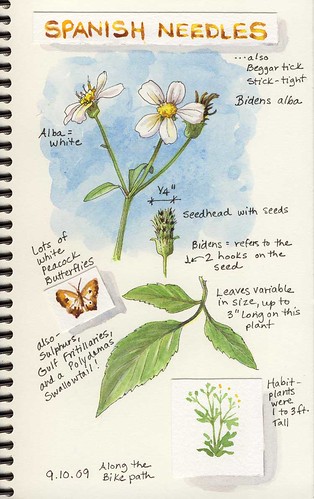
    Spanish Needles


    Spanish needles, Aster family

    Hated by hikers and gardeners, beloved by butterflies

    Right now these scruffy wildflowers (or weeds) are growing and blooming like crazy. The butterflies are feasting! They’re also setting seed, those troublesome little slivers with hooks on the end that hitchhike onto our sneakers, socks, cuffs, and pets. I read that one plant can produce 1250 of these seeds!


    Once one plant gets a foothold in your garden, it seems they show up forever after. They’re still attractive to me; they are survivors and cheery-looking, and anything that attracts so many butterflies can’t be all bad!