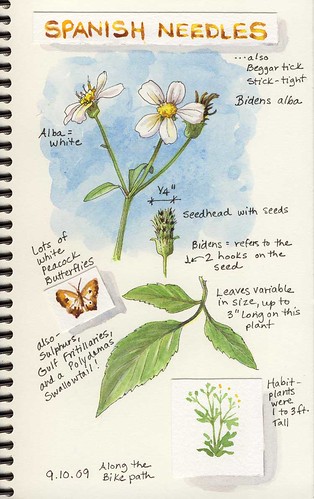
I like to draw, paint, and write short notes about the natural world around me – it might be a leaf, or an insect, or a habitat. We all see things just a little bit differently than our friends; we each have a unique viewpoint. When an artist draws, he or she also edits what they present on the page.
For example, if you drew a picture of your house, you might not draw every window and door. You pick out what you want to show. Drawing and writing is also about learning, it’s a process. Writing about your observations is a further exploration, making connections that are important to you, in your own words. Your words might be direct observations, a story, or your personal feelings about the subject.
Let me share a bit of my process and how I approach drawing the natural world around me.
First, observation. Everything has a story behind it. Sometimes I think of this as being like a nature detective. Sometimes we can find out more just by asking little questions and then moving to big questions. This is part of my observation. I might also write notes, and make little “map” sketches about it. All of these things help me draw a better picture.
1. Who? Do I know the name of my subject? If not, can I guess?
2. What? Do I know what it is? What does it eat? What color is it? What shape is it?
3. Where? Where did I find this or observe it? Where might it live?
4. Why? Why is it here? Why does it exist – what is its purpose? Why is it this color and shape?
5. When? When was this found or observed? What time of year? Write the date…
6. How? How does it function? Survive? How many leaves? Legs?
Can you see how asking and answering those questions made me more aware? You probably added a few more questions of your own. You can also ask these three additional questions that will guide you in your notes, research, and future drawings:
1. What do I already know about this?
2. What do I want to learn about it?
3. What did I learn?
Get comfortable, look at your subject again for a minute, become the nature detective, ask some questions of yourself, then draw!
Clicking on the above image will take you to my Flickr photostream, where you can view this larger.