Showing posts with label journal ideas. Show all posts

Monday, April 26, 2010

More ideas for journal entries


Some time ago I wrote about my process for nature journal entries (you can read about it here). In general, I use drawings and words to describe my daily experiences.

A nature journal doesn’t have to be limited to illustrative artwork or words about your subject, especially for kids. Home school or independent projects can include fun ways to explore and express the things we learn about the natural world around us.

If you are stuck for ideas, try choosing one item from each column below to mix and match, or use them as a starting point for your own imagination.

A menufor a birdin your yard
CD cover a mammalat a nearby park
Diagrama habitatin your community
A map ofwater creaturesat your school
A game plants and animalslast month
Charta food webin wetlands
Interviewthings that flyin the summer

When I was at the park yesterday, I decided to try a map of a habitat (a map of...a habitat...at a nearby park). The more I looked at the habitat I chose (a lake and its surroundings) – the more I realized the sheer numbers of different plants and birds there were! So I did a small portion of it (top drawing). I didn’t feel that my drawing showed the ups and downs of the land, and how it transitioned into the water very well, so then I did a cross-section. That led me to consider all sorts of things…
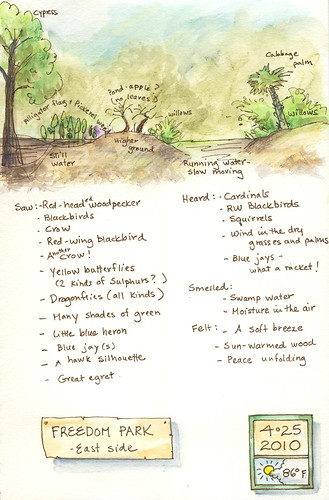

Next, I went to the swampy end of the park and created a cross-section of two kinds of water: still water and moving water. I also wrote down what I saw, heard, smelled and felt as a way to capture the experience. Now I remember that time vividly!

Be open to new ways of recording your observations. Think about adding new media to your nature journal such as photography, collage, poems, music lyrics, rubbings, prints, or computer-generated works. We are open to new interpretations when we create in new and different ways!

Click on either drawing to view larger on my Flickr photostream.

Thanks for visiting!

Sunday, November 1, 2009

Creative journal ideas for drawing plants

We’ve all had those blocks in writing or drawing...nothing is sparking, the ideas have stopped, we see through a muddy glass. We sigh. The wellspring seems to have dried up, and there is nothing new under the sun.

Sometimes all we need is a little pump-priming to get the flow moving again. Think about these ideas for drawing, interpreting, and revealing things about plants:

• Draw the same subject three times using different media and/or line styles.

• Write a haiku about your drawing. Let a favorite quote inspire a new sketch.
• Try leaf printing with acrylics and watercolor paints.

• Sketch a series of seedpods or fruits for comparison and contrast.

• Explore the stages of maturity: for example, the sprouting seed, an opening bud and flower, or the withering folds and forms of your subject.

• Look at different leaf shapes through silhouettes.

• Describe line textures in different kinds of tree bark.

• Incorporate graphic elements into your journal pages. Think of text blocks, or a border a plant or leaf study.

• Paint a collection of nature objects from your yard.

Enjoy!

Above left:  a watercolor leaf print on heavy muslin of a fern frond.  Above right: another fern watercolor leaf print on handmade paper enhanced with a Pitt brush pen and watercolor washes.

Monday, October 5, 2009

Car sketching

Sometimes my time to draw and paint is limited, and I have to squeeze in time for sketching. It’s hard to do that as a passenger in a car with the scenery speeding by, but I’ve found that it’s possible if I practice memory sketching and focus on drawing composites.

The memory sketches help my observation skills – if I start an internal dialogue about the subject, I’m surprised at what I remember. I make mental notes, and figure out the colors I see that relate that relate to my watercolor palette.

I start a composite sketch with a typical subject - in the drawing below, trees. I use the same procedure as a memory sketch, but look at as many of that particular species of tree as I can. Then I draw while still observing, adding details as I go. No time for pencil! These are quick, QUICK sketches with a Sakura Micron Pigma pen. Color can be added later if needed, but it’s important to get the basic forms down.
Composite sketching is especially useful for easily recognizable and fairly common species. For example, along this northbound stretch of Interstate 75 in Collier and Lee counties, we pass through pine flatwoods, pasturelands bordered by live oak, wet stands with cypress and red maple, and the occasional cabbage palm scattered throughout.

Drawing in a moving car is an interesting experience: the occasional construction, bridge, or swerve adds a looseness and sketchiness that my normal work lacks. It also pushes me to work quickly and not worry about wrong lines, so I’m letting go of a lot of my expectations. You don’t need much in the way of tools, you can start with a sketchpad and a pen, adding color later. You can also use colored pencils, or a small watercolor set or watercolor pencils with aquabrushes (brushes that hold water in the handle). You can see how I handle this here.

The sketch at the very top is nothing special, but it contains a lot of information. I wanted to capture Florida’s subtle change from summer into autumn: the rusty transformation of the bald cypresses feathery green needles, a bit of bronzy-red new foliage on the red maples, the still-vibrant greens of foliage against the fading grasses. The blue of the sky changes in October, I think; there is a sparkling clearness and intensity of cool blue.

I saw a small stand of young cypress, grouped together like awkward colts on a canal bank. Chaotic masses of coreopsis and Spanish needles bloom between the asphalt and the grassy canal border. The cattails are still green, but will turn to yellow and brown soon. Even a quick, small sketch like this brings back a flood of memories of sights, sounds, and smells.

You can click on the images above to see them larger on my Flickr photostream.

Saturday, September 12, 2009

Keeping a nature art sketchbook

I like to draw, paint, and write short notes about the natural world around me – it might be a leaf, or an insect, or a habitat. We all see things just a little bit differently than our friends; we each have a unique viewpoint. When an artist draws, he or she also edits what they present on the page.

For example, if you drew a picture of your house, you might not draw every window and door. You pick out what you want to show. Drawing and writing is also about learning, it’s a process. Writing about your observations is a further exploration, making connections that are important to you, in your own words. Your words might be direct observations, a story, or your personal feelings about the subject.

Let me share a bit of my process and how I approach drawing the natural world around me.


First, observation. Everything has a story behind it. Sometimes I think of this as being like a nature detective. Sometimes we can find out more just by asking little questions and then moving to big questions. This is part of my observation. I might also write notes, and make little “map” sketches about it. All of these things help me draw a better picture.  
1. Who? Do I know the name of my subject? If not, can I guess?
2. What? Do I know what it is? What does it eat? What color is it? What shape is it?
3. Where? Where did I find this or observe it? Where might it live?
4. Why? Why is it here? Why does it exist – what is its purpose? Why is it this color and shape?
5. When? When was this found or observed? What time of year? Write the date…
6. How? How does it function? Survive? How many leaves? Legs?
 Can you see how asking and answering those questions made me more aware? You probably added a few more questions of your own. You can also ask these three additional questions that will guide you in your notes, research, and future drawings: 
1. What do I already know about this?
2. What do I want to learn about it?
3. What did I learn?
Get comfortable, look at your subject again for a minute, become the nature detective, ask some questions of yourself, then draw!

Clicking on the above image will take you to my Flickr photostream, where you can view this larger.