Monday, May 20, 2013

Nature Journal Workshop at the FNPS Conference

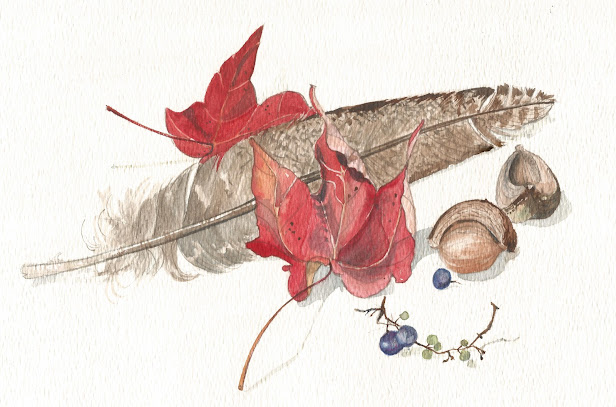
Quercus falcata leaves, souvenirs from Jacksonville.

Last Thursday I led a Nature Journal Workshop on the opening day of the 33rd Annual Florida Native Plant Society's (FNPS) conference, Celebrating La Florida: The Land of Flowers.  Eleven enthusiastic participants and I met on the back deck of the Herbert University Center at the University of North Florida in Jacksonville, ready to learn.

It was a varied group, with some having had some sketching experience, and some just beginning.  Some wanted to learn nature journaling to document their native gardens, some wanted to use it as a learning tool, and several people mentioned that they hoped it would help them slow down and improve their observation of the natural world.

Starting out - learning about the supplies provided.
As part of the workshop, each member of our group received a starting sketch bag with a 6x9 inch Aquabee sketchbook, mechanical pencil, Micron Pigma pen, Dick Blick folding palette with a few Daniel Smith watercolors, a medium size Niji Aquabrush, and a White Pearl eraser.  I also included a handout on the paints provided and a booklet of drawing tips that everyone could refer to later.

After an introductory overview of materials, we set off to do some sketching on the lovely grounds of the university.  I did  a short demonstration of my process, then participants had a chance to draw.

Walking around the lake to find our sketching spot.
I tried to get around to each person to help with any challenges.  There were some beautiful yarrow plants blooming -- which means feathery foliage and multiple flower heads -- definitely a challenge for anyone's skill level!  Halfway through our three-hour time frame, we took a break and learned about the waterbrush and the watercolors I selected.  Needless to say, the waterbrush was a big hit!

Painting watercolor swatches was a good way to learn how to use the waterbrush.
We took some time to play with our watercolors, and wrapped up with a look through some of the reference books I had brought up.  I also brought along some of my sketch journals for people to look through since I use a variety of techniques and approaches to nature journaling.

I had a great time sharing what I love to do, and hope that my new-found friends continue on with their sketching.  Keeping a nature journal has given me a lot of joy, helped me learn more about the natural world around me, and broadened my observation skills.  It's also helped me improve my drawing skills, and given me a chance to slow down and take time to enjoy the process.

Getting some great feedback on the workshop!
I'd like to say thanks to Ginny Stibolt, FNPS member and author, who invited me to present the workshop.  You can also read more from her live blog on the FNPS website, with photos of our sketching time.  I'd also like to say thanks to those who attended the workshop for your enthusiasm and feedback -- Happy Sketching!

Click on any image to view larger.

Saturday, May 11, 2013

Mistflower

Conoclinium coelestinum
A.K.A. Wild ageratum, Blue mistflower

I often notice this fluffy-headed wildflower growing along the edges of moist woods or grassy areas.  A member of the composite family (Asteraceae), the blooms lack the disk flowers commonly associated with composites.  The long stamens of the ray flowers give it that fluffy look.  The color of these little flowers is hard to describe.  In my sketch you’ll see shades of lavender, pink, and blue – all colors I picked out on close observation.  From a distance they look bluish, but on film they tend to look more pink.  A bit of a challenge for an artist…

Blue, lavender, or pink?
Besides being attractive in form and color, the flowers attract bees and butterflies, and the plants are easy to propagate from seed.  You’ll notice that the dates on my sketch above are from January, one of the Sketchbook Project spread of pages I hadn’t posted yet.  I gathered seeds from this subject then and am happy to report that my plants are now blooming vigorously!  The tiny seeds are designed for dispersal by wind; each seed has a small wisp of silky fluff attached to catch the faintest breeze.  You can see the seeds (barely!) illustrated in my earlier drawing below.   

Mistflower is a perennial that grows up to 2 feet high, with hairy stems, and crinkly, velvety, triangular leaves.  The coarsely toothed leaves are oppositely arranged on the stems in variable sizes.  This pretty wild- and cultivated flower has quite a range in the eastern U.S. – from Florida and up into New Jersey.  It prefers moist soil, which is a bit of a challenge in my yard.  Right now, my plants are growing in a large pot so wetness is easy to control.

An earlier sketch of mistflower.
In my reading about mistflower, I learned that our native Conoclinium coelestinum is often confused with the almost identical non-native Ageratum houstonianum.  If given a choice, I feel that native is the better choice.  The other living things in our area that interact with plants have evolved similarly, and are adapted to native species.  Non-natives often carry the baggage of unintended consequences. 

According to this article I read in on the Mangrove Chapter of the Florida Native Plant Society website, the best way to tell the difference between the two is to look at the roots.  The native version develops and spreads by rhizomes.  I just can’t bring myself to dig these up to check!  Another source describes the non-native plants developing a clumping habit.  Mine are definitely not clumping, but have a somewhat “untamed” tendency, which I actually like.
 
As you can see from my notes on both sketches, mistflower blooms in September and January, as well as May.  Beyond that, I’ve heard that it blooms in fall and winter.  I’ve read that it can be invasive and get a bit weedy-looking.  Right now though, I love the colors, the shapes, and the form of this delightful plant, and am sure it will be sketched a few times to come.

Click on images to view larger.

Media:
The Sketchbook Project sketchbook,
Pitt Artist pen in black, size XS for the sketch, and S for the text
Kimberly watercolor pencils,
Niji Aquabrush, small size.

The 2013 Sketchbook Project is now online, and you can see the little booklet I created here.

For further reading:
University of South Florida Herbarium specimen, showing root structure of the native mistflower.

Friday, April 12, 2013

The Sketchbook Project completed and online!


One of my interior pages, railroad vine.


Last June I received my sketchbook for the 2013 Sketchbook project, which you may remember from my post here.  I completed my book and dutifully sent it in this January for digitizing and to become part of the traveling tour.  I kept it simple, drawing and writing short notes about the plants I see around me.  For this book I chose some common flowers in nearby parks and in my yard; it seemed easier to complete the pages drawing the things I love.

You can browse through my 32-page sketch booklet titled "A Few Florida Flowers" at the Sketchbook Project’s digital library.   Just start clicking on the white arrows on the right side of the image to flip through the pages.  My browser will let me use my mouse wheel to scroll the page larger as I hold down the control key, which really helps me read smaller text.  You’ll notice that some of the pages are a bit wrinkled and there is some bleed-through of the scans, but all-in-all it looks good.  Most of the drawings were done in the field so between the wind and a few sweat drops, the paper fared pretty well, considering.

I did this project as part of a group-buy initiated by my friend Stephanee (thank you!), one of the artists in our Fakahatchee sketching group.  It’s awesome to think that my little book will join thousands of others in a tour throughout the country, coming to rest in Brooklyn and available in their lending library.  Thanks for visiting!

Wednesday, March 13, 2013

FLOR500

Pinepink, framed and ready for the show.
My entry for FLOR500 - #371 Pinepink, one of our terrestrial orchids.  I've seen this at Fakahatchee several times, noticing that it likes growing along the edges of roadways and wooded areas.  It seems to enjoy full sun or semi-shade and thrives in rocky ground - a true survivor plant!  It has long strap-like basal leaves that are pleated and come to a tapering point.

You may remember my earlier studies of this orchid from our sketching at Fakahatchee Strand Preserve State Park, once last March, and again last April, in two very different locations.
You can see the works in person of artists in our southwest Florida region on display at:
South Regional Library
8065 Lely Cultural Parkway
Naples, FL 
(239) 252-7542

Medium: watercolor on paper.
FLOR500 is an exciting and unique collaborative project, drawing in artists from all over the state of Florida.  Each artist selects a subject from a list of 500 native wildflowers, plants that were growing  when Ponce De Leon set foot on a peninsula filled with flowers, inspiring him to name our state La Florida (flowery land).  In addition to the artworks, wildflower gardens are being planted outside schools and libraries.

Visit their website: www.FLOR500.com
See them on Facebook: FLOR500 on Facebook


Thursday, January 24, 2013

Sketching in Fakahatchee and Worldwide SketchCrawl


Climbing aster

Last Saturday was our first sketch outing at the Fakahatchee StrandPreserve State Park for the year, as well as the WorldWide SketchCrawldate.  We had a wonderful turn-out for our group, and beautiful weather.  With so many interesting subjects, it was difficult to choose just one or two!
Starting the sketch, using dots as a reference for the petal placement.

As usual, I found myself looking at the small things.  Along the edge of a wooded area, a flash of lavender and yellow about eye-level lured me over.  Growing in a tangle and wandering up the trunk and branches of a bald cypress was the largest climbing aster (Aster carolinianus) I’ve ever seen before.  It was in all stages of bloom, from flower-buds to seed-heads.  I quickly sketched it in ink (dodging the numerous honeybees) and moved to a nearby picnic table to add color with my watercolor travel palette and waterbrush. 

After completing that page in my sketchbook, I checked the color choices with the vine in question and noticed a small broken branch hanging precariously among the other branches.  What caught my eye this time was the unusual airplant growing from the lichen-encrusted bark.  Luckily I had brought a reference book or two, and with the help of a friend decided it was the potbelly airplant, Tillandsia paucifolia.  I don’t see these very often and was excited to sketch it!  
Potbelly airplant.

I was able to complete an ink drawing, but with no color, as our time was drawing to an end.  After taking a reference shot with my camera, I carefully hooked the broken branch back onto a sturdier branch so it wouldn't fall to the ground.  I wasn’t able to draw the many tiny seedling “pups” that were growing on a seedhead, or the different lichens,but perhaps that’s for another time.  I was told that one of the lichens was named “old man’s beard” – I’ll leave you to guess which lichen it is from the photo below!
Click on any image to view larger.


Media:
  • Nature Sketch sketchbook by Pentalic, 7x5 inches
  • Pitt Artist Pen by Faber Castell, size XS for the drawing, size S for the writing
  • Daniel Smith watercolors
  • Niji Aquabrush, size S
You can see a slideshow of our get-together on the Events Page here.

Monday, January 7, 2013

Yellow hawksbeard

My two page spread in the small sketchbook from The Sketchbook Project.


Even though I like to learn about the natural world around me through drawing and writing, I don’t recommend that anyone encourage this particular weedy nuisance. A common volunteer in lawns and disturbed areas throughout the southeastern United States (and Hawaii!), yellow hawksbeard (Youngia japonica, synonym Crepis japonica) is a dainty and graceful version of the dandelion.

Each petal has five notches on the end.
Its lobed basal leaves radiate outwards above a sturdy root, the stems emerging to support panicles of small clear-yellow composite flowers. It is native to Southeast Asia and has naturalized throughout many countries, often becoming locally invasive.

This weed has many common names, often-seen are oriental false hawksbeard and Japanese hawkweed. In all of my exploring, I haven’t come across any explanations of the inclusion of the word “hawk” in these names. Is it because of the jagged or notched edges of the petals – perhaps they look like the talons of a hawk? And where does the word “beard” come into play? A mystery I’d love to solve.

According to Practical plants.org, yellow hawksbeard was used historically to treat snakebite and boils. Recent research shows it to have antiviral and anticancer properties. The young leaves are edible, eaten raw or cooked like spinach. You can read more about its edibility at Eat the Weeds.com.

I picked this weedy interloper to sketch because of its beauty and daintiness. I have a fondness for plants with basal rosettes – I’m always excited to discover a small green mandala in a thicket of grasses! Its one of my entries for the Sketchbook Project booklet I’m trying to complete before the deadline date!

Media:
The Sketchbook Project sketchbook,
Pitt Artist pen in black, size XS for the sketch, and S for the text
Kimberly watercolor pencils, Derwent Inktense,
Niji Aquabrush, small size.

Disclaimer: As always, with any foraged wild plants, be absolutely positive of identification before handling or ingesting.

For further reading:
Florida Department of Agriculture


Monday, December 31, 2012

Spanish needles

Most people with a garden or yard consider Spanish needles (Bidens alba) to be a weedy pest, a tough rooted interloper that pops up in the most inconsiderate places. As for myself, first I appreciated the butterflies that circled the daisy-like blooms. Now I admire the way the flashes of white and brief yellow lighting up the green roadside edges and swales. I enjoy the symmetry of leaves and the square-ish stem.

And its persistence! We could all take lessons from this hardy plant, especially during these last tough years of a faltering economy, when many of us have had to adapt to changing conditions and dig our roots a little deeper, learning to bloom where we find ourselves planted.
I know it by the common name Spanish needles, but it’s also called Shepherds’ needles, beggar tick, and pitchfork weed among others. The common names derive from its two-pronged seeds, which are shaped like small needles. They attach themselves to everything. It’s a great adaptation that ensures that seeds are spread far and wide in search of fertile ground. I can only imagine the miles some seeds have traveled on my socks!
From my pages for The Sketchbook Project.
The young shoots are edible, used like spinach greens. It belongs to the large and diverse composite family, Asteraceae. Often considered a weedy invasive, I was surprised to learn that it’s one of our more important nectar and pollen plants for local bees and butterflies. Spanish needles is also used as a larval food for the Dainty Sulfur butterfly (Nathalis iole). Learning about the positive side this of lowly wildflower/weed, I’m leaving more to grow and nourish the butterflies visiting my yard.

Coloring page:
For a FREE downloadable PDF, please click here, or visit my Coloring Pages tab above. The link includes two pages (each 8.5x11 inches). The first page has a drawing of Spanish needles, the second page has a drawing of three butterflies you can select from to color, cut, and paste onto the first.

For further reading, please visit:
Eat the Weeds
Floridata

Media:
The Sketchbook Project sketchbook,
Pitt Artist pen in black, size XS for the sketch, and S for the text
Kimberly watercolor pencils,
Niji Aquabrush, medium size.