Showing posts with label laurel oak. Show all posts

Tuesday, December 13, 2011

Live and laurel oak leaves


Live and laurel oak leaves, originally uploaded by Elizabeth Smith.


"There is always something
to make you wonder 
 in the shape of a tree, 
 the trembling of a leaf."

~ Albert Schweitzer

Thursday, September 15, 2011

Is is fall yet?


Laurel oak leaf, originally uploaded by Elizabeth Smith.

With temperatures still in the low to mid-nineties here in south Florida, this is the question on my mind almost every day during the last half of September. I found this laurel oak leaf on the ground the other day, and it reminded me that fall is lurking around the corner.

Just in the last few days, the mornings have been a tiny bit cooler, and the air has been drier. The sky has taken on a tinge of cooler blue as the earth tilts away from the sun. Fall in Florida doesn’t have the drama and glory it does further up the northern hemisphere, but it does have a subtle splendor.

This tattered, beaten-up leaf still glowed with color, inspiring me to try to capture them in watercolor. I painted this in a new watercolor sketchbook by Strathmore, purchased at Michaels with a 40% off coupon! And since it was a low price to start, I felt I couldn’t go too wrong.

It is the Strathmore Windpower Watercolor pad, spiral bound, with 15 sheets of cold press 140 lb. acid-free paper. I bought the small size (6 x 9 inches) for field and small study painting and sketching. I like the clear white color of the paper and the way it takes initial washes. I also like the heavier paper in this book; I used a fairly wet wash on the leaf and had no buckling at all.

What I didn’t like was the way my watercolor lifted when I attempted to add another glaze layer, but I think that is partly my choice of paint color. Still, I’m used to the Pentalic sketchbook that seems to “grab” all of my watercolors. I think I need to experiment more with getting my initial washes right, and fuss less with detail.

I sketched this first in pencil, and then painted with Daniel Smith watercolors: Quinacridone Gold, Sap Green, Raw Sienna, Burnt and Raw Umber, and Cadmium Red. Darker vein accents were a mixture of Raw Umber and Indanthrone Blue; the shadow is a mix of Shadow Violet plus Indanthrone Blue.

It’s been a lot, hot summer for many of us, but I know some of you in the upper parts of the northern hemisphere are enjoying autumn already, with cooler temperatures and even frost!

Tuesday, November 30, 2010

Autumn leaves from a Florida wetland


Autumn in Florida can be a subtle season, but the signs are there if one pays attention.  Autumn is my favorite season, and I particularly like plants, so I tend to notice those changes most.  Here are just a few of the things I notice around me in the southwestern part of our state:

• There are more yellow flowers blooming, but also some purple and lavenders.
• We're enjoying lower humidity and less rainfall.
• Acorns and pine cones are ripening and dropping to the ground, attracting birds and squirrels.
• The red maple leaves have tinges of red – when they fall they often take on beautiful colors of scarlet, burgundy, and gold.
• A few more oak leaves and pine needles on the ground.
• I see more grasses with seed heads, especially broom sedge, which has turned a beautiful yellow ochre hue.
• We have cooler temperatures that come in waves with each new cold front.
• Some of the bald cypress needles are turning a delightful rusty red-yellow color.
• Berries are ripening: most recently I’ve noticed Dahoon holly and marlberry.
• The colors of the sky are different than summer – now they are a cooler blue. The sunsets are different, too, with clearer skies and deeper colors.
• I notice more flocks of birds in the air.
• Some of the ponds and lakes have lower water levels.

I discovered the leaves above on a walk along the boardwalk at Freedom Park (here in Naples, Florida) and knew that I needed to paint them.  This section of the park is an old wetland area with red maple, laurel oak, bald cypress, pond apple, pop ash, royal palm, and red mangrove trees – some of them fairly mature. 

There is still water in these wetlands, but areas that were wet are now merely damp, and sections that were damp are now dry.  Scattered among the trees are understory shrubs and young trees and water-loving flags and grasses. 

What have you noticed about your surroundings? During busy holiday times, we sometimes forget to look around us and enjoy the changing theater of our environment. As artists, naturalists, and humans, observation is a primary force of being.  Observing nature can be a wonderful way to relax and relieve stress, center ourselves within place, and entertain our senses.

Clicking on the caption below the image will take you to that page on my Flickr photostream.

Parents and teachers – please use the link below for a free PDF coloring page of the leaves above (with names):
Coloring page, Florida wetland leaves

Monday, November 8, 2010

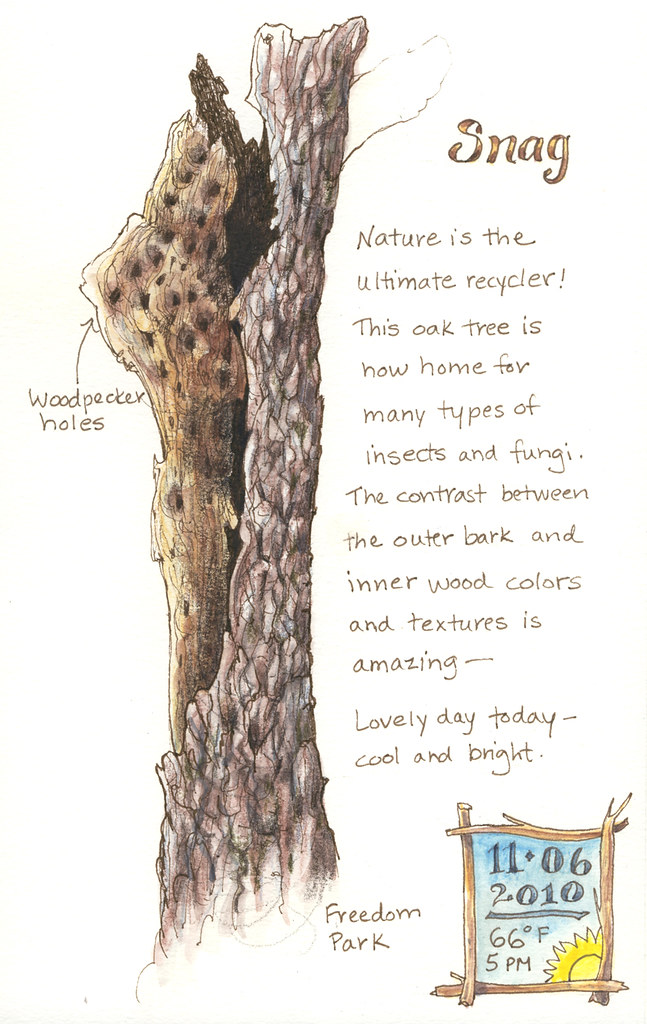
Tree snag


I confess to a fascination with dead wood, perhaps related to childhood memories of exploring woodpiles and decomposing logs. The echo of life is still there –I can imagine the seedling reaching for the sun, the unfurling of bud and leaf and inflorescence, the ripening of fruit or nut.

After death, another cycle of life begins – that of detritivores. On the microscopic level, bacteria and fungi colonize and start the breakdown process.

Invertebrates such as beetles, borers, and termites process wood nutrients or feast on fungi, and are feasted on in turn by vertebrates such as woodpeckers, anoles, and armadillos. Dead trees are used as homes by many species, including birds, bats, and squirrels.

This particular tree was an oak, probably a laurel oak. Something damaged it (lightning, a falling tree?), and the bark shows signs of regrowth round the split. The exterior bark and interior wood seemed to mirror each other, a glimpse of the past and present.

While nature may be extravagant, nothing goes to waste; all is consumed, refashioned, and repurposed – nature is the ultimate recycler.

You can click on the image to view it larger on my Flickr photostream.