Sunday, September 27, 2009

I need to take my own advice more often…

At least when it comes to drawing exercises. If I’m sketching regularly I can easily slip right into drawing; I don’t wrestle much, the drawing seems to draw itself.

But when I’ve been away from my sketchpad or journal, facing a block, or approaching a tough subject, I need to take the advice I give others. Go back to basics: gesture and contour drawing exercises. Remember those from school?

I find that gesture drawing is a great way to loosen up. I have a tendency to draw from the wrist, which is great for detail studies, which I love. Drawing with the whole arm, from the shoulder, makes me connect with my subject in a dynamic, unfettered way. Because it’s the drawing in the framework of an exercise, I also let go of any expectations.

Freedom to draw without expectation is…well, freeing. And my detailed study afterwards seems to flow much better.

I enjoyed the gesture drawing in pencil so much that I tried one in watercolor, just to see what it would be like. I was more pleased with that one than the more detailed study I did afterwards!


Sunday, September 20, 2009

Mistflower


Mistflower, originally uploaded by Elizabeth Smith.

Mistflower
Conoclinium coelestinum
Aster family

It seems to me that autumn has a penchant for lavender and purple flowers. These Mistflowers have a peculiar lavender color that sometimes looks pinkish, but other times more blue. These were volunteers in a recent landscaping job, popping up from under the low shrubs lining the sidewalk/bike path. The blooms seem to be ending as most of the flowers have gone to seed; a mere breath of wind sends the fluff-tailed seeds aloft.


Pale violet colors are tricky to paint, so I did some test color charts beforehand to get a feeling for the best combinations. Glad I did! It may be hard to tell on your screen, but the Opera Rose and Manganese Blue yielded clear and bright mixes that were most like the bloom color. I’ll save these for reference later!

Clicking on the top image will allow you to see it larger on my Flickr photostream.

Wikipedia fans can read a bit more by clicking  here.

My portable art kit

Tools are wonderful things, but it’s not necessary to start with more than a few things: pencil, eraser, pencil sharpener, and paper. These may be any type of your choosing; the important thing is to start drawing! I find that an inexpensive .7 mm mechanical pencil is a great tool. They never need sharpening, they provide a fairly wide range of darks (depending on your paper), and they are easy to refill or replace.
Whatever your materials, get acquainted with them. See what they can do, what types of lines they make — what darkest or lightest marks? If you’re brushing up on drawing skills and have an assortment of tools, use those that are most comfortable, at least to start.
A larger kit might include: hard and soft drawing pencils, a sketchbook or bound journal, a permanent artist’s ink pen (such as Pitt or Micron Pigma), a white vinyl eraser and/or kneaded eraser. Portable color media can include a small set of watercolors, colored pencils, or watercolor pencils. You’ll want to have some brushes and a water source.

Here’s an example of my art kit; I tried to make it as portable as possible, and it all fits in an inexpensive tote bag. I make sure to keep my supplies limited so it also fits in my backpack if needed, but generally speaking, the tote bag is more accessible (you can click on the photo below to view larger on my Flickr photostream).

Currently I carry:
• Two sketchbooks, one with hot-press watercolor paper and one with an assortment of paper (these are sketchbooks I made myself).
• A pencil box with an assortment of mechanical pencils, artist drawing pencils, charcoal pencils, and pencil sharpener. Erasers: I like the white ones as they don’t leave a colored residue behind. One is a tougher vinyl eraser and one is slightly softer.
• A brush box with four Niji Aquabrushes. These are waterbrushes that have a hollow barrel in the handle that can be filled with water. Great tools for field sketching! I also keep a small ruler, and some Q-tips in there.
• A miscellaneous box (shown below right). A bit of everything: emery boards for pointing pencils, toothpicks, a cut credit card for scraping, and GUM brand teeth cleaners for lifting.  Derwent Blue-gray watercolor pencil, Albrecht Durer watercolor pencils in Black, White, and Payne’s Gray, and a #11 Xacto knife (blade protected by an eraser). A Signo Uni-ball white gel pen, and a Prismacolor white colored pencil. . A white birthday candle for watercolor resist.
• Pens: Black Micron Pigmas in the .005 and .01 sizes. Faber Castell Pitt artist pens, S, F, M, and B sizes.
• Water soluble pencils. Both Derwent watercolor pencils and Derwent Inktense pencils, each 12 piece sets.
• A travel set of watercolor paints by Sennelier, they are about three years old.
• A magnifying glass, an all-purpose multi-tool, and an assortment of binder clips (good for windy days).
• Extra paper towels, zip-lock bags (different sizes), a travel spray bottle with water, and some empty Rx containers for water and small samples. NOTE: the Rx containers are not totally leak-proof, so keep them empty in your kit. As a precaution I keep anything wet or damp in a zip-lock bag.
• Depending on my needs, I still have room to throw in a digital camera, sunscreen, and/or insect repellent.
Wish list:
• Micron pens in brown and green, .005.
• Cold-press watercolor sketchbook.
• A small tin of primary watercolors, Daniel Smith Hansa Yellow, Prussian or Ultramarine Blue (or both?), and Quinacridone Red. And maybe a Burnt Sienna and Indanthrone Blue. I'm waiting for the right tin to come along.
• Should I add a larger trash bag to sit on or to serve as a rain poncho?  Probably.  I also have my eye on one of those foldable stools.  Maybe I'll need another bag!

Friday, September 18, 2009

Wild poinsettia


Wild poinsettia, originally uploaded by Elizabeth Smith.

Wild Poinsettia
Poinsettia cyathophora
Euphorbia or spurge family

Another one of my favorite weeds, Wild Poinsettia grows in moist disturbed areas and pinelands, this one at the bottom of a chain link fence that borders a bike path and the back of a golf course. The golf course used to be a pine flatwoods habitat, and they kept the pines around the edges, but they spray herbicide nearly every year to keep the bike path from getting overgrown. These stands die back, but they return every summer. I’m glad I got to paint them before they disappeared.

The genus name Poinsettia honors Joel Roberts Poinsett, the first United States Ambassador to Mexico.
The species name cyathophora is from the Greek Cyathodes, meaning a small cup or urn, or cup-bearing. I think the flowers do look like a collection of little cups.  It’s related to our beloved Christmas poinsettia, which is poisonous as well, and both have the milky sap that is characteristic of many Euphorbias.

I’ve had a hard time painting this in the past. The red splotches are a peculiar color, depending on the light and the plant. They seem to range from a pale red to a fluorescent red tinged with orange. After seeing Sigrid Frensen’s beautiful orange berries  that she achieved with Opera Rose and Cadmium Yellow, I knew this might be the right color base to try!  It worked well, although the image above seems a little darker than the original.

This sketch on the right is from last year, with the failed attempt at red; the plants were sprayed before I could paint them again so I had to wait until now. This particular plant had the fiddle-shaped leaves often seen, but the leaf shapes (and colors) seem to be highly variable. 

Other common names for Wild Poinsettia are Painted Leaf, Fire-on-the-mountain, Painted Spurge, and Summer Poinsettia.

Saturday, September 12, 2009

Keeping a nature art sketchbook

I like to draw, paint, and write short notes about the natural world around me – it might be a leaf, or an insect, or a habitat. We all see things just a little bit differently than our friends; we each have a unique viewpoint. When an artist draws, he or she also edits what they present on the page.

For example, if you drew a picture of your house, you might not draw every window and door. You pick out what you want to show. Drawing and writing is also about learning, it’s a process. Writing about your observations is a further exploration, making connections that are important to you, in your own words. Your words might be direct observations, a story, or your personal feelings about the subject.

Let me share a bit of my process and how I approach drawing the natural world around me.


First, observation. Everything has a story behind it. Sometimes I think of this as being like a nature detective. Sometimes we can find out more just by asking little questions and then moving to big questions. This is part of my observation. I might also write notes, and make little “map” sketches about it. All of these things help me draw a better picture.  
1. Who? Do I know the name of my subject? If not, can I guess?
2. What? Do I know what it is? What does it eat? What color is it? What shape is it?
3. Where? Where did I find this or observe it? Where might it live?
4. Why? Why is it here? Why does it exist – what is its purpose? Why is it this color and shape?
5. When? When was this found or observed? What time of year? Write the date…
6. How? How does it function? Survive? How many leaves? Legs?
 Can you see how asking and answering those questions made me more aware? You probably added a few more questions of your own. You can also ask these three additional questions that will guide you in your notes, research, and future drawings: 
1. What do I already know about this?
2. What do I want to learn about it?
3. What did I learn?
Get comfortable, look at your subject again for a minute, become the nature detective, ask some questions of yourself, then draw!

Clicking on the above image will take you to my Flickr photostream, where you can view this larger.

Friday, September 11, 2009

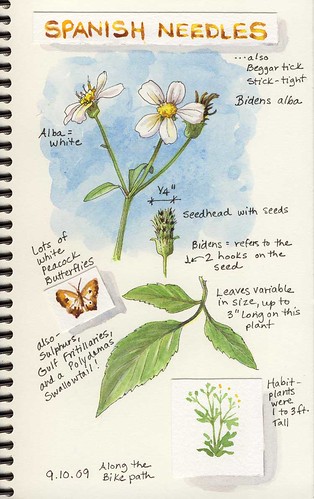
Spanish Needles


Spanish needles, Aster family

Hated by hikers and gardeners, beloved by butterflies

Right now these scruffy wildflowers (or weeds) are growing and blooming like crazy. The butterflies are feasting! They’re also setting seed, those troublesome little slivers with hooks on the end that hitchhike onto our sneakers, socks, cuffs, and pets. I read that one plant can produce 1250 of these seeds!


Once one plant gets a foothold in your garden, it seems they show up forever after. They’re still attractive to me; they are survivors and cheery-looking, and anything that attracts so many butterflies can’t be all bad!