Showing posts with label beach sunflower. Show all posts

Monday, June 18, 2012

The Sketchbook Project , first pages


Click on image to view larger.

A peek at the start of a new project, as part of The Sketchbook Project; you can view my post about this here.

I drew these with a Pitt Artist pen outside (sitting on a lumpy rock!), then back inside to a comfortable chair for lettering and adding color with my water-soluble pencils.  The paper is a nice bright white, and beautifully smooth.  The ink goes on like silk, with no noticeable bleeding or penetrating (so far).  My watercolor pencils worked nicely, picking up a light texture from the paper - however, too much water is a no-no which resulted in wrinkled pages.  I’ll have to pay attention to find that fine line between just enough and too much water from my waterbrush!

Click on image to view larger.

The details:
The Sketchbook Project book is from Scoutbooks.com, but I couldn’t find out any information on the paper. 
Ink:  Pitt Artist pen in black, size XS for the sketch, and S for the text.
Watersoluble media: Kimberly watercolor pencils (you can read about my set here), and Inktense by Derwent.
Brush:  Niji Aquabrush, small size.

The subjects:
I’ve written about both of these two lovely plants that are blooming right now in south Florida, so I won’t repeat myself!  If you’d like to read about the Florida butterfly orchid, please visit my post from last year.  Here is a link to the post from 2010, which also shows a honeybee and its funny pollen “hat” that I observed while drawing.

You can find the beach sunflower post here.  I started these from seed several months ago, and they are doing extremely well in a dry and sandy spot that nothing wanted to grow in before now.  The seeds took a VERY long time to germinate (or perhaps I’m an impatient gardener), but I’m glad they did.  The flowers lift my spirits every time I see them!

The cover:
Oh - and if you'd like to see what I've done with the cover so far, I wrapped it in a recycled and crumpled Tyvek envelope (blank side to the outside), and painted it with some leftover latex paint.  Wiping the paint with a damp paper towel removes enough to reveal the random fibers in the Tyvek, which add a lot of texture and interest.  The two colors I used were an "old gold" and a tobacco brown; leaving on more of the gold, and wiping off more of the brown. The last step was a seal coat with a matte acrylic medium.  I've found the Tyvek to be extremely durable as a sketchbook cover; even the wear marks add to the beauty.
Back and front of the sketchbook.

 There may be more to come regarding the cover - time will tell!  In the past I've used acrylic paint on my handmade sketchbook covers; if you'd like to see some examples, please visit my Flickr set here.

Click on images above to view them larger.
Thanks for visiting!


Sunday, November 13, 2011

Beach sunflower


Beach sunflower, originally uploaded by Elizabeth Smith.

A few months ago, I collected some beach sunflower seedheads and scattered the seed in a flowerpot. So much time went by that I thought surely the seed wasn’t viable, so I set another pot on top of the dirt. Not long after that, I noticed seedlings with distinctive triangular shaped leaves. Finally! They’re a foot high now and growing vigorously, topped off with the bright yellow blooms typical of the sunflower family.

Beach sunflower is Helianthus debilis, a smaller relative of the large and beloved domesticated sunflower we cultivate for seed and beauty. Sunflowers are a member of the huge Aster family, with typical composite flowers – two types of flower structures, ray and disk. Think of the rays of the sun and you’ll know immediately which are which. The disks are tiny flowers that make up the center “button.”

The leaves are an attractive deltoid-to-heart shape, but the plant has rough and prickly stems. The foliage is usually a bright green, but does have a period in late summer when it tends to get weedy and needs some grooming if you are a particular gardener. Although many sources mention beach sunflower as a butterfly attractor, my experience is that it’s especially enjoyed by many types of bees and the occasional skipper.

Because beach sunflower will tolerate a wide range of light and soils, and scoffs at drought, it’s a favorite of mine. I have a partially green thumb and a full-time job, so plants in my care need to be low maintenance! Besides, I also like those cheerful daisy-like blooms and splashes of vivid yellow.

You may have guessed that this species is often found near the beach; in fact, another common name is dune sunflower. It has a high salt tolerance and can be seen growing right out of white sand – it’s roots busy stabilizing shifting dunes. Beach sunflower blooms year-round in South Florida, flowering in the warmer months along the Gulf Coast and into Texas.

I painted this directly in watercolor, first putting in a yellow background wash. After the wash dried, I added the leaves right on top, sketching the outline of the petals with my brush tip. Then I added my pen sketches of the flower and leaf to record a bit more detail. Next, a little more color and some text, and I felt I had a nice balance of science and art. I hope you enjoy them as much as I do!


You can click on the image above to see it on my Flickr photostream, and you can also see an earlier journal entry on beach sunflower here.

Sunday, January 17, 2010

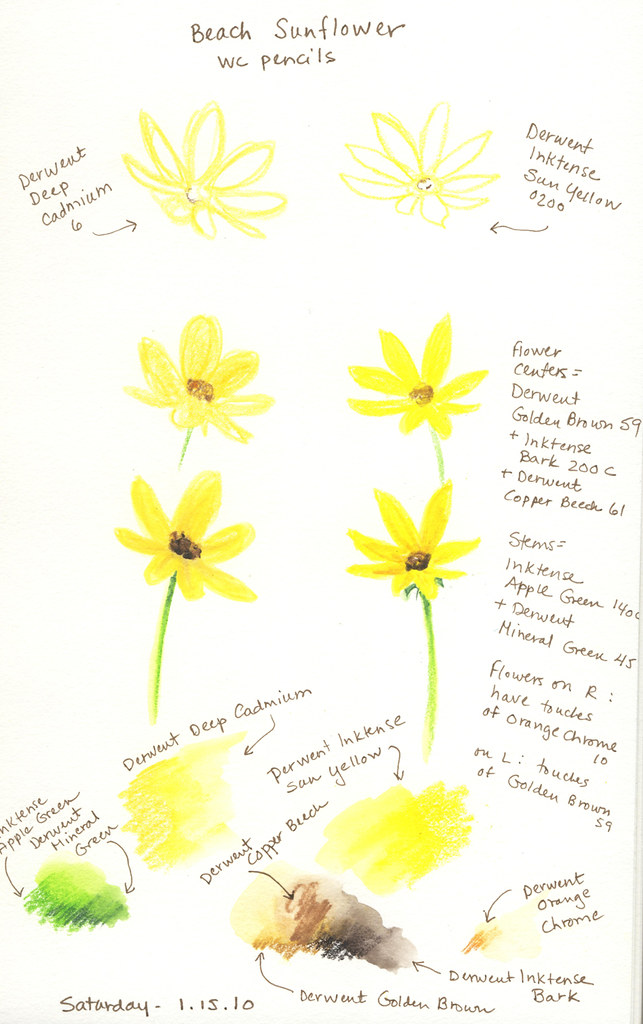
Beach sunflowers - practice and color samples


Watercolor beach sunflowers, originally uploaded by Elizabeth Smith.

I've mentioned before that I've been using an Aquabee sketchbook, and recently I did some media comparisons using the same subject: beach sunflowers.

What inspired me to start some quick studies of a single flower was a book I got as a gift - "The Flower Painter's Pocket Palette," by Elisabeth Harden. It's a small book and describes itself as an "...instant visual reference on colors and shapes." I would recommend it for the beginner or as a quick reference for anyone. The book has several examples of how to paint different colors and shapes of flowers, showing examples of a 2 or 3 step painting process. If you are interested in the book, you can take a look at it here.

Anyway, I decided to test out my various yellows, as a comparison, and also to see how well they worked on the Aquabee paper (see sketchbook page above). The sketchbook features heavyweight drawing paper for both wet and dry media. It does have a slightly textured surface, and withstands light washes well. I did have some buckling with heavier washes.  The white paper is bright, but not overly so. It isn't sized like watercolor paper, so there isn't a lot of nice flow and mingling of color, like a good cold-press watercolor surface. The color stays brilliant, though.


Next, I thought I'd try out my water-soluble pencils: a combination of Derwent regular and Inktense (the next sketchbook page). I did a 3-step example so I could remember the process in the future. Once again, the colors didn't flow as well together as I would have liked, but the tooth made for some nice pigment textures!

I learned a lot form these simple exercises.
  • I need to practice more with watercolor washes to get the hang of the different paper.
  • My yellows are quite different looking when I compare them side-by side.
  • This paper seems to do well when I work in layers, letting each one dry well between painting or drawing.
  • I also learned a bit about how other artists use color mixes in their flower painting.
  • And I learned about a new color: brown-pink, which actually looks like a yellowed medium to light brown.  That started me off on a whole new tangent investigating organic pigments...but that's for another day!
You can click on the drawings above to view them larger on my Flickr photostream.

Saturday, November 21, 2009

Beach sunflower


Beach sunflower, originally uploaded by Elizabeth Smith.
We have a new park in town planted with all sorts of native vegetation. I used my Pitt pens, Derwent watercolor and Inktense pencils, and Niji Aquabrushes to capture these sunny yellow flowers.

I've always loved these tough plants - they have coarse and bristly leaves and stems and bloom under the most adverse conditions.

You can click on the image above to view it on my Flickr photostream.