Showing posts with label The Sketchbook Project. Show all posts

Saturday, May 11, 2013

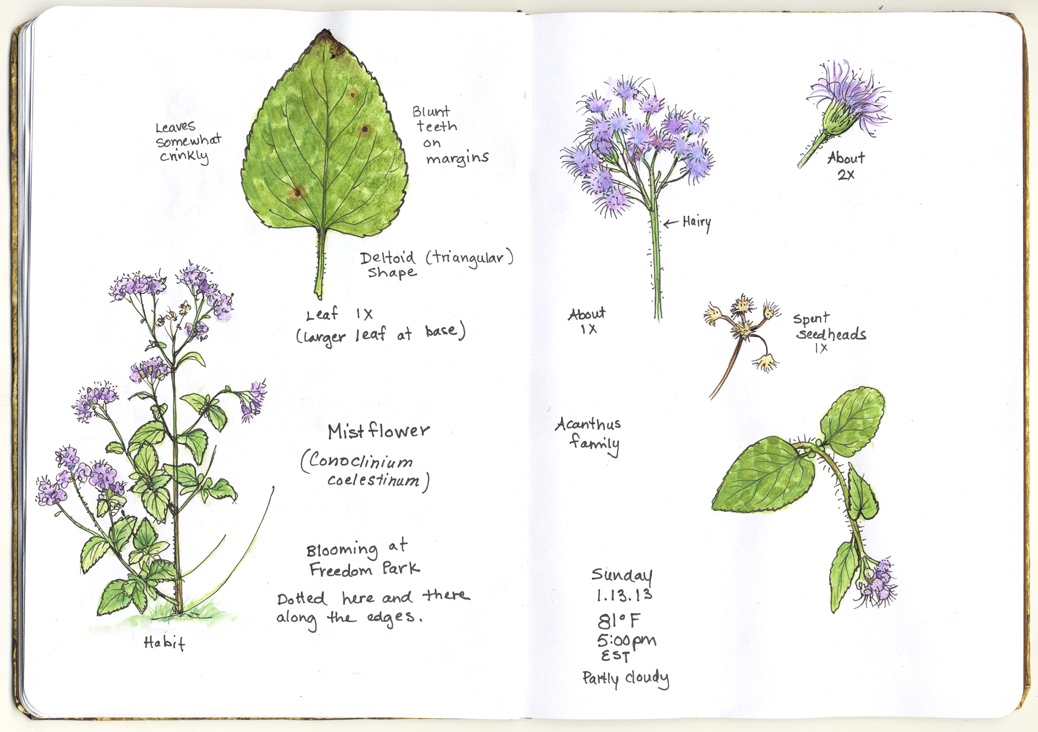
Mistflower

Conoclinium coelestinum
A.K.A. Wild ageratum, Blue mistflower

I often notice this fluffy-headed wildflower growing along the edges of moist woods or grassy areas.  A member of the composite family (Asteraceae), the blooms lack the disk flowers commonly associated with composites.  The long stamens of the ray flowers give it that fluffy look.  The color of these little flowers is hard to describe.  In my sketch you’ll see shades of lavender, pink, and blue – all colors I picked out on close observation.  From a distance they look bluish, but on film they tend to look more pink.  A bit of a challenge for an artist…

Blue, lavender, or pink?
Besides being attractive in form and color, the flowers attract bees and butterflies, and the plants are easy to propagate from seed.  You’ll notice that the dates on my sketch above are from January, one of the Sketchbook Project spread of pages I hadn’t posted yet.  I gathered seeds from this subject then and am happy to report that my plants are now blooming vigorously!  The tiny seeds are designed for dispersal by wind; each seed has a small wisp of silky fluff attached to catch the faintest breeze.  You can see the seeds (barely!) illustrated in my earlier drawing below.   

Mistflower is a perennial that grows up to 2 feet high, with hairy stems, and crinkly, velvety, triangular leaves.  The coarsely toothed leaves are oppositely arranged on the stems in variable sizes.  This pretty wild- and cultivated flower has quite a range in the eastern U.S. – from Florida and up into New Jersey.  It prefers moist soil, which is a bit of a challenge in my yard.  Right now, my plants are growing in a large pot so wetness is easy to control.

An earlier sketch of mistflower.
In my reading about mistflower, I learned that our native Conoclinium coelestinum is often confused with the almost identical non-native Ageratum houstonianum.  If given a choice, I feel that native is the better choice.  The other living things in our area that interact with plants have evolved similarly, and are adapted to native species.  Non-natives often carry the baggage of unintended consequences. 

According to this article I read in on the Mangrove Chapter of the Florida Native Plant Society website, the best way to tell the difference between the two is to look at the roots.  The native version develops and spreads by rhizomes.  I just can’t bring myself to dig these up to check!  Another source describes the non-native plants developing a clumping habit.  Mine are definitely not clumping, but have a somewhat “untamed” tendency, which I actually like.
 
As you can see from my notes on both sketches, mistflower blooms in September and January, as well as May.  Beyond that, I’ve heard that it blooms in fall and winter.  I’ve read that it can be invasive and get a bit weedy-looking.  Right now though, I love the colors, the shapes, and the form of this delightful plant, and am sure it will be sketched a few times to come.

Click on images to view larger.

Media:
The Sketchbook Project sketchbook,
Pitt Artist pen in black, size XS for the sketch, and S for the text
Kimberly watercolor pencils,
Niji Aquabrush, small size.

The 2013 Sketchbook Project is now online, and you can see the little booklet I created here.

For further reading:
University of South Florida Herbarium specimen, showing root structure of the native mistflower.

Friday, April 12, 2013

The Sketchbook Project completed and online!


One of my interior pages, railroad vine.


Last June I received my sketchbook for the 2013 Sketchbook project, which you may remember from my post here.  I completed my book and dutifully sent it in this January for digitizing and to become part of the traveling tour.  I kept it simple, drawing and writing short notes about the plants I see around me.  For this book I chose some common flowers in nearby parks and in my yard; it seemed easier to complete the pages drawing the things I love.

You can browse through my 32-page sketch booklet titled "A Few Florida Flowers" at the Sketchbook Project’s digital library.   Just start clicking on the white arrows on the right side of the image to flip through the pages.  My browser will let me use my mouse wheel to scroll the page larger as I hold down the control key, which really helps me read smaller text.  You’ll notice that some of the pages are a bit wrinkled and there is some bleed-through of the scans, but all-in-all it looks good.  Most of the drawings were done in the field so between the wind and a few sweat drops, the paper fared pretty well, considering.

I did this project as part of a group-buy initiated by my friend Stephanee (thank you!), one of the artists in our Fakahatchee sketching group.  It’s awesome to think that my little book will join thousands of others in a tour throughout the country, coming to rest in Brooklyn and available in their lending library.  Thanks for visiting!

Monday, January 7, 2013

Yellow hawksbeard

My two page spread in the small sketchbook from The Sketchbook Project.


Even though I like to learn about the natural world around me through drawing and writing, I don’t recommend that anyone encourage this particular weedy nuisance. A common volunteer in lawns and disturbed areas throughout the southeastern United States (and Hawaii!), yellow hawksbeard (Youngia japonica, synonym Crepis japonica) is a dainty and graceful version of the dandelion.

Each petal has five notches on the end.
Its lobed basal leaves radiate outwards above a sturdy root, the stems emerging to support panicles of small clear-yellow composite flowers. It is native to Southeast Asia and has naturalized throughout many countries, often becoming locally invasive.

This weed has many common names, often-seen are oriental false hawksbeard and Japanese hawkweed. In all of my exploring, I haven’t come across any explanations of the inclusion of the word “hawk” in these names. Is it because of the jagged or notched edges of the petals – perhaps they look like the talons of a hawk? And where does the word “beard” come into play? A mystery I’d love to solve.

According to Practical plants.org, yellow hawksbeard was used historically to treat snakebite and boils. Recent research shows it to have antiviral and anticancer properties. The young leaves are edible, eaten raw or cooked like spinach. You can read more about its edibility at Eat the Weeds.com.

I picked this weedy interloper to sketch because of its beauty and daintiness. I have a fondness for plants with basal rosettes – I’m always excited to discover a small green mandala in a thicket of grasses! Its one of my entries for the Sketchbook Project booklet I’m trying to complete before the deadline date!

Media:
The Sketchbook Project sketchbook,
Pitt Artist pen in black, size XS for the sketch, and S for the text
Kimberly watercolor pencils, Derwent Inktense,
Niji Aquabrush, small size.

Disclaimer: As always, with any foraged wild plants, be absolutely positive of identification before handling or ingesting.

For further reading:
Florida Department of Agriculture


Monday, December 31, 2012

Spanish needles

Most people with a garden or yard consider Spanish needles (Bidens alba) to be a weedy pest, a tough rooted interloper that pops up in the most inconsiderate places. As for myself, first I appreciated the butterflies that circled the daisy-like blooms. Now I admire the way the flashes of white and brief yellow lighting up the green roadside edges and swales. I enjoy the symmetry of leaves and the square-ish stem.

And its persistence! We could all take lessons from this hardy plant, especially during these last tough years of a faltering economy, when many of us have had to adapt to changing conditions and dig our roots a little deeper, learning to bloom where we find ourselves planted.
I know it by the common name Spanish needles, but it’s also called Shepherds’ needles, beggar tick, and pitchfork weed among others. The common names derive from its two-pronged seeds, which are shaped like small needles. They attach themselves to everything. It’s a great adaptation that ensures that seeds are spread far and wide in search of fertile ground. I can only imagine the miles some seeds have traveled on my socks!
From my pages for The Sketchbook Project.
The young shoots are edible, used like spinach greens. It belongs to the large and diverse composite family, Asteraceae. Often considered a weedy invasive, I was surprised to learn that it’s one of our more important nectar and pollen plants for local bees and butterflies. Spanish needles is also used as a larval food for the Dainty Sulfur butterfly (Nathalis iole). Learning about the positive side this of lowly wildflower/weed, I’m leaving more to grow and nourish the butterflies visiting my yard.

Coloring page:
For a FREE downloadable PDF, please click here, or visit my Coloring Pages tab above. The link includes two pages (each 8.5x11 inches). The first page has a drawing of Spanish needles, the second page has a drawing of three butterflies you can select from to color, cut, and paste onto the first.

For further reading, please visit:
Eat the Weeds
Floridata

Media:
The Sketchbook Project sketchbook,
Pitt Artist pen in black, size XS for the sketch, and S for the text
Kimberly watercolor pencils,
Niji Aquabrush, medium size.


Sunday, October 7, 2012

Morning glory

Click on image to view larger.


Morning glory
Ipomoea species

This morning glory was growing along the same roadside as the railroad vine I sketched at the end of September.  Areas like these are known as ruderal, disturbed sites that have had the original vegetation removed, paving the way for colonizer plants that are often thought of as weedy or invasive.  You have to be tough to be a colonizer, though, for sometimes the ground has been stripped of topsoil, or replaced by nutrient-poor fill material.

Morning glory bloom.
I’m not sure which morning glory this is, especially since there are so many species throughout our state.  The closest I’ve come to an identification is Ipomoea cordatotriboba (also known as I. trichocarpa).  The leaves look correct, but my bloom color is more blue than the photos in my plant books and online. 

I’ve read that morning glory blooms are sometimes more blue in the early morning, turning lavender to pink as the day passes.  These were a bright purple-blue when open, but I noticed that the spent blooms were a pale pink/lavender on the underside.  Perhaps one of you can help with the identification.
Worm-like?  Maybe...

Morning glory is a member of the Convolvulaceae family, as is the railroad vine.  The genus Ipomoea drives from two Greek words: ips (a worm) and homoios (resembling).  The twining and curling vines are thought to have put the author in mind of worm-like behavior.  Personally, I think they’re too beautiful for such a epithet! 


Media:
The Sketchbook Project sketchbook,
Pitt Artist pen in black, size XS for the sketch, and S for the text
Kimberly watercolor pencils,
Niji Aquabrush, medium size.

For further reading:
Universityof Florida and Lee County  IFAS Extension.  One of their photos has blooms are closer in color to those in my drawing. 


Sunday, September 23, 2012

Railroad vine


Click on image to view larger.

Railroad vine
Ipomoea pes-caprae

I discovered this railroad vine growing along the side of the road, but I most often see it growing on beach dunes.  As you might guess – railroad vine is heat, salt, and drought tolerant.  An early pioneer plant, the vine sends out thick, flexible runners with roots at each node that stabilize shifting dune sands.  The runner I sketched was easily the diameter of my little finger. These runners are the source of the common name of railroad vine; the “railroad tracks” can cover quite a distance as shown in this video. 

Railroad vine is a member of the morning glory family (Convolvulaceae), which includes a culinary favorite, the sweet potato.  The vine bears the typical trumpet-shaped bloom of morning glory, in shades of lavender, violet, magenta, and pink.  In the bright sunlight, the colors seem to glow.  The blooms are held erect on a prostrate vine, and are a food source for bees and butterflies. 

The blooms are more vivid than my tools can show!
The flowers open in the morning, fading in the heat of the day.  The fertilized blooms produce seed pods containing four brown seeds.  Although the seeds are poisonous, they’ve been used historically for medicinal purposes.

The leathery leaves grow up to 4 inches long, the two-lobed kidney-shape suggesting a split goat’s hoof (Latin pes-caprae, foot of the goat).  Long petioles (leaf stems) support the upright leaves, often folded along the midrib. 

The sap is used as a natural first aid treatment for jellyfish and insect stings, and the family in general has many beneficial properties. 

Media:
The Sketchbook Project sketchbook,
Pitt Artist pen in black, size XS for the sketch, and S for the text
Kimberly watercolor pencils, Derwent Inktense,
Niji Aquabrush, medium size.

For further reading:


Sunday, July 15, 2012

Black-eyed Susan


Summertime yellows, I see them everywhere!  Fragments of yellow blossoms flash against the green landscape like tiny bits of sunlight.  Tickseed, beach sunflower, cassia, and black-eyed Susans are all blooming now. 

Black-eyed Susan (Rudbeckia hirta) differs from many of our yellow composite wildflowers by the shape of the fertile array of disk flowers (the brown center); it has a distinctive cone shape that is similar to Echinacea or purple coneflower.  In fact, another common name for black-eyed Susan is yellow coneflower.
Wikipedia reports that the roots have been used like those of Echinacea.  Black-eyed Susan contains anthocyanin, an antioxidant found in many purple, blue, and red fruits such as blueberries, raspberries, and cranberries, as well as the stems, leaves, and flower petals of some plants.  Historically, different parts of the wildflower were used by Native Americans for various ailments.  The Cherokee used the roots for snakebite, worms, and earaches.1   Seminoles used the coneflowers for headaches and fevers. 2

Black-eyed Susan grows as a wildflower throughout most of the United States, but is also a popular cultivated garden flower.  It’s a biennial plant, with a two year life span, but sometimes grows as a short-lived perennial.  Forming a basal rosette of leaves the first year, plants send up stems and bloom the second year.  In Florida, I usually see them growing along the edges of grassy areas near pine flatwoods.  Black-eyed Susan blooms attract bees, butterflies, and other insects foraging for nectar and pollen, and birds for the ripe seedheads. 

The leaves and stems are scabrous, an interesting-sounding word that always bring to my mind the term “frabjous” from The Jabberwocky.  Scabrous actually has a more ordinary meaning: rough, or having a rough surface, an apt description of the coarse bristly hairs covering those parts.  The species name refers to these hairs as well; hirtus is from the Latin for “hairy.”  The genus name of Rudbeckia was bestowed by Linnaeus to honor Olaus Rudbeck, one of his botany professors.

Reading and researching black-eyed Susan online brought up some other fascinating tidbits.  Sending a black-eyed Susan bouquet to a loved one in Victorian times meant “encouragement.”  I also came across a charming and romantic legend about black-eyed Susan and sweet William, memorialized in a poem by English author John Gay.  I grew up knowing sweet William as a type of wild phlox, with five petals and light blue-to-lavender in color.  It’s more probable that the name sweet William actually refers to a type of Dianthus, which is native to Europe.

I drew this as part of The Sketchbook Project in the small sketchbook provided.  If you’re not familiar with the project, you can read about it here.  So far, my booklet seems to be turning into a collection of flowers found in Florida – but we’ll wait to see what else might appear on its pages!  So far, I think this one has to be my favorite; after sketching and reading about this common wildflower, I have a deepened appreciation for its uncommon beauty and history.

**Note: ethnobotany information is intended for educational purposes only, please consult reliable  sources before attempting to duplicate any medical uses!**
  

Media:
The Sketchbook Project sketchbook,
Pitt Artist pen in black, size XS for the sketch, and S for the text
Kimberly watercolor pencils, Derwent Inktense,
Niji Aquabrush, small size.
  
For further reading:
US Department of Agriculture, with range map 
Floridata,  descriptions and growing information