A watercolor pencil sketch of red mangrove roots, looking down from the boardwalk. Right now the ground is damp - in the summer (our rainy season) it would be swampy with several inches of water. I added a haiku (I'm at the beginner's level!) as a way to expand on the sensations I felt.
You can click on the image above to view it larger on my Flickr photostream.

Saturday, November 28, 2009


Saturday, November 21, 2009
Beach sunflower
We have a new park in town planted with all sorts of native vegetation. I used my Pitt pens, Derwent watercolor and Inktense pencils, and Niji Aquabrushes to capture these sunny yellow flowers.
I've always loved these tough plants - they have coarse and bristly leaves and stems and bloom under the most adverse conditions.
You can click on the image above to view it on my Flickr photostream.

I've always loved these tough plants - they have coarse and bristly leaves and stems and bloom under the most adverse conditions.
You can click on the image above to view it on my Flickr photostream.
Tuesday, November 17, 2009
MATH AND ART?
Growing up, I always felt challenged by math. I know now that it was due to a combination of factors: trying to learn “new math” after moving from a school that taught “old math” and never having the time to learn certain fundamentals. In the working world I learned to use math in a functional way, although I often came up against what I call “math block,” my belief that I was not any good with numbers. I believe that quite a few artists may feel challenged by mathematics and the hard sciences – what about you?

Here are some ways to use math with your nature art sketchbook entries:
1. Counting
2. Measuring
3. Comparing
4. Finding patterns and relationships
Click here for a PDF document that lists more specific ways to use each one of these categories. I would love to hear your experiences with math and art, and how you use them together. Better yet, share them with us all!
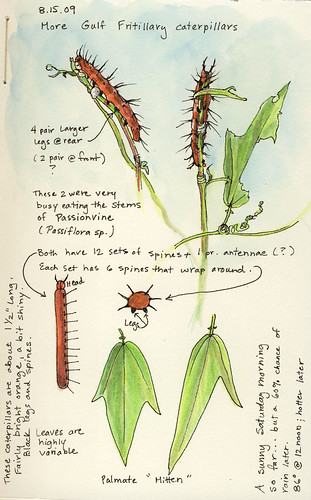
Throughout the years, I discovered that I actually had an innate sense of math and pattern – imagine my surprise! In fact, I use and manipulate numbers quite a bit in my artwork and sketchbooks. Consciously introducing and using math in nature art journals is a wonderful way to expand knowledge and application of numbers in real-world experiences. It’s an interdisciplinary practice that’s useful for home schooling, nature camps, art and math classes, personal journals and sketchbooks, science observations, and scout projects.
1. Counting
2. Measuring
3. Comparing
4. Finding patterns and relationships
Click here for a PDF document that lists more specific ways to use each one of these categories. I would love to hear your experiences with math and art, and how you use them together. Better yet, share them with us all!
Tuesday, November 10, 2009
Magnolia seeds

I haven’t had much time to draw lately, and I miss it. Circumstances in my life have changed for the time being, and the hours in the day are just not long enough. I’m in the process of figuring out how to add more creative and daily sketch time, but so far it’s fallen to the bottom of the list.
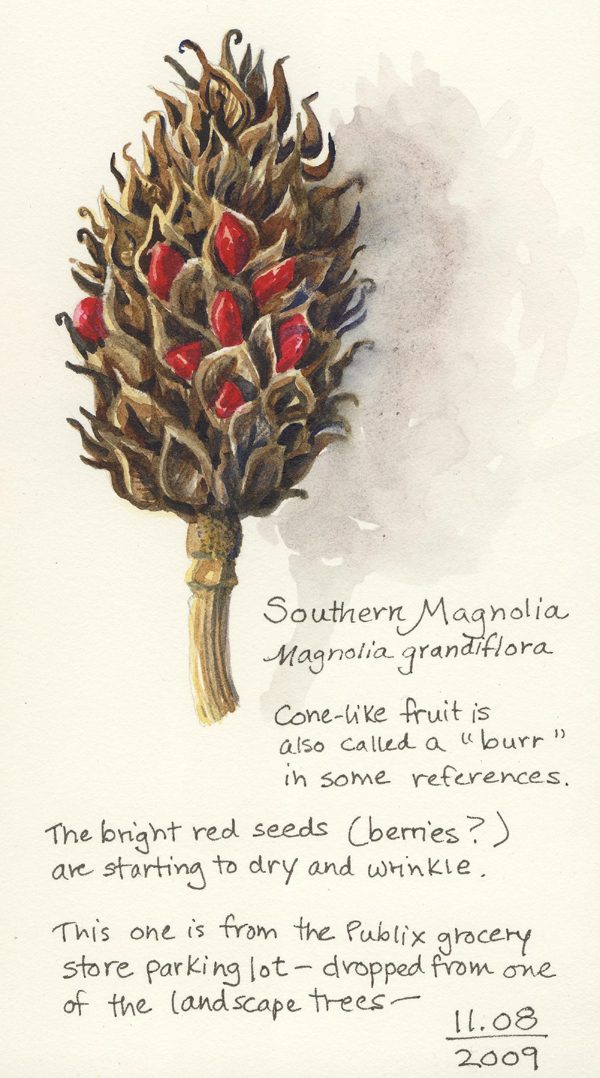
It’s an evolving process, and right now my compromise is to work on small things in small chunks of time. Working in a small journal (this one is 5 by 8 inches) seems to be a perfect solution for now.
I won’t be able to read and comment on blogs and images as much in the past, my friends, but please know that when possible I’ll be enjoying them!
Sunday, November 1, 2009
Creative journal ideas for drawing plants

Sometimes all we need is a little pump-priming to get the flow moving again. Think about these ideas for drawing, interpreting, and revealing things about plants:
• Draw the same subject three times using different media and/or line styles.
• Write a haiku about your drawing. Let a favorite quote inspire a new sketch.

• Try leaf printing with acrylics and watercolor paints.
• Sketch a series of seedpods or fruits for comparison and contrast.
• Explore the stages of maturity: for example, the sprouting seed, an opening bud and flower, or the withering folds and forms of your subject.
• Look at different leaf shapes through silhouettes.
• Describe line textures in different kinds of tree bark.
• Incorporate graphic elements into your journal pages. Think of text blocks, or a border a plant or leaf study.
• Paint a collection of nature objects from your yard.
Enjoy!
Above left: a watercolor leaf print on heavy muslin of a fern frond. Above right: another fern watercolor leaf print on handmade paper enhanced with a Pitt brush pen and watercolor washes.
Subscribe to:
Posts (Atom)