
Tuesday, November 30, 2010
Autumn leaves from a Florida wetland

Autumn in Florida can be a subtle season, but the signs are there if one pays attention. Autumn is my favorite season, and I particularly like plants, so I tend to notice those changes most. Here are just a few of the things I notice around me in the southwestern part of our state:
• There are more yellow flowers blooming, but also some purple and lavenders.
• We're enjoying lower humidity and less rainfall.
• Acorns and pine cones are ripening and dropping to the ground, attracting birds and squirrels.
• The red maple leaves have tinges of red – when they fall they often take on beautiful colors of scarlet, burgundy, and gold.
• A few more oak leaves and pine needles on the ground.
• I see more grasses with seed heads, especially broom sedge, which has turned a beautiful yellow ochre hue.
• We have cooler temperatures that come in waves with each new cold front.
• Some of the bald cypress needles are turning a delightful rusty red-yellow color.
• Berries are ripening: most recently I’ve noticed Dahoon holly and marlberry.
• The colors of the sky are different than summer – now they are a cooler blue. The sunsets are different, too, with clearer skies and deeper colors.
• I notice more flocks of birds in the air.
• Some of the ponds and lakes have lower water levels.
I discovered the leaves above on a walk along the boardwalk at Freedom Park (here in Naples, Florida) and knew that I needed to paint them. This section of the park is an old wetland area with red maple, laurel oak, bald cypress, pond apple, pop ash, royal palm, and red mangrove trees – some of them fairly mature.
There is still water in these wetlands, but areas that were wet are now merely damp, and sections that were damp are now dry. Scattered among the trees are understory shrubs and young trees and water-loving flags and grasses.
What have you noticed about your surroundings? During busy holiday times, we sometimes forget to look around us and enjoy the changing theater of our environment. As artists, naturalists, and humans, observation is a primary force of being. Observing nature can be a wonderful way to relax and relieve stress, center ourselves within place, and entertain our senses.
Clicking on the caption below the image will take you to that page on my Flickr photostream.
Parents and teachers – please use the link below for a free PDF coloring page of the leaves above (with names):
Coloring page, Florida wetland leaves


Friday, November 26, 2010
Pine flatwoods and slash pine

One of my favorite ecosystems in southwest Florida is the one called pine flatwoods. Anyone who knows Florida knows that most of our state has relatively slight variations in height – and this habitat is a good example. My top drawing shows the edge of a pine flatwoods at the Fred C. Babcock/Cecil M. Webb Wildlife Management Area near Punta Gorda, Florida.
Pine flatwoods typically have poorly drained sandy soil, with a canopy of pine and an understory of low shrubs. The pines in this case are slash pine; the shrubs are saw palmetto. Fire and water play key roles in this habitat.
 |
| Squirrel on slash pine |
Natural fire shaped the development of the grasses, wildflowers, and trees living here, most of them evolving to produce flowers and seed in the aftermath of heat and ash. Water levels and soil moisture affect the flowering seasons of wildflowers, and determine which understory shrubs will thrive.
According to Dick Workman in his book Growing Native , slash pine derives its common name from the historical practice of slashing the bark to obtain sap for naval stores. Naval stores are resin-based products made from the sap: pitch, tar, varnish, and turpentine. The wood is also valuable, used for construction and for pulpwood.
, slash pine derives its common name from the historical practice of slashing the bark to obtain sap for naval stores. Naval stores are resin-based products made from the sap: pitch, tar, varnish, and turpentine. The wood is also valuable, used for construction and for pulpwood.  |
| Dead pine at Cecil Webb WMA |
Another reason I enjoy this tree is the beauty of its bark and needles, the sway and curve of the branches and twigs. I found a recently dead tree to draw that shows these branch forms in a wonderfully detailed way. Slash pine bark has large rough scales of varied browns and grays that are intriguing to draw and paint, while the cones are a logistical challenge to map out and draw.
There is also something about the way the wind sings through pine needles, a soft sighing whisper, that strikes a resonant note deep within. And the smell of pine needles and sticky sap on a balmy day – another word for heaven! I love this quote by Terri Guillemets (quotation anthologist), which is both literal and symbolic:
“The best part of happiness is the pines.”
Saturday, November 20, 2010
Great egret

It surprises me how a short time out in nature with my sketchbook can eliminate a week’s worth of stress! Last Sunday afternoon was warm with a cool-ish breeze, and filled with a lovely golden light.
I sat to the side of the path that winds around the north lake at Freedom Park, reveling in the abundance of butterflies nectaring on cassia and Spanish needles. As I started to sketch the grasses and water, a great egret walked into view.
I knew this was a great egret and not the white version (morph) of the great blue heron because of its black legs. Great blue heron legs are yellow, though sometimes grayish-yellow. Great egret legs are definitely black.
For the longest time I had no memory device to remember this trivia, until I associated *egret = ebony* to describe the ebony-like leg color. Now I just have to remember that it doesn’t apply to every egret! We have snowy egrets (black legs, yellow feet), and cattle egrets (yellow legs and feet) here in Southwest Florida, but they’re smaller birds with slightly different head and neck shapes.
 |
| Pond apple trunk |
I sketched these directly with a Sakura Micron Pigma pen, and then added watercolor pencil to the lake sketch, washing over it with clear water from my Niji waterbrush. If you’d like to read more about great egrets, visit the links below. You can also click on the caption of the top image to visit my Flickr photostream for more sketchbook entries.
National Geographic
The Cornell Lab of Ornithology
Audubon
Saturday, November 13, 2010
Spatterdock

Spatterdock is a common emergent plant also known as cow lily, alligator bonnet, alligator blanket, and yellow pond lily. Spatterdock runs a tight race as a favorite name next to alligator bonnet. “Alligator bonnet” paints a cherished image in my imagination, but “spatterdock” has rhythm and mystery going for it.
I’ve looked at many online sites and checked my books – but I haven’t been able to find the origins of the common name of spatterdock. Perhaps the leaves reminded someone once of a heart-shaped leaved dock, but why “spatter”? Maybe one of my learned friends can tell me.
This plant seems to grow nearly everywhere in the United States, and was used historically for food and medicine by native people. The rhizome was used as a starchy vegetable in stews, or dried and ground for baking flour. The seeds were cooked like popcorn. Medicinally, the roots were used for poultices, and the leaves to stop bleeding.
Although an altogether useful plant, I was content last week to sit on the dock and enjoy the bright yellow flowers against the dark, wind-rippled water, and trace the outlines of the varied heart-shaped leaves on my paper. If you’d like to see a bit more of this plant, this link from the University of Florida has a video that includes a look at the rhizome.
You can click on the image above to view it larger on my Flickr photostream.
Monday, November 8, 2010
Tree snag
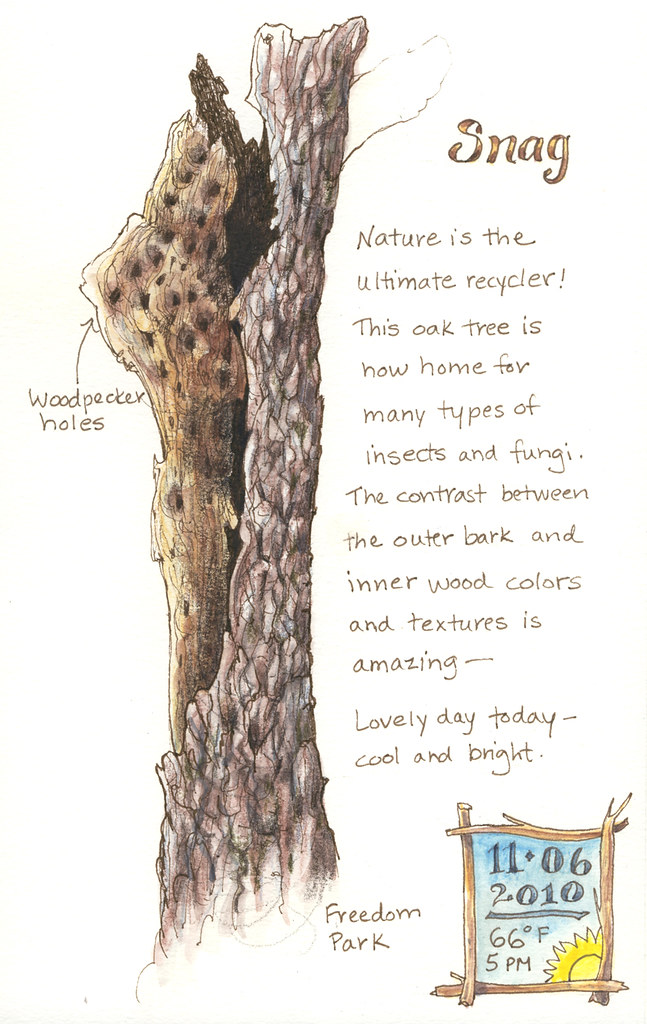
I confess to a fascination with dead wood, perhaps related to childhood memories of exploring woodpiles and decomposing logs. The echo of life is still there –I can imagine the seedling reaching for the sun, the unfurling of bud and leaf and inflorescence, the ripening of fruit or nut.
After death, another cycle of life begins – that of detritivores. On the microscopic level, bacteria and fungi colonize and start the breakdown process.
Invertebrates such as beetles, borers, and termites process wood nutrients or feast on fungi, and are feasted on in turn by vertebrates such as woodpeckers, anoles, and armadillos. Dead trees are used as homes by many species, including birds, bats, and squirrels.
This particular tree was an oak, probably a laurel oak. Something damaged it (lightning, a falling tree?), and the bark shows signs of regrowth round the split. The exterior bark and interior wood seemed to mirror each other, a glimpse of the past and present.
While nature may be extravagant, nothing goes to waste; all is consumed, refashioned, and repurposed – nature is the ultimate recycler.
You can click on the image to view it larger on my Flickr photostream.
Wednesday, November 3, 2010
Dahoon holly

Dahoon holly is a small, columnar tree often used in landscaping here in southwest Florida. Now that the berries are turning color, I’ve been noticing it in the wild as well, especially along roads that border wooded areas of pine and maple. Not only do the vibrant red berries catch my eye, but the pale gray trunks distinguish it from the noxious and invasive Brazilian pepper shrubs with similar-looking fruit.
I have always wondered what the word “dahoon” meant. Was it someone’s name? A place? Daniel F. Austin in Florida Ethnobotany
 explains that it may derive from a French corruption of the Catawba word yaupon. Before I confuse the issue further, There is a yaupon holly (Ilex vomitoria) that was thought to be used by native Americans in a ceremonial black drink. And yes, it’s said to induce vomiting.
Because the yaupon holly is similar to the Dahoon holly, Linnaeus grouped them together in the mid 1700's, which caused some classification muddiness. It’s thought that the French began referring to the slightly different holly as houx d’Ahon; Ahon being an altered form of yaupon (houx means holly in French). D’Ahon became Dahoon, and hundreds of years later we still call it dahoon holly.
Dahoon holly provides food for birds and small mammals, and bushy cover for smaller bird species. The trees are dioecious, which means that a tree is either male or female, with the female producing fruit. The berries ripen gradually, revealing shades of light yellow-green to amber to bright red, a feast for the eyes as well!
You can click on the caption above to view it larger on my Flickr photostream.
Subscribe to:
Posts (Atom)