Showing posts with label Food Forest. Show all posts

Friday, February 21, 2020

Exploring the Food Forest through art


Nature journaling at FGCU

On February 11th and 18th I visited Professor Mary Voytek’s Environmental Art class at Florida Gulf Coast University in Ft. Myers.  One of the projects for class is to keep a nature art journal – a wonderful and effective tool for exploring our natural world.  I shared my own nature journals and a presentation on how to use watercolor pencils with ideas on themes, as well as a wealth of reference books and art tools.    No better way to spend the hours than to explore art and nature!

This is my third or fourth annual visit here, and each time I get to connect with a brand-new group of students.   And each time, I’m inspired by their creativity and unique viewpoints.  Some of the students are artists, some are environmental or biology majors.  They share one thing in common: all are invested in our environment.

In the studio: drawing and painting natural specimens that resonated with each artist.

Part 1 (Feb. 11) 
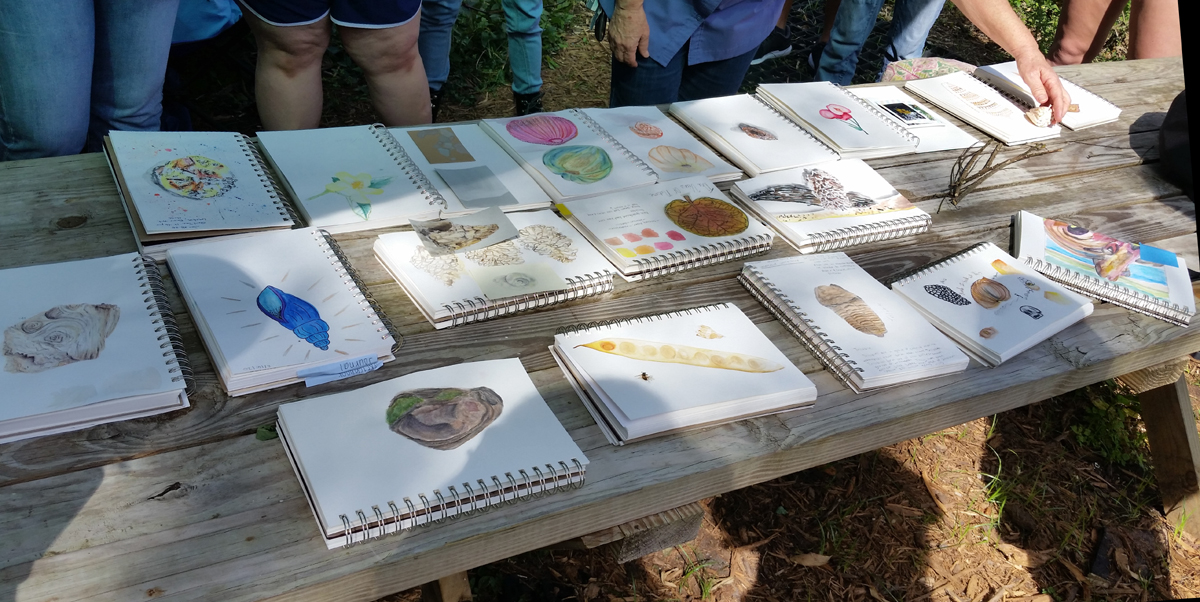
Because the class session is nearly three hours long, we have a nice chunk of time to draw after my part is done.  The found nature objects brought in to class for drawing range from pine cones to a sand dollar and shells, to leaves and wood and a dead honeybee.  And – wow! – the range of expression is quite remarkable.


Observation is the key to a great drawing! Mary and Elizabeth,and the joy of making art.


Completed artwork from our class time.  Sharing at the start of our Food Forest jaunt.

Part 2 (Feb. 18)
The week following our indoor class time typically takes us to the Food Forest at FGCU, and we spend our class hours drawing the plants and trees that line the trails.  Professor Voytek fills us in on the history of how one student’s initiative brought the Forest into being.  The project emerged into reality in 2011, and the half acre site continues to thrive (even after Hurricane Irma!), serving as a classroom and a food source, but also as a space for inspiration.  Apart from the cycles of predator-and-prey, it is a safe place for living things, with no pesticides or herbicides used.

So yes, there are honeybees and spiders, and the occasional black snake.  They are as essential to the ecosystem as butterflies, birds, and bunnies.  It makes me happy to see the abundance of pollinators busy doing their job, buzzing from flower to flower, trying to dodge the large humans blocking their flight path.   


ohana means welcome in the Hawaiian language, but it also honors community and our connections to each other. The new signs are filled with useful information.


Sketching a  Firebush. The smile says it all!
My mission there is to inspire these artists, but they inspire me in turn.  I feel competent to guide someone through a sticky color choice or a composition question, but only when needed, and it’s not needed often.  This is an invested and mindful group (regardless of skill level), so I get to do more admiring than assisting!  They inspire me with their unique viewpoints, willingness to take a risk and try new materials, and even their choice of subject.

Sharing after our outing.
We take time to share our work before and after our foray.  Sharing is important for any group of artists.  It takes courage to put our work and ourselves out there.  But it creates a place to learn from each other and to grow as artists.  It creates a space for support, and for caring for each other, if we will allow it.  We get to see our work with new eyes.

The Food Forest is free and open to the public.  It’s created by students, maintained by students, and promoted by students.  This is their website (by students, of course!) for more information: http://fgcufoodforest.weebly.com/


Click on images to view larger.
Online about FGCU’s Food  Forest
My past post on the Food Forest 


Thursday, February 16, 2017

Sketching in the Food Forest

My nature journal entry after my visit. 
Click on images to view larger.
The class
Tuesday I had the opportunity to be with a group of Professor Mary Voytek’s Environmental Art students as we scattered throughout the Food Forest at Florida Gulf Coast University in Fort Myers. Sketching plein air in a nature journal is one of their assignments for the course, but what I saw from their work went beyond mere obligation. I was inspired by the deep observations made as they struggled to translate a moving forest of color and light and shape onto a two-dimensional rectangle of white paper. Some captured small bits of landscape while most focused on a smaller detail or a plant portrait.

 Making art
One of the things I always find fascinating is the way different artists translate the same subject. We each see the world through a different lens, informed by our interests and experiences. The story we record on paper is our story: our relationship and reaction to our subject. For instance, several students drew in the banana tree area. Some were caught by the torn and fluttering flags of the leaves, some by the structures of the entire tree, some by the contours of a close-up leaf. Each was unique, each a different story, each wonderful in itself.

And drawing and painting en plein air is a struggle, no matter how experienced you are. In the classroom or studio, we are surrounded by an environment we control to some extent. Outside, we are subject to all of our senses, to weather, temperature, other people, insects, and animals, noises from natural and manufactured sources. Our light source changes as the sun moves. Air currents lift and drop delicate leaves and branches. All of these serve as the backdrop of the story we tell with marks on our pages.

Red mulberry tree is native to Florida; its story
is linked with humans over centuries.
That particular story has deep roots. Back to the human who interacted with plants and some form of medium – a cave wall? A piece of blackened carbon? Is this plant good to eat? Does it help with pain in the head? With healing? Our entire food and pharmaceutical chain is founded on plant life. Humans have shared information on the plants good for food, shelter, healing, and making tools. When we put pencil or brush to paper, that action connects us to all those who came before, who recorded their story of the plants around them.

Shaded paths circle and criss-cross for access to all parts.
The garden 
In the Food Forest, it is easy to imagine that scenario. It is indeed a forest, not a traditional garden with plants in regimented rows. Tropical fruit and nut trees shade paths that wind through herbs and shrubs. Most of the plants yield edible parts, while some are there to entice pollinators. Tomatoes and other vegetables grow in sunny spots, there are fruit and flowers on several mulberry trees, and the bananas have finished flowering, stalks of miniature fruit on their way to becoming edible adults. Splashes of yellow, blue, and red signal flowers of pigeon pea and papaya, blue porterweed and Cuban oregano, Turk’s cap and tropical sage.

With permission, I brought home some things to sample and sketch – a perfect way to extend my visit! And to remember the participants and their wonderful artwork, their stories told with pictures. These are the people who are changing our future. It was a student who first conceived of the Food Forest, and students who maintain and plant, harvest and educate. How exciting to think of the new and ancient paths they are making and taking! I appreciate being part of this as a guest speaker and artist, even for the short time I shared with them. Thank you, everyone.

Read more about FGCU’s Food Forest on their website (also created and maintained by students): http://fgcufoodforest.weebly.com/ 

And learn about the day-to-day plants and activities on their Facebook page:
https://www.facebook.com/groups/214926875208363/ 

 Strathmore Visual Journal sketchbook, 
140 lb. watercolor cold-press, 5.5 x 8 inches .
7 mm mechanical pencil 
Mondeluz watercolor pencils 
Niji waterbrush M