Showing posts with label black vulture. Show all posts

Tuesday, April 19, 2011

Sketching at Fakahatchee


This past Saturday, I had the opportunity to visit the Fakahatchee Strand Preserve State Park again as part of the En Plein Air event for April. This trip, we visited a disused remnant of Old U.S. 41 (also known as the Tamiami Trail), just north of the newer road. The remnant of road borders a canal and looks out over a marsh prairie habitat. As we traveled down the old road, a swallow-tailed kite swooped overhead, diving low enough for me to glimpse bright eyes and feather details.

We stopped at an old concrete bridge where the vista opened up. This part of the park has a different feeling from the cypress strands I visited before; the sky seems to extend infinitely above a vast expanse of grasses. It was a sunny day, and warm, with a breeze that kept the mosquitoes and some of the deerflies away.


Two of us settled down to draw and paint our surroundings, after our Park Ranger guide showed us some potential spots. Our choices included a buttonwood forest at the end of the road, an open canal lined with cattails, a variety of roadside shrubs and trees, and the prairie marsh. Our guide joined us to sketch after conducting more participants to our location. One of them included a flautist, and we enjoyed her music as it mingled with the wind rustling the grasses and dry palm fronds. What a wonderful experience!
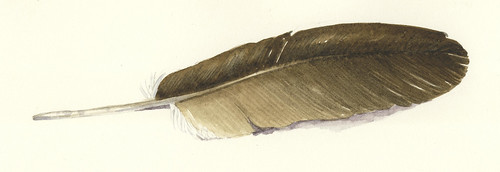
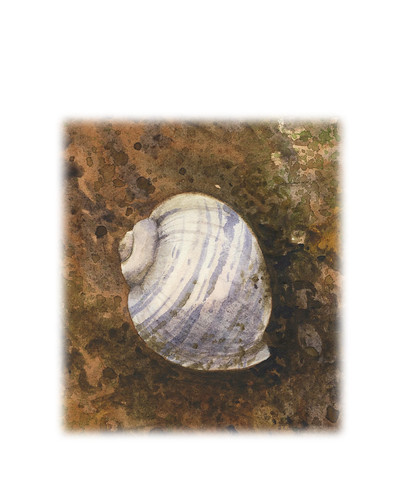
Our explorations yielded some interesting discoveries: an empty Florida apple snail shell, black vulture feathers scattered along the roadside, a water snake shedding its skin, and a wooden framework under the concrete bridge, which may have been the original structure. We saw green buttonwoods, wax myrtles, red mangroves, airplants (Tillandsia utriculata), a snowy egret, great blue heron, turkey and black vultures, and a raccoon ambling across the mud flats under the cattails.

It was a beautiful day, and a happy accident that our planned plein air sketching coincided with the 31st Worldwide SketchCrawl. If you’d like to see photos from the past art events at Fakahatchee, please click on the events tab just under the top banner. A warm thank you to everyone who joined us!

You can click on the caption of the top image to view it on my Flickr photostream.

Friday, September 3, 2010

Black Vultures, the cleanup crew


You know you’re a nature nerd when you find yourself stopping to take photos of vultures hanging out near a fast-food dumpster!

I don't remember this scavenger when I lived in the northern Midwest, but they seem to be abundant in the South – I see them as or more often than the more familiar turkey vultures. My bird books show a range for black vultures extending into South America, and as far north in the United States as Missouri, Tennessee, and Pennsylvania.

Without vultures to clean up dead and decomposing matter, our world would be rampant with disease-causing bacteria (not to mention how untidy and smelly it would become). Although some view vultures as harbingers of death, symbols of filth, or ominous omens – they have an indispensable job in our natural system.

Wikipedia has a nice entry about black vultures, and Saturday, 9-04-10 is International Vulture Awareness Day. Consider this event to be a reminder to learn a little more about these thankless janitors, and to appreciate their role in the circle of life and death on earth.

The more I read about vultures, the more impressed I am by their unique adaptations and value to mankind. Tidbits I found interesting:

• The common name of vulture comes from the Latin word vulturus meaning “tearer.”
• The genus name Cathartidae means “purifier.”
• The scientific name (Coragyps atratus) means “raven-vulture” and “clothed in black.”
• Care must be taken with vulture chicks because they imprint readily with humans.
• Black vultures may choose to migrate or to stay.
• They tend to be social birds.
• Like turkey vultures, they do not sing or call, but hiss and grunt.
• Black vultures are New World Vultures. Current dispute on vulture classification going on!
• They are monogamous.
• Vultures use the sun to bake and kill bacteria from their heads, beaks, and feathers.

You can click on the image above to view it larger on my Flickr photostream.

Parents and teachers:
You can click here to download a PDF coloring page of an ink drawing of the center bird.