Friday, April 22, 2011

Earth Day 2011

Earth is Square, Heaven is Round
Wooden cigar box, plastic, leather, found objects, roots, acrylic paint, and beeswax.
4 x 4 ¾ x 5½”
 Today I felt inspired to share a piece I made several years ago that was part of a body of work created for an exhibition.

I started with the concept in Chinese mythology that the earth is square, and that heaven is round. In this piece, the square earth is enclosing the heavens, an inversion of the general perspective that heaven surrounds the world.

The exterior of the box contains a gold and jeweled tortoise, meandering across a painted representation of the swirling matter of the cosmos. The tortoise is an ancient symbol for originator, and a vehicle for supporting the world. I won’t say much more, because I prefer that each viewer create their own meanings.

Throughout history our relationship to nature and the earth has been one of discovery, exploration, and domination. In our effort to understand the natural world, we collect and name plants, insects, rocks, and animals – displaying them in museums and organizing them in cabinets. This is a way to control both the things we fear and those we don’t understand.

Yet even in our attempts to dominate, we still have a connection to the natural world that we value, an ancient link grounded in mystery that has endured despite our increasing technology. This piece is about the unsolved mysteries of natural things, and how we relate to them.

So this weekend in your travels, think about your personal connections to nature and the earth, and the deeper meanings they have for you.  What are the things that strum your heartstrings?

Tuesday, April 19, 2011

Sketching at Fakahatchee


This past Saturday, I had the opportunity to visit the Fakahatchee Strand Preserve State Park again as part of the En Plein Air event for April. This trip, we visited a disused remnant of Old U.S. 41 (also known as the Tamiami Trail), just north of the newer road. The remnant of road borders a canal and looks out over a marsh prairie habitat. As we traveled down the old road, a swallow-tailed kite swooped overhead, diving low enough for me to glimpse bright eyes and feather details.

We stopped at an old concrete bridge where the vista opened up. This part of the park has a different feeling from the cypress strands I visited before; the sky seems to extend infinitely above a vast expanse of grasses. It was a sunny day, and warm, with a breeze that kept the mosquitoes and some of the deerflies away.


Two of us settled down to draw and paint our surroundings, after our Park Ranger guide showed us some potential spots. Our choices included a buttonwood forest at the end of the road, an open canal lined with cattails, a variety of roadside shrubs and trees, and the prairie marsh. Our guide joined us to sketch after conducting more participants to our location. One of them included a flautist, and we enjoyed her music as it mingled with the wind rustling the grasses and dry palm fronds. What a wonderful experience!

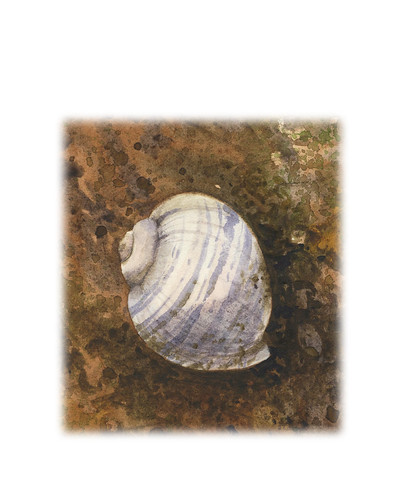
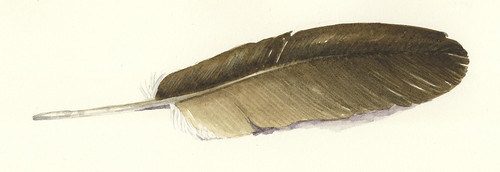
Our explorations yielded some interesting discoveries: an empty Florida apple snail shell, black vulture feathers scattered along the roadside, a water snake shedding its skin, and a wooden framework under the concrete bridge, which may have been the original structure. We saw green buttonwoods, wax myrtles, red mangroves, airplants (Tillandsia utriculata), a snowy egret, great blue heron, turkey and black vultures, and a raccoon ambling across the mud flats under the cattails.

It was a beautiful day, and a happy accident that our planned plein air sketching coincided with the 31st Worldwide SketchCrawl. If you’d like to see photos from the past art events at Fakahatchee, please click on the events tab just under the top banner. A warm thank you to everyone who joined us!

You can click on the caption of the top image to view it on my Flickr photostream.

Monday, April 11, 2011

Apple snail studies


Apple snail studies, originally uploaded by Elizabeth Smith.

This empty snail shell was found in a ditch near some woods in town, and although I know it’s an apple snail, I’m not sure which one it is. Florida has one native species of apple snail,  and several invasive species –causing concern among biologists and farmers. The invasive species are probably released from home aquariums. Apple snails are popular in the aquarium trade because they’re attractive and are effective tank cleaners.

Apple snails are the largest freshwater snails on earth; the snail shell I sketched is about 3 inches long! The fact I find most interesting about these snails is their breathing structures. Some snails have gills, and some have lungs, while some (like the apple snail) have both gills AND lungs. Having both breathing arrangements allows them to successfully weather our wet and dry seasons. The Florida apple snail is the main food for the limpkin and the Florida snail kite, an endangered species. No wonder biologists are concerned over the nonnative invaders.

I sketched this shell from several different angles with a Sakura Micron Pigma sepia color pen with an 01 point. Lately, I’ve found myself sketching directly with ink more often, bypassing the preliminary pencil lines. It’s very freeing (once you get over the initial *yikes* factor), and I find that with a fine point and hatch lines, my false starts fade into the rest of the drawing. Anyway, I hope you get a more immediate connection to my subject with this method – unfortunately, I find that the more detail I add, the tighter my drawing gets. Some days I find it very difficult to loosen up my drawing style.  There's always next time!

If you’re interested in reading more about these snails, please visit these additional links:

Technical Bulletin on Apple Snails from the Commissioner of Agriculture (PDF)

USGS (United States Geologic Survey), about the Florida apple snail (PDF).

You can click on the caption of the top image to visit it on my Flickr photostream.

Sunday, April 3, 2011

Nursery log


Nursery log, originally uploaded by Elizabeth Smith.

On our swamp walk after our art get-together at Fakahatchee Strand Preserve State Park, we came across this nursery log. Nursery logs (or nurse logs) are fallen trees; the decomposing trunks create a food web in the forest or swamp. When this log fell, it left a gap in the canopy which let additional sunlight into the swamp. As it decayed, the log became home for many types of life: insects, fungus, mosses, ferns, and tree seedlings.

The softening wood provides nutrition and a raised bed away from the competition of existing plants on the woodland floor. Leaf litter collects in the nooks and around the base of the degenerating log, which provides habitat and nesting material for small animals.

Detritivores such as bacteria, fungi, millipedes, slugs, terrestrial worms, and small land crabs feast on the log and the surrounding leaf litter. They break down large matter into smaller pieces and return nutrients back into the soil. In turn they are eaten by birds and small animals, which are preyed on by even larger species.

This particular log was probably a felled cypress. The diameter of the remains is about two feet; the truncated length suggests that it may have been left as a remnant of the cypress logging heyday in the mid 1900’s. What amazes me about this log is the number of seedlings, mosses, and fungi growing on it – I can only imagine the activity going on inside of it!

You can click on the caption below the image to see it on my Flickr photostream.