Every day this time of year our skies start out fairly clear and blue. Then the clouds start to build, usually puffy clouds, turning into towering cumulus. Towering cumulus can assemble themselves into cumulonimbus – tall, tall skyscrapers of misty water droplets that return to earth in tropical downpours. These clouds can tower for miles, up to 40,000 feet!
This time of year I also see a lot of butterflies: Sulphurs of all types, Whites, Gulf Fritillaries, Viceroys, White Peacocks, Swallowtails…a riot of fluttering color. It seemed appropriate to add a Sulphur against the clouds, since I see so many pairs of them dancing and swirling up in the sky lately.
You can click on the image above to see it larger on my Flickr photostream.

Sunday, August 29, 2010


Sunday, August 22, 2010
Sea grape

Sea grapes are seen throughout Southwest Florida, in both wild and cultivated settings. They’re a distinctive tree, with leathery round leaves on sturdy petioles. The grape-like fruits ripen in the fall to red and purple, eaten by birds and wildlife and used by humans to make jelly or wine.
They’re especially attractive growing wild along the back of the dunes in beach scrub areas. The influences of salt and wind stunt and twist the trunks in fantastic ways.
 Emerging leaves are a shiny bronze-red against the varied light and dark greens of the older leaves. The older leaves turn all shades of reds in the winter after they drop, and are wonderful to sketch. Trees along the dunes have a smooth gray-brown bark, some of them silvered – while the tree in my yard has is covered with a range of light to dark browns.
They’re especially attractive growing wild along the back of the dunes in beach scrub areas. The influences of salt and wind stunt and twist the trunks in fantastic ways.
 Emerging leaves are a shiny bronze-red against the varied light and dark greens of the older leaves. The older leaves turn all shades of reds in the winter after they drop, and are wonderful to sketch. Trees along the dunes have a smooth gray-brown bark, some of them silvered – while the tree in my yard has is covered with a range of light to dark browns.
 Sea grape seems essentially tropical: I can imagine the larger leaves (some up to 9 inches across!) used as serving plates or temporary hats, clothing, or to thatch a quick shelter. The fruit is described as astringent, sometimes with a sweet-sour taste. Sometimes those are the best thirst-quenchers, diluted and sweetened like lemonade.
I’m trying out my new sketchbook here with Derwent watercolor pencils. I’m not sure it layers as well as I’d like – the leaf on the left is a good example of what not to do – too many layer attempts! I sketched the right leaf with more economy and it turned out better. I think I’m used to a smoother textured paper, but that’s all part of getting to know one’s materials!
You can click on the sketchbook page to view it larger on my Flickr photostream.
I've added a PDF coloring page of a scrubby young sea grape tree (with a leaf inset) if you'd like to download it for your class or home school use. Just a warning: it's 2.03 MB, so download times may vary depending on your connection. I've found that the best way to download PDF's for a PC is to right-click the link and use the "save target as" feature and save it to my computer before opening. Let me know if you have any problems and I can email it to you directly. Here is the link:
Seagrape coloring page
Sunday, August 8, 2010
Firebush

The heat, humidity, and mosquitoes are keeping me inside, so I brought in a small branch of Firebush to paint. It's just as well, as it's been quite overcast today.
This plant is one of my all-time favorites! It looks great in the middle of summer, and attracts all sort of butterflies, as well as our ruby-throated hummingbird. It does get a bit bedraggled in the winter, but the birds seem to relish the berries after a couple of cold spells.

I'm trying out my early birthday present - a new Pentalic Nature Sketch sketchbook in the 6 x 12 inch size. The format is unusual, but I read a good review about it, so I'm giving it a try.
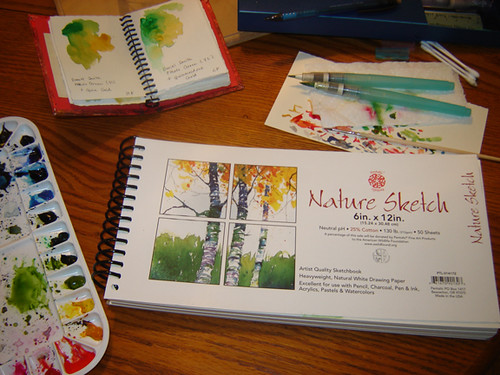
The paper scans a bit yellow (as does the Arches hot-press watercolor paper), but it seems to take watercolor fairly well. I wouldn't recomend it for finished paintings; it won't withstand repeated washes and/or color lifting. Otherwise the paint goes down nicely, and the Micron pens work well on the surface.
I'll try out regular pencil and watercolor pencil soon. All in all, I think it will be a great nature journal!
You can click on the images above to view them larger on my Flickr photostream.
Sunday, August 1, 2010
A Florida Walk

I took a walk this morning, down our neighborhood bicycle path and sidewalk. It’s probably not that much different from your neighborhood – filled with trees, plants, birds, and butterflies of one sort or another. It always amazes me the amount of life that abounds in even small areas.
When I got home from my walk I did a memory sketch – a composite of those things that I most vividly remembered, but believe me there was so much more left out! For example, I didn’t see any birds, but they were singing and calling and fussing all around me: crows in the pines, blue jays in someone’s backyard, mockingbirds in the cabbage palms, and somewhere… the “chip, chip” of a cardinal.
My drawing is a bit off in some areas, but free-sketching like this helps strengthen my observation and drawing skills. My snake is pretty symbolic, and the Virginia Creeper leaf is really not shaped like that. By the time I added that, all I could remember was “five lobes.”
Anyway, I hope you enjoy a vicarious outing in Southwest Florida. At least with a virtual walk there is no heat and humidity!
You can click on the image above to view it larger on my Flickr photostream.
Subscribe to:
Posts (Atom)