
Monday, May 31, 2010
Swamp lily

I’m not always able to get out in the field to draw, so when I’m outside I try to take reference photos of interesting subjects for those times. Swamp lily is one of those reference photos. There is something prehistoric about them – perhaps it is the thick stems and leaves, maybe the spidery blooms.
Rather than try to capture a botanical likeness, I wanted to convey my feelings about this plant in an expressive way. The shapes are recognizable, but also left somewhat ambiguous. Sharp edges contrast with softer edges. I felt there should be mystery, and poetry, and gaps left for the viewer to complete.
I used watercolor pencils over a light pencil drawing, and sponged away some of the color towards the bottom for a soft look, adding more color and darks around the centers of the blooms to bring them into a sharper focus.
You can click on the image above to view it larger on my Flickr photostream.


Saturday, May 22, 2010
Florida privet
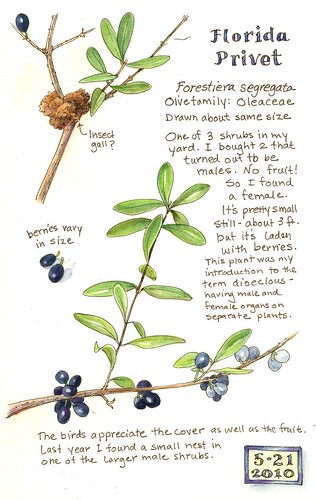
This multi-branched, fine-leaved shrub is fruiting right now in Southwest Florida. the berries are a deep indigo blue with a dull satin sheen to them. I've seen many different types of birds in these shrubs, but haven't observed any species in particular eating the berries.
A flowering Florida privet seems to attract a lot of insects, which also attracts the birds, especially the small warblers. I think it also provides a welcome intermediate cover between the ground and the taller trees.
One thing I didn't show here in my close-up study of the leaves, gall, and berries is the delightful arching droop the larger branches have taken. The older shrubs have a willow-like grace to them, but with more branching.
You can click on the image above to view it larger on my Flickr photostream.
Snake skin

Found on the ground: a papery memory of a snake event. Apparently snakes shed their skins several times a year, depending on their age and environmental factors. My young friends were kind enough to bring me this gift to add to my nature journal. It was interesting to draw the wonderful folds and crinkles and scales - not to mention the occasional whiffs of a peculiar "snake" smell!
You can click on the image to view it larger on my Flickr photostream.
Saturday, May 15, 2010
Dragonfly

I found this dead dragonfly on the ground recently; perfect for observing those tiny details and for a closer study. Their life span is measured in months - so although I felt sad at its death, it seemed special that I found this specimen in great condition (except for a couple of missing legs). Usually I find only partial bodies of decomposing insects, often in the process of being consumed by other insects!
I don't know much about dragonfllies, so naturally I went off to research them. the fist thing I learned is that this is a skimmer, one of the dragonfly families. I found out that the order Odonata means "toothed one," and also read an interesting theory on the origin of their common name. You can read the short theory here.
I carefully drew this out in pencil first, then used my Sakura Micron Pigma sepia pens to outline and fill with texture, using hatching and cross-hatching to get my deepest browns. I added watercolor washes, using Daniel Smith Burnt and Raw Umbers, as well as the Quinacridone Gold (yes, from my new palette!).
Since this is my personal nature journal, I didn't feel compelled to draw each vein, although someday I would like to be able to enjoy the patience (and eyesight) to do so! The enlarged wing detail is off in proportion (yikes); I think I was overwhelmed anticipating all of those wonderful netted veins!
The important part of this exercise is that I learned a lot from my observations and research, and enjoyed quieting my busy left brain while I focused on line and form and texture. Ahhhhhhh...
You can click on the image above to view it larger on my Flickr photostream.
Sunday, May 9, 2010
New WC palette

I already have two watercolor kits for the field – one is a Sennelier 14-color travel set and one is a 3-color Daniel Smith primary set I made from a repurposed eye shadow container. I’ve enjoyed using the Sennelier colors, but since they came as a set I wasn’t always happy with the color choices (are we ever?). I always planned to use them up and refill them with colors I use most often. The primary set I use for times when I lighten my load and carry just the basics. Part of me always wanted to have access to some of the colors on my larger palette – some have wonderful properties that I wanted to use in the field or just anywhere.

So I’ve been browsing for some time through art catalogs and online, searching for an empty palette that I could travel with, wouldn’t cost much, and wouldn’t leak (one of my complaints about my other kits). Wow! One can spend a lot of money on EMPTY palette containers. You may remember from an earlier post that I am at heart a frugal artist. Since I recently had a pleasant experience buying Kimberly watercolor pencils on eBay, I felt comfortable taking a chance there. I found this 18-color empty plastic travel palette at a reasonable cost, and with more of a complete description than I found in my catalogs. Shipping costs were minimal, and it arrived in the original box.
I filled them with the Daniel Smith paints that I felt I would use most often, trying for a balance between warm and cool versions of hues. I sketched and painted my layout as an aid for the future: not only does it help to see how the colors look on paper, but when it’s time to refill them I’ll select the right color! Then I also wrote down some of the properties from my Daniel Smith catalog. Knowing certain properties can really help me as I paint, especially the transparency and staining attributes, since sometimes I like to glaze or lift colors. There were some surprises in store; this exercise taught me a bit more about my materials that I’d either forgotten or had never realized.
So far, it’s worked out well! It has a hinged lid with a fold-over latch. The seal is indeed leak-proof, and I appreciate the ample mixing wells. A clear plastic lift-out tray fits into the top lid for mixing colors. The entire closed box measures 5-1/4 wide by 10-5/8 long by 1 inch tall. It’s larger than my other palettes but it works; it’s nearly the same size as my sketchbooks. I made a 2-inch wide elastic large strap with a Velcro closure that I use to bundle my sketchbook, palette, and waterbrush box together, and it works better with that set-up than my other palettes.
If you click on the bottom image you can see them larger on my Flickr photostream.
Subscribe to:
Posts (Atom)