Sunday, October 16, 2011

Sketchcrawl at Naples Preserve


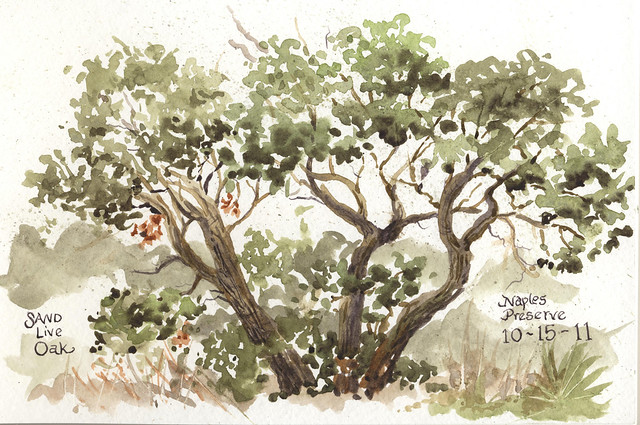
Sketchcrawl at Naples Preserve, originally uploaded by Elizabeth Smith.

Yesterday eight of us met at the Naples Preserve to participate in the 33rd Worldwide SketchCrawl!  The sky was overcast, and the air was that soft, satiny texture that comes before a rain.  Thankfully the rain held off and we enjoyed exploring the boardwalk that winds through scrub habitat, and sketching the wonderful inhabitants. 


Young gopher tortoise ambling to its burrow. Length was about 12 inches.

Lavender, violet, yellow and blue were the colors of blooming flowers: moss verbena, Florida paintbrush, liatris (violet colors), black-eyed Susan, coreopsis, beach sunflowers (bright yellow) and dayflower (vivid, clear blue).  These were punctuated by the brilliant magenta-purple berries of American beautyberry. 

Gopher tortoise burrows dotted the sandy soil, and we spotted one partially hidden in its underground hideaway, and another smaller tortoise digging in the sugar sand.  Cicada and bird song accompanied our ambles, and we spotted red-bellied woodpeckers and mockingbirds flitting in and out of the scrub oaks. 


My watercolor of a wonderfully twisted sand live oak toward the beginning of the boardwalk.

In progress!


It was an enjoyable day: an opportunity to paint plein air and to make detailed studies of unusual plants.  Thank you to those who helped organize our event, and to those who attended!


Saturday, October 8, 2011

Sycamore leaf


Sycamore leaf, originally uploaded by Elizabeth Smith.

This leaf is from my recent trip to Copeland, Florida to draw and paint the Bula Baptist Mission Church. There was a small stand of trees nearby, and I picked up some of the fallen leaves to paint later. Most of the fallen leaves were monotonously brown in color, but this particular one still had some green turning to a warm reddish brown (later it faded to an even medium brown color).
 
I used two pigments to create a brown and to liven up and exaggerate the colors I saw: Daniel Smith Sap Green and Cadmium Red. I added the veins later with a dark-brown watercolor pencil. I’m still testing the Strathmore Windpower Watercolor sketchbook, which is the paper I used for this study. The spiral bound 6x9 book is loaded with 15 sheets of 140 lb. cold-press paper and is a good value for the cost (under $10.00).

Sycamore trees are not common in Southwest Florida – they’re almost always planted as part of a landscaped home or institution. They are more common in the wild in north Florida, and are trees that prefer floodplains, although they adapt well to other habitats.

Their distinctive features: out-sized, broad palmate leaves; thin plate-like bark in mottled cream and brown colors, and a large height and spreading leaf crown. I’ve found the leaves to be great subjects for study because of the strong veins and interesting shapes they take when drying.

Interesting facts about sycamores in Florida:

•We have two co-champion trees, one in Orange County and one in Alachua County. Champion trees are documented as the largest representative tree of their species.  If you’re a fan of big trees, you may want to visit:
Native Tree Society (scroll down to BigTree/Tall Tree listings in the left navigation pane).

•We have sycamores growing here that traveled to the moon! Well, the seeds did, anyway. Hundreds of various species of tree seeds traveled on the Apollo 14 mission to the moon on January 31, 1971 as part of a joint NASA/USFS project. The seeds were germinated upon return to earth, and seedlings ended up at the University of Gainesville, The Kennedy Space Center, and Cascades Park in Tallahassee.

You can see more sycamore leaves on my Flickr photostream, especially in the set labeled Color Charts and Mixes, where I was trying out various triad color combinations.

Thanks for visiting!

Monday, October 3, 2011

American sycamore ~ how many ways to draw a leaf?

On the left, a leaf drawn with pen scribbles; on the right, the same leaf drawn with a mechanical pencil.
I like sycamore leaves because they're quite large, and as they dry they create interesting shapes that are a challenge to sketch or paint.  Sometimes I like to experiment with different ways of drawing the same subject, and a sycamore leaf is the perfect subject.  This practice helps my future sketching because it gives me ways to compare ease of media as well as the mood and texture they create.  You can see from the examples that each leaf has a different character, depending on the technique I used.

The leaf at the top left has a free and casual feeling; I used random, rather large scribbles to build up the planes and masses.  The leaf sketched in pencil (top right) has a much softer feeling - this particular pencil allows for fine lines and a gradation of grays.  Notice how the pencil lines follow the curve of the leaf between the veins, and how each line has continuity in direction, totally unlike the scribble texture.

The leaf in the bottom example (left) has an ink outline with stippled dots describing the shadows and masses.  This lends a more formal feeling to the drawing, and is often used for botanical illustrations because the dots reproduce well and can indicate a lot of detail.  This particular drawing doesn’t contain much detail, because of the size of the dots relative to the size of the subject.  Imagine if you were to make a large drawing with many dots, and how descriptive it could be!  Needless to say, this method is time-consuming and not a good choice for sketching in the field, although it can have its purposes. 


The next leaf is also in ink, but with hatching and cross-hatching to show form and value.  This technique can mimic old ink engravings if the lines are very parallel and evenly spaced, or be more free if the lines are more haphazard (like mine).  Each technique is unique, and can be combined to create even more interesting lines. 


Left, an inked outline with stippling in pen; right, the same pen but with cross-hatching.
I hope this exercise has been helpful, or spurred some new thoughts about alternate ways of making lines.  You might want to think about using them with unconventional media as well as the traditional standbys I used.  Next post: more about sycamore leaves!

You can click on the images to view larger.  Thanks for visiting!