
 |
| Sketching with a brush and watercolor paint directly onto the paper. From my photo reference. The cormorant was tired at this point, and bunched its neck up close to its body, huddling near the floor. |
Naturally, I felt the need to grab the camera and take some photos for future reference. Cormorants have glossy brown feathers that follow the contours of their duck-like body, and a sinuous snake-like neck. They look very much like another water bird, the anhinga. Both are diving and fish-eating birds, but the cormorant has a hooked tip at the end of its long, slender bill, while the cormorant has a pointed tip.
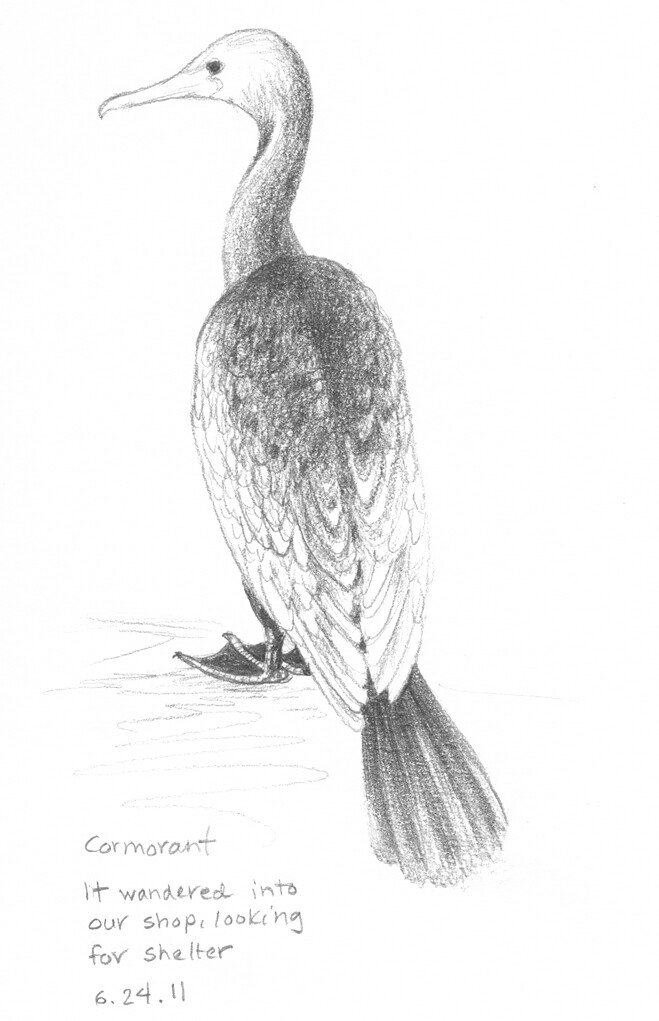 |
| A pencil sketch from my reference photo . |
The nature center had warned us to wear safety glasses or sunglasses when we handled it, and minutes later I found out those cormorants have VERY sharp bills, and was glad I was wearing my glasses. When I put the lid onto the box, my left hand wasn’t as nimble as my right and I now have two shallow slashes near the nail bed of my middle finger. Ouch!
I drove to the Conservancy without further mishap and dropped the cormorant off to more capable people. I called to check up on it the next day, and they told me that the poor bird was dehydrated and underweight, and that they were giving fluids and keeping it in the incubator for warmth. I think the poor bird was on its last legs when it came to us; they said it might be 24 to 48 hours before they knew if the bird would pull through. I’m keeping my fingers crossed.
You can also visit my Flickr photostream to see other nature sketchbook images.


