
Tuesday, July 27, 2010
Florida rock

Geology in Southwest Florida is simple; our rocks are mostly one type. Below our soil and sand lies sedimentary limestone, composed of calcium carbonate from the remains of billions of marine invertebrates from an ancient sea. Florida has so many different types of limestone that they’ve identified and named the different areas; take a look at this geologic map of South Florida from the USGS (United States Geological Survey).
This rock is from my garden, imbedded with pieces of fossilized shell and coral and overgrown with algae. Normally limestone is white or off-white, but this rock has been in a moist and shady environment for quite a while and has taken on many shades and ranges of grays. It seems that most of the shells are bivalves, but there is a bit of repeating coral pattern here and there. This limestone has a rough texture, not pleasing to handle, but full of fascinating discoveries.
Ever since I can remember, I’ve had a fascination with rocks: picking them up, wondering over their origins and travels. They seem to possess a slumbering consciousness – they are a connection to the dust we sprang from, a talisman of timelessness. This one, especially, is a reminder of the shallow seas that covered the bottom third of Florida 325,000 to 650,000 years ago.
I painted this rock on a stormy Sunday afternoon, when the outlying moisture-rich clouds of Tropical Depression Bonnie passed over us. I scanned it in stages to document each phase, from loose washes to tighter details: click here to see the progress. The final product came out a bit darker than I planned, but I think you can still see the different pieces of fossil shells, and get a feeling of my connection to it.
You can also click on the image above to view it larger on my Flickr photostream.


Sunday, July 18, 2010
Bumble bee (also bumblebee)

I found this bee on the ground and couldn’t resist the opportunity to study it in detail. I’m not fond of bees or other stinging insects, but I’ve always had a soft spot for bumble bees.
The sound of its common name “bumble” seems to fit so well! It fits the rumbling buzzing sounds and the way the bees forage for nectar and pollen: clumsily bumping and nuzzling blossoms in an apparent aimless way.
When I draw or paint something, it spurs me to research my subject a little more deeply – now that I know it better from my observation and drawing, I need to answer the questions that surface during the process.
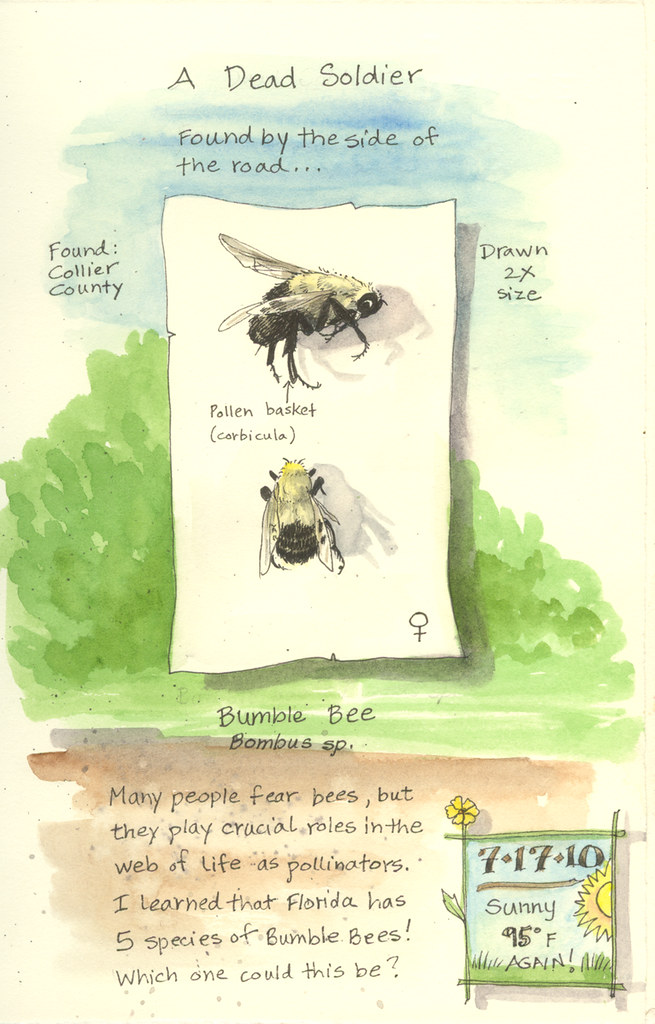
Florida has five species of bumble bees! In my entomological ignorance, I thought there was just one. Florida is a long state north to south, so we encompass several zones and many habitats. I learned that the further south one travels in Florida, the fewer bumble species there are.
I tried to use the identifier interface at Discoverlife.org to find out which bumblebee this might be, but didn’t succeed. Perhaps I entered some incorrect information or this bee is an anomaly; I just don’t know enough about bees to know what I might be missing. The portal for bumblebees is here if are interested.
I further learned that bumbles nest underground or in convenient cavities. Growing up in Iowa, most country kids know the importance of bees for crop pollination. Without bees, our food base would suffer.
I found that bumblebees are also valuable for something called “buzz pollination.” Their technique dislodges firmly held pollen, and they are especially sought for greenhouse pollination or for certain plants such as tomatoes, potatoes, eggplant, blueberries, and cranberries.
Next time you visit the produce department or a vegetable roadside stand, thank a bumblebee!
You can click on the images above to view larger on my Flickr photostream.
Thursday, July 15, 2010
Simpson Stopper

Simpson stopper is blooming and fruiting now; the flowers are incredibly fragrant! This is a quick sketch on cold-press watercolor paper with my Sakura Micron Pigma sepia pens. I added some watercolor washes during and after.
Rather than trying to be precise, I tryed for a more emotive style. Ha! Somehow I still reverted to drawing the leaves and flowers in a more descriptive way.
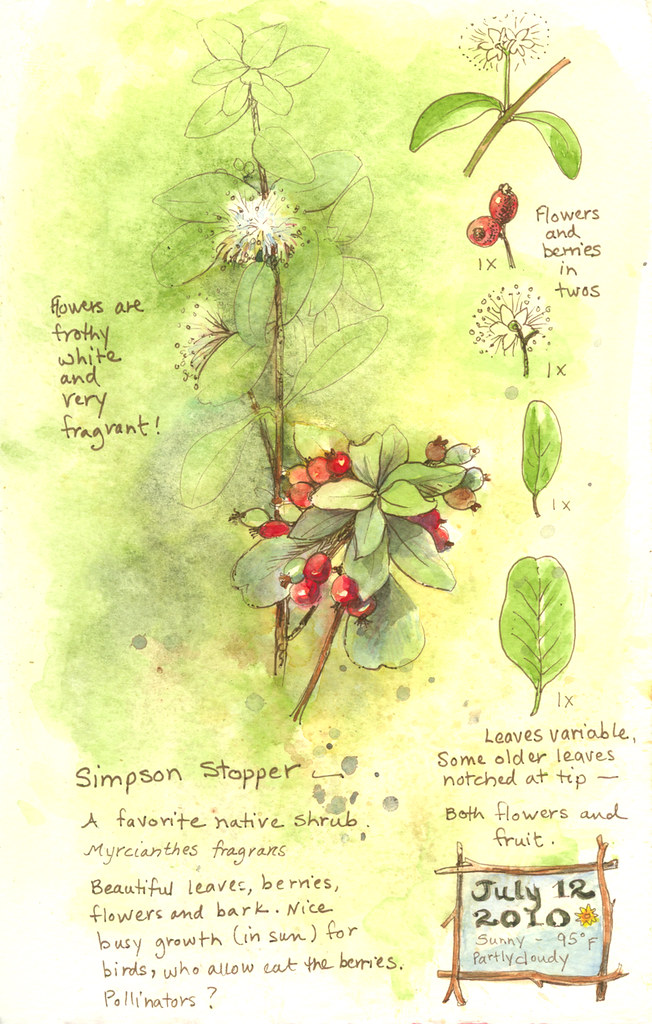
You can click on the images above to go to my Flickr photostream, where you can view them larger. If you'd like to see a more precise sketch of this shrub or small tree (leaves, bark, and berries) you can click here. Thank you for visiting!
Wednesday, July 7, 2010
Why watercolor pencils?

You might have noticed that many of my recent nature journal entries are in watercolor pencil, and some people wonder why I often choose this over other media. My answers? Portability, ease of use, and versatility.
Right now I don’t have a studio space, so I often find myself sketching in odd spaces such as a sofa corner or the dining room table. I also like to sketch outside, and might be standing on a boardwalk or sitting on a lake’s edge; neither of which is friendly to an elaborate set-up.
Watercolor pencil media seems to be an ideal solution for my nature journal because I can carry a small set and a waterbrush for field sketching, or use them in a cramped indoor space for a close-up study.
Besides being extremely portable, they’re also easy to use after a bit of practice. I’ve always enjoyed having a pencil in my hand, and watercolor pencils give me a connection to drawing and sketching. I also love brushwork and the unpredictability of watercolors. These give me both! Once I’ve created a chart of my basic colors (see my Kimberly chart here) and have played around with the media, I know a bit more about what to expect when I use them.
Their versatility allows me to use them as pencils, or like watercolors, or as a combination of both. Working from light to dark, I often like to work in layers, although sometimes I like to keep it simple and work in just one pass. They’re handy to use for quick thumbnail sketches or for more detailed studies on the fly. Please note that in the following demonstration, you can click on the image to view it larger.
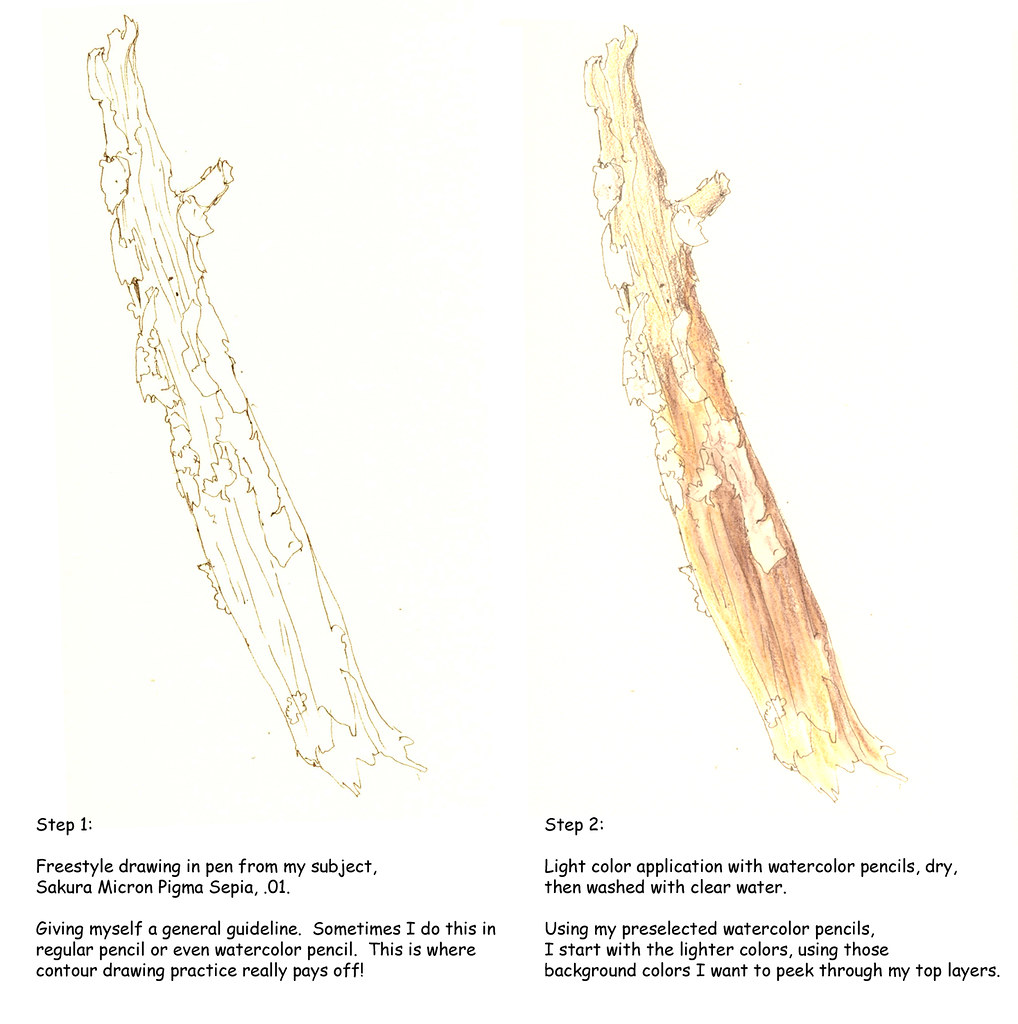
A dry pencil can be used for linear textures or solid color, or the scribbles dissolved completely for a wash similar to watercolor paint. At times I mix media, frequently using a fiber-tipped ink pen (such as Sakura’s Micron Pigma or Pitt’s Artist Pens), then add color with watercolor pencils. I’ve also used the water soluble pencils with watercolors and charcoal.
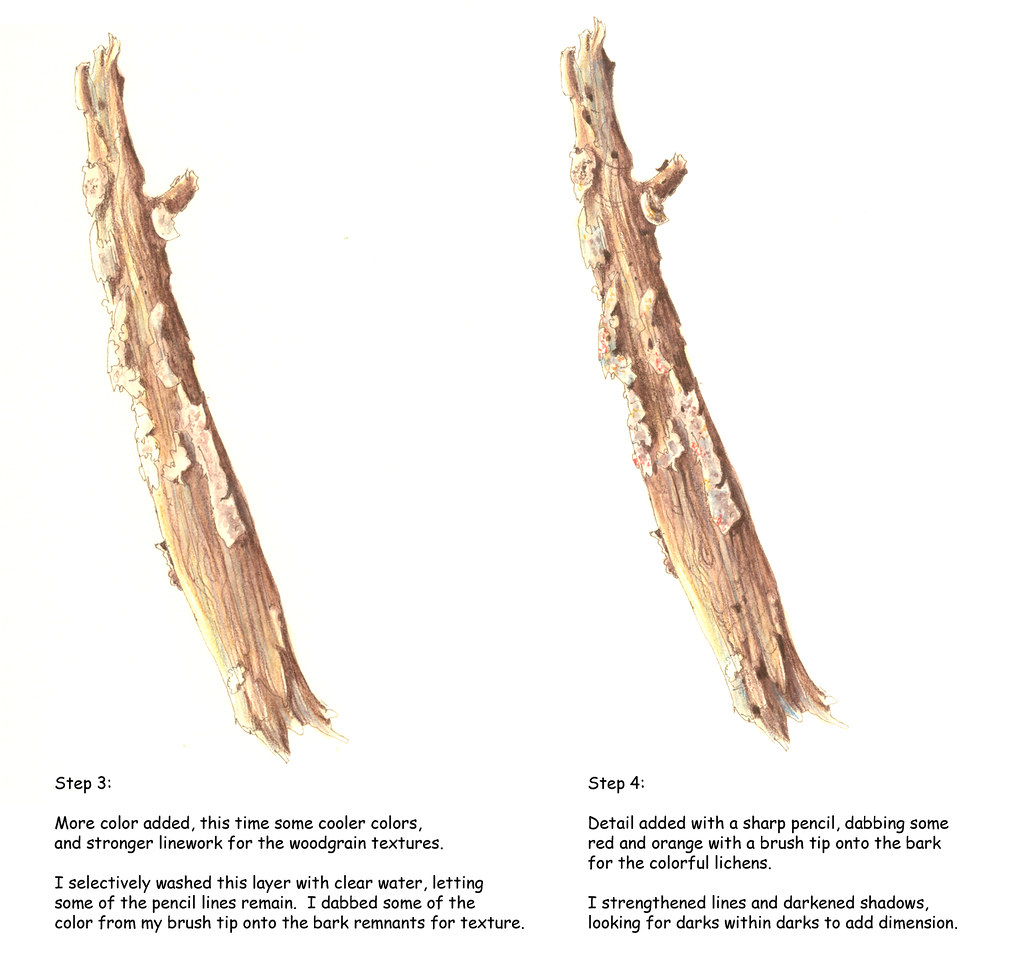
The step-by-step demonstration of this old pine branch gives a good idea of the process that I often use. The best tool is a test sheet of different colors that might be good candidates. The test sheet at the top of this post shows several colors that seemed to be present in my subject. I did utilize them all, however the Yellow Ochre and Orange were used very sparingly.
I was introduced to watercolor pencils last summer when I took an online class from artist and author Cathy Johnson, and learned how wonderful the media can be. Water-soluble pencils turned out to be a great tool for my nature journal kit!
You can click on any of the images above to view larger on my Flickr photostream.
Saturday, July 3, 2010
My seashell collection


“I have a seashell collection; maybe you’ve seen it? I keep it scattered on beaches all over the world.”
Steven Wright (American comedian)
I used to collect all sorts of natural things when I was younger: shells, rocks, butterflies, bones, pieces of wood. I was demonstrating the perfect example of a naturalistic intelligence, as defined by Howard Gardner’s theory of multiple intelligences.
His theory states that different people have different frameworks of viewing and interacting with the world around them. This structure influences the way we learn, create, and problem-solve. Education World has a nice article that summarizes his theory and each of the eight intelligences he described.
A naturalistic intelligence simply means that I tend to operate on a “recognize and classify” basis, but I also have an equal tendency to relate to the world around me in a spatial/visual way. Literacy Works has a fun online test you can take to find your top strengths or intelligences.
The reason I like the quote I illustrated is that it describes the way my focus has changed. At eight, I marveled at the individual treasures I could hold in my hand, at fifty-five I feel that if I can draw or paint or photograph them, they should stay in their spot in the world. I still pick up and value some of these small treasures occasionally, but for the most part, my seashell collection can stay on the beaches!
You can click on the image above to view it larger on my Flickr photostream.
Subscribe to:
Posts (Atom)