Monday, April 26, 2010

More ideas for journal entries


Some time ago I wrote about my process for nature journal entries (you can read about it here). In general, I use drawings and words to describe my daily experiences.

A nature journal doesn’t have to be limited to illustrative artwork or words about your subject, especially for kids. Home school or independent projects can include fun ways to explore and express the things we learn about the natural world around us.

If you are stuck for ideas, try choosing one item from each column below to mix and match, or use them as a starting point for your own imagination.

A menufor a birdin your yard
CD cover a mammalat a nearby park
Diagrama habitatin your community
A map ofwater creaturesat your school
A game plants and animalslast month
Charta food webin wetlands
Interviewthings that flyin the summer

When I was at the park yesterday, I decided to try a map of a habitat (a map of...a habitat...at a nearby park). The more I looked at the habitat I chose (a lake and its surroundings) – the more I realized the sheer numbers of different plants and birds there were! So I did a small portion of it (top drawing). I didn’t feel that my drawing showed the ups and downs of the land, and how it transitioned into the water very well, so then I did a cross-section. That led me to consider all sorts of things…
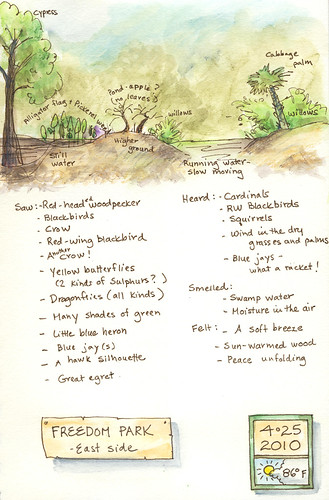

Next, I went to the swampy end of the park and created a cross-section of two kinds of water: still water and moving water. I also wrote down what I saw, heard, smelled and felt as a way to capture the experience. Now I remember that time vividly!

Be open to new ways of recording your observations. Think about adding new media to your nature journal such as photography, collage, poems, music lyrics, rubbings, prints, or computer-generated works. We are open to new interpretations when we create in new and different ways!

Click on either drawing to view larger on my Flickr photostream.

Thanks for visiting!

Friday, April 23, 2010

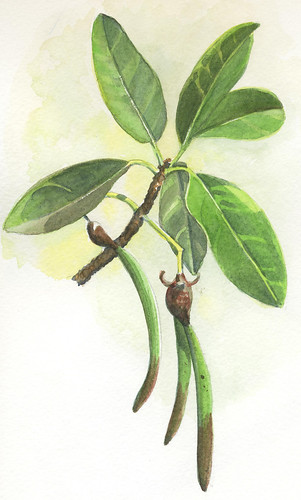
Red mangrove seedlings


Red mangrove seedlings, originally uploaded by Elizabeth Smith.

Red Mangroves are amazing trees. They blanket parts of the Southwest Florida coastline, protecting us inland from the brunt of tropical storms and hurricanes, and providing a nutrient-rich protective home for juvenile seafood. In his book “Growing Native,” Dick Workman states that “…red mangrove debris serves as the energy base for an extensive food web upon which almost all fish, shrimp, crabs, shellfish and other marine creatures depend.”

The propagules, or mini-trees, are equally astonishing. They start life as a brown berry, and while still attached to the tree, germinate and start to grow into an olive-green cigar-shaped structure. Eventually, this structure drops off and floats on top of the water (both salt- and fresh-water tolerant). As the root end becomes saturated and heavy with water, it drops, causing the propagule to float vertically. And so it bobs upon the water, waiting to find just the right oyster or sand bar to snuggle into, and then to put out roots and grow into a tree.

I found these on Christmas Day, 2009; they’ve been in fresh water and are just now putting out leaves. Exciting!

You can click on the top image to view it larger on my Flickr photostream.

Saturday, April 17, 2010

Bald Cypress trunk


Bald Cypress trunk, originally uploaded by Elizabeth Smith.
Time has been short, so I've had to resort to my photo references again. This is drawn from a photo taken at Corkscrew Swamp Sanctuary.

The distichous definition is from "Manual of the Trees of North America" by Charles Sprague Sargent, published by Dover Books (orginally published in 1905). I find his descriptions often have information I can't find anywhere else!

Our granddaughter Angela calls this the "bell-bottom" tree because of the way the trunk flares at the base!

You can click on the image to view it larger on my Flickr photostream, thank you for visiting.

Monday, April 12, 2010

Iris


Iris, originally uploaded by Elizabeth Smith.

Sunday – rainy and stormy – a perfect day to get out my reference photos of this native iris. I took these on Easter Sunday as we meandered through the Corkscrew Sanctuary Boardwalk. These are also blooming at Freedom Park in Naples, dotting the wet ground in subtle bursts of color.

I’m trying out my new Kimberly watercolor pencils in the Aquabee sketchbook. So far, so good!

You can click on the image above to view it larger on my Flickr photostream.

Saturday, April 10, 2010

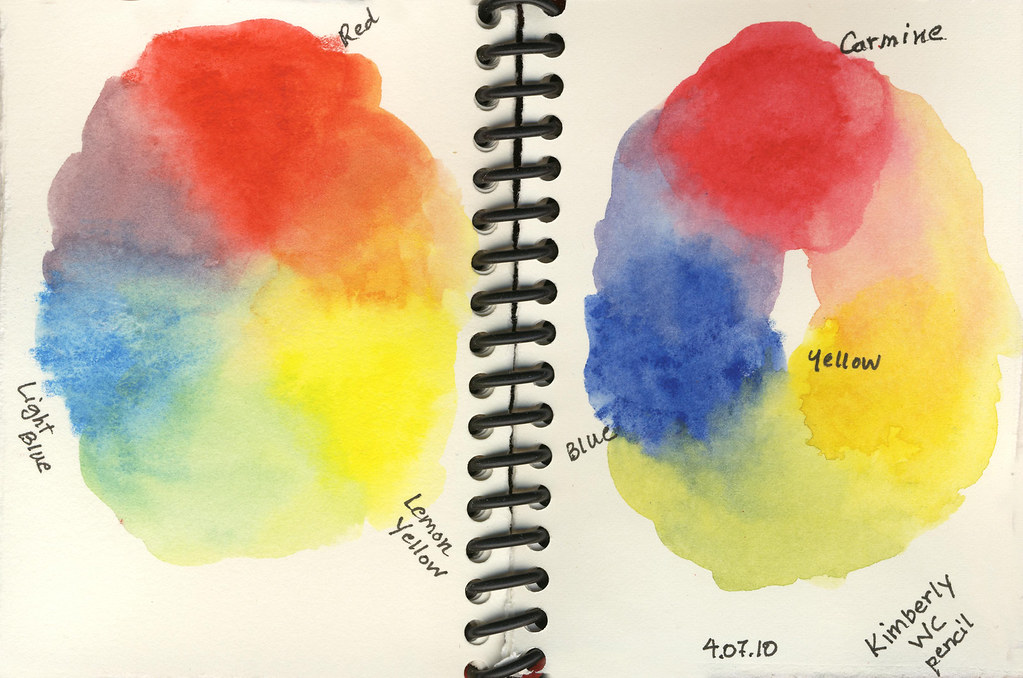
New Kimberly watercolor pencils!


Although I’ve been using Derwent Inktense and Derwent regular watercolor pencils quite a bit in my nature sketchbooks, I recently bought a loose set of 24 Kimberly watercolor pencils. I was inspired by a blog post on this brand by Pam Johnson Brickell (South Carolina Low Country Nature Journaling & Art); specifically her comments about the ease of use and the reasonable cost.

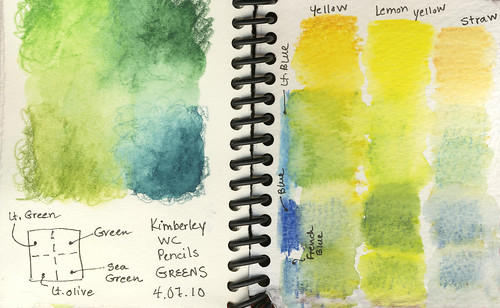
I’ve only had time to do my color swatches and a few color mixes, and so far I find them to be as soft and durable as reviewed. I highly recommend making color swatches of any new media – needless to say, I had a few surprises! Some colors were striking in the way they retained their intensity (such as yellow and lemon yellow), and some were destined to be pastels (such as Madder lake and Light Blue). I confess that I’m a bit excited about the range of blue and violet colors, since our wild blue iris is blooming right now in wetland areas. : )


Since I purchased this set loose, I’m not sure if it's a standard set of colors for Kimberly. I’m fairly pleased with the selection of greens, but feel there could be more earth tones. The family-owned General Pencil Company in New Jersey makes the Kimberly brand. According to their website, the watercolor pencils are certified as non-toxic, made from artist’s pigments and encased in cedar. I’ve emailed the company to ask about the archival properties, but don’t have anything to report back yet.


I created the color swatches on Arches hot-press watercolor paper, and then tried some mixes and blending on both hot- and cold-pressed surfaces. I’m very happy with these so far!  If you've tried these, I'd love to hear your comments or suggestions.

You can click on the top image to view them larger on my Flickr photostream. After arriving at Flickr, click on the magnifying glass above the image marker “all sizes.”  The other images link directly to the "all sizes" page.

Tuesday, April 6, 2010

Necklace pod


Necklace pod, originally uploaded by Elizabeth Smith.

A bit late in posting this; life has a way of making other plans for us, sometimes! This is one of our native shrubs that's in bloom now, and one I've drawn and painted several times before, which you can see here and here. I definitely did a pencil drawing first with this one!

You can clilck on the image above to view it larger on my Flickr photostream.